



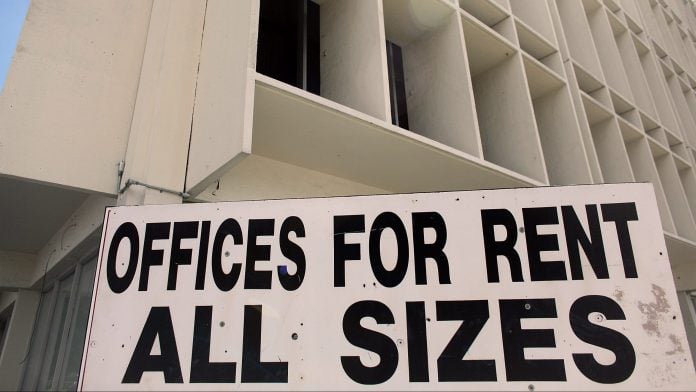
In March 1836, businessman and former New York City Mayor Philip Hone noted in his diary that he had sold his house on Broadway across from City Hall Park for $60,000 ($2.2 million in current dollars) with the buyer planning to convert it into shops and a hotel. “Almost everybody down-town is in the same predicament, for all the dwelling houses are to be converted into stores,” Hone wrote. “We are tempted with prices so exorbitantly high that none can resist.”
The term “downtown” wasn’t entirely new at this point. A witness in the murder trial that followed the Boston Massacre in 1770 spoke of seeing “people running down town,” perhaps a reference to Boston’s commercial heart being somewhat lower-lying than nearby neighborhoods, as was usually the case in port cities. Nonetheless, the emergence in the US of central business districts packed with shops, light manufacturing, hotels, restaurants, bars, churches, concert halls and offices — but ever-fewer full-time residents — and the practice of calling them downtowns seems to have stazrted with the experiences of Hone and his New York neighbors, for whom downtown meant the southern tip of Manhattan and uptown the new residential areas to the north (Hone landed 22 blocks farther up Broadway).
Later, as desk work began to proliferate and new technologies allowed buildings to go higher, office towers became downtowns’ most prominent structures. In 1897 a prominent civic reformer predicted that a century hence Manhattan would house only office skyscrapers, public buildings and parks, and “the whole island will be largely abandoned as a place for residence.” In 1910, five-and-dime titan Frank W. Woolworth paid $2 million ($72 million today) for Hone’s old property and four adjacent lots on Broadway and Park Place to construct what until 1929 was the tallest building in the world.
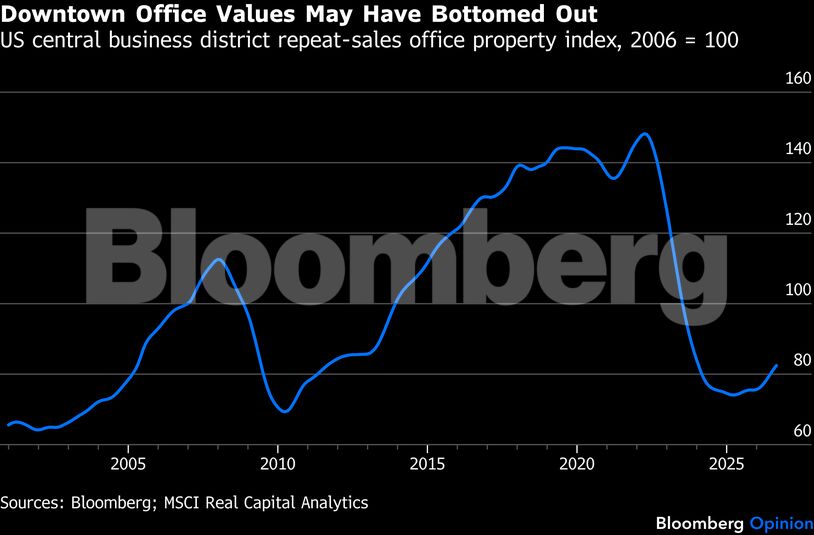
Downtowns have been through a lot since then, and may be at a turning point now. As a team of Bloomberg News reporters described in great detail last week, the commercial real estate slump caused by the Covid-19 pandemic and accompanying shift to remote work has reached a moment of reckoning, with downtown property owners in many cities finally having to acknowledge that their buildings are worth a fraction of their former values.
It takes such a reckoning before there can be a recovery, and the MSCI Real Capital Analytics price index for offices in central business districts has actually risen a little this year. But the downward revaluation — the reverse of the phenomenon that Philip Hone described in 1836 — represents a huge challenge for big cities as they risk a so-called “doom loop” of falling tax revenue and reduced government services. It could also be an opportunity to return to other uses of downtown property that offices once priced out.
In his 2001 book Downtown: Its Rise and Fall, 1880-1950, Massachusetts Institute of Technology historian Robert M. Fogelson found seeds of downtown’s decline as early as the late 1800s, when major new cultural institutions such as the Metropolitan Opera and Metropolitan Museum of Art opted for midtown and uptown locations in New York, and downtown activity began to slow in the evenings. After World War II the decline accelerated as the rise of the automobile enabled a vast expansion of suburbia, with retail and eventually offices following.
Downtowns haven’t regained their centrality since, but there was a partial turnaround starting in the 1990s. One key element was repopulating areas that had become almost resident-free, with “24-hour cities” that mixed work, living and play described in the 2010s as the wave of the commercial real estate future. New York’s original downtown, now known as the Financial District, was a leader in this transformation, its population going from 833 in 1970 to more than 60,000 in 2020. On Philip Hone’s old property, a residential developer paid $68 million ($99 million in current dollars) for the top 30 floors of the Woolworth Building in 2012, and subsequently converted them into condominiums.
Then came Covid-19. Some worried early on that it spelled the end of densely populated cities, which it apparently did not. But by spurring a sudden shift to remote work the pandemic did bring into question the need for large buildings full of offices, and with it the financial health of cities dependent on commercial property tax revenue and public transportation systems dependent on commuters.
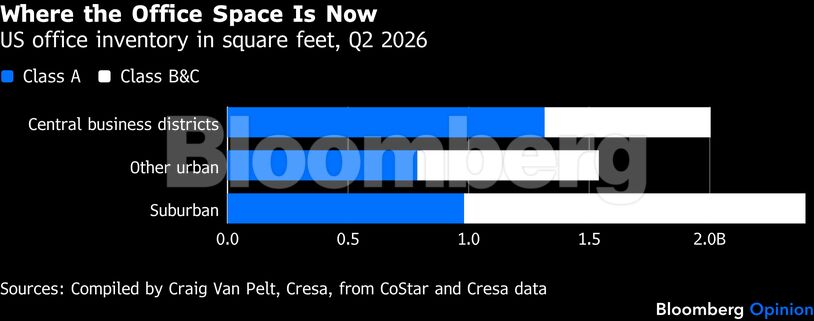
Downtown offices will clearly continue to exist, and in some cases make their owners lots of money. Yes, there is now more office square footage in suburbs than in central business districts, according to an accounting that Craig Van Pelt, head of research at commercial real estate advisory firm Cresa, prepared for me. But downtowns have a big edge in the Class A — highest quality — office space that remains most in demand. Of the 100 biggest office leases signed in the US last year, 54 (representing 59% of the square footage) were in downtowns, brokerage CBRE reported.
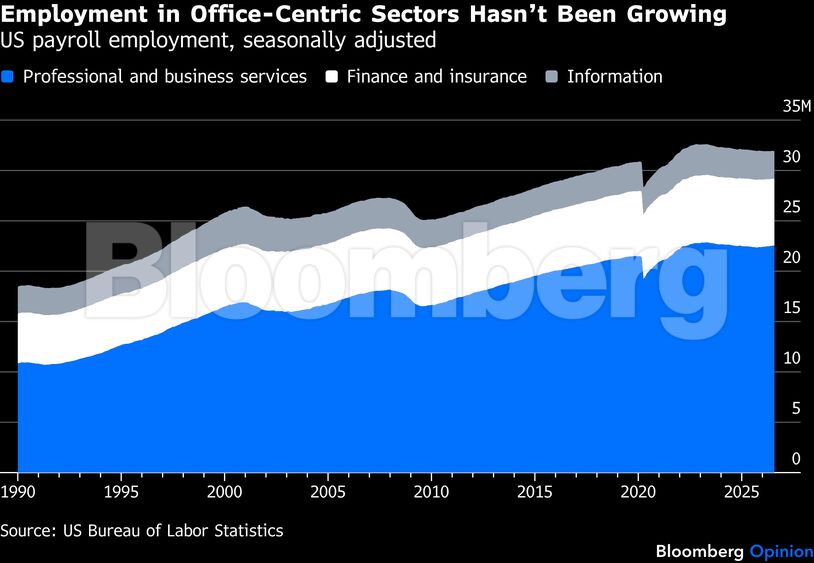
Still, offices alone aren’t going to be enough to spur a true downtown revival. Along with the shift to remote work, the economic sectors that employ the most office workers just haven’t been adding jobs lately — and while there’s a huge amount of uncertainty about what artificial intelligence will do to white-collar employment it’s not unreasonable to think it could reduce it.
Downtowns thus need to continue the move toward residential and other non-office uses that started before the pandemic. This transformation is well underway in Manhattan, where another iconic office tower, the Flatiron Building, is about to reopen as condominiums and there’s speculation that the Chrysler Building — which wrested the world’s-tallest honor from the Woolworth Building in 1929 — might be next.
The dwellings that result from these conversions tend to be quite pricey, though. They alone can’t solve New York City’s chronic housing shortage. In many other big US cities it’s still a stretch to think of downtowns as appealing places to live or hang out rather than just work. The departure of office workers during the pandemic made many of them even less appealing, as did the short-lived urban crime wave that accompanied it.
Still, dense urban neighborhoods with a mix of residences and commerce predate the 19th century rise of the American downtown, and exert an enduring attraction. American tourists flock to such places overseas. The downtowns of many smaller US cities have seen remarkable revivals in recent decades. Outlying commercial districts of big cities and walkable suburban downtowns have boomed since the pandemic. There is a path forward for big-city downtowns, and while I don’t know where it leads I’m pretty sure it is not lined with office buildings.
Disclaimer: This report is auto generated from the Bloomberg news service. ThePrint holds no responsibility for its content.