





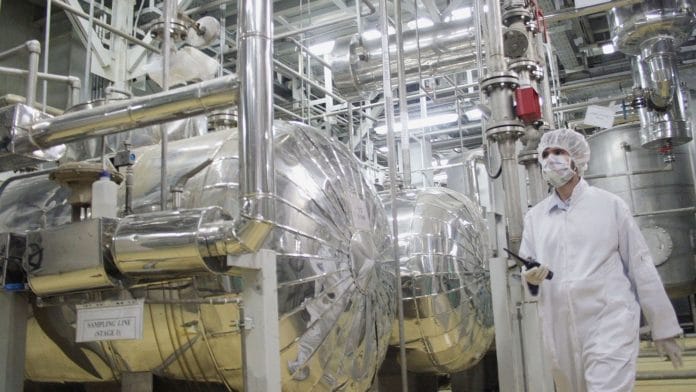



Iran has faced suspicion for decades over its nuclear ambitions and whether it’s developing the capability to fire an atomic weapon. It agreed to cap its nuclear activities in exchange for sanctions relief in a landmark 2015 international deal. But that accord was undercut three years later when President Donald Trump unilaterally withdrew the US from the pact during his first term in office.
While the second Trump administration engaged in talks to try to reach a new agreement last year, those negotiations collapsed after Israel and the US bombed Iran’s nuclear facilities in June. Even though Trump said at the time that Iran’s nuclear program had been “obliterated,” he’s since ramped up pressure on the Islamic Republic to agree to a new deal, warning that the US could launch a “far worse” attack. Trump initially threatened military intervention in response to a deadly crackdown on anti-government protests, before shifting his focus to Iran’s atomic capabilities.
The two sides restarted talks in February. It’s unclear how they’ll break a longstanding impasse on the US demand for Iran to halt all enrichment of uranium, including for nuclear power. Other barriers to a deal could be Iran’s ballistic-missile program and support for regional militias, which the US has at points insisted must be on the negotiating table. Tensions remain high amid a buildup of US air and naval assets in the Middle East, while Iran has held military drills in the region of the Strait of Hormuz, a key choke point for energy exports.
Why is there concern about Iran’s nuclear program?
Iran has always maintained that its nuclear program is peaceful and for energy purposes. President Masoud Pezeshkian told the UN General Assembly in September that “Iran has never sought, and will never seek, to build a nuclear bomb.”
However, just a day before Israel commenced its strikes in June, the International Atomic Energy Agency — the United Nations nuclear watchdog — censured Iran, saying it had breached its responsibilities to cooperate with inspectors and that the agency was unable to determine whether the country’s nuclear program is “exclusively peaceful.”
The IAEA accounts for gram-level changes in uranium inventories worldwide to ensure the material isn’t being diverted for weapons. Since the June attacks, Iran has blocked the IAEA from verifying the size and location of its stockpile of near-bomb-grade uranium, prompting the return of sweeping UN sanctions.
The last time IAEA inspectors were able to access Iran’s uranium reserves, they determined it had amassed 441 kilograms (972 pounds) of uranium enriched to 60% — a more than 50% increase from February. If processed further, that’s enough material to power around a dozen nuclear bombs.
Iran’s Stockpile of Highly Enriched Uranium Had Surged | IAEA hasn’t been able to verify Iran’s reserves of 60%-enriched uranium since the June airstrikes
While the current status of Iran’s uranium stockpile is unclear, it retains the technical know-how for enrichment, which could allow the country to rebuild its nuclear program with relative ease.
What is highly enriched uranium?
Natural uranium consists mainly of two isotopes: U-238 and U-235. The latter is key to the fission reaction necessary for both nuclear power and weapons, but it occurs in low concentrations in raw uranium ore. The material therefore needs to be enriched to increase the concentration of U-235, which is done using thousands of centrifuges spinning at supersonic speeds to separate the isotopes.
A threshold of 3.7% is required to fuel most nuclear-power plants. Anything above 20% is defined as “highly enriched uranium” because at that stage, it requires special handling and getting to weapons-grade level is a relatively quick process. The typical concentration of uranium for nuclear weapons is 90%. Uranium enriched to 60% can still be used in a crude bomb, albeit one with less power and reliability.
Iran has previously said it’s prepared to limit its enrichment of uranium to levels required for non-military purposes, but that it won’t stop entirely. It remains to be seen whether this would be acceptable to the US as part of a nuclear deal. Trump said as recently as mid-February that “we don’t want any enrichment.”
Is having weapons-grade uranium enough for a nuclear bomb?
An upgrade to 90%-enriched uranium isn’t technically challenging; just a couple hundred centrifuges could achieve this in a matter of weeks or months. But for the next step in the process, casting the uranium into a metal that can be used in a bomb, Iran would need to replace the capacity destroyed at its Isfahan facility in the June strikes.
In addition to the fissile material, Iran would require a bomb mechanism and the means of delivering it. It’s likely that Iran already has the technical know-how to produce a simple gun-assembly implosion device, such as the one the US dropped over Hiroshima, Japan, in 1945.
To strike a remote target, Iran would need a warhead that’s small enough to ride atop one of its ballistic missiles and could survive re-entry into the Earth’s atmosphere. It hasn’t conducted tests that would suggest it knows how to make a nuclear warhead.
Iran carried out studies on how to assemble such a device until 2003 but according to US intelligence reports, it probably hasn’t resumed that work. Estimates for how long Iran might need to complete the necessary activity range from four months to two years. Its most powerful ballistic missile has an estimated range of as much as 5,000 kilometers (3,100 miles).
What do we know about Iran’s remaining capabilities to enrich uranium?
Whether enrichment can still be carried out at Iran’s two known facilities, Fordow and Natanz, after they were attacked is an unanswered question. Satellite imagery showed major damage at the surface level from US bunker-busting bombs, but it’s unclear how much this impacted the deeply buried operations.
The main enrichment site in Natanz, located in the center of the country, included structures that were more than 40 meters (131 feet) below the surface, protected by a steel and concrete shell that researchers estimated to be eight meters thick. Fordow was even more heavily fortified, built into the side of a mountain and believed to be buried about 60 to 90 meters underground.
While Trump said that Iran’s nuclear program was destroyed by the US strikes last year, there’s consensus among experts that the country retained key capabilities. Preliminary analysis by the Pentagon estimated Iran’s program was set back by one to two years. A firm picture is unlikely to emerge until IAEA inspectors can physically verify the damage to the sites.
A Number of Iran’s Interconnected Nuclear Facilities Were Struck Last Year | These are the main steps involved in the nuclear fuel cycle…
It’s possible that Iran could further refine its remaining highly enriched uranium at a facility that’s unknown to the outside world. In mid-June, the Atomic Energy Organization of Iran said a third enrichment plant had been built at an unspecified, secure location. There’s precedent for Iran operating secret nuclear facilities. Both Natanz and Fordow were built clandestinely and IAEA inspectors were only allowed in after the sites were nearly completed.
Why were international sanctions reimposed on Iran?
UN sanctions were reinstated in September, just weeks before they were set to expire under the terms of the international nuclear deal known as the Joint Comprehensive Plan of Action. The three European signatories to that pact — France, Germany and the UK, who are collectively known as the E3 — activated the agreement’s “snapback” mechanism for sanctions, alleging that Iran “repeatedly breached” its commitments under the 2015 accord.
The E3 triggered the snapback over Iran’s refusal to allow IAEA inspectors to resume monitoring its nuclear activities, detail the state and whereabouts of its stockpile of highly enriched uranium, and reopen negotiations over its atomic program with the US. The European countries said the return of sanctions doesn’t hail the end of diplomacy and that they would seek “a new diplomatic solution to ensure Iran never gets a nuclear weapon.”
The revived sanctions, which were originally introduced between 2006 and 2010, include an arms embargo; a ban on uranium enrichment and processing; an asset freeze for certain Iranian individuals and entities; a block on access to technology for ballistic missiles; and restrictions on Iran’s oil and financial services sectors.
They add to the sanctions imposed by the Americans after Trump pulled the US out of the JCPOA in 2018 and pursued a policy of “maximum pressure” on Iran — a strategy he’s revived since returning to office.
This report is auto-generated from Bloomberg news service. ThePrint holds no responsibility for its content.