





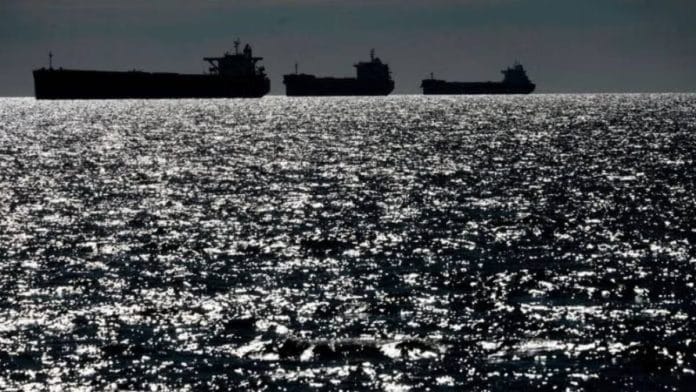


New Delhi: Three tankers, three strikes in three days, with three dead and 65 Indian seafarers requiring rescue off the coast of Oman. The three attacks have raised concerns in New Delhi over the safety of Indian seafarers on the “shadow fleet”, or ships that operate in grey areas.
The attacks have all followed a similar pattern—warnings from the US Navy followed by launch of precision strikes at the engine room to disable ships that show an inclination to take a run at the US blockade of Iranian ports.
The US strikes against oil tankers off the coast of Oman have hit the Indian seafarer community hard, with three of their own killed in the 10 June attack on MT Settebello. The Indian government has strongly “condemned” the strikes against commercial vessels, while also summoning the US Charge D’Affaires Jason Meeks Wednesday to lodge a strong protest over the action against the Palau-flagged ship.
“At least one of the ships attempted to break the US naval blockade by going dark—turning off its transponders—noting the effort by the captain to sail willingly into an Iranian port despite military warnings,” a person familiar with the matter told ThePrint.
None of the three ships was India-flagged. Two were Palau-flagged, while one flew under the flag of Guinea-Bissau. India-flagged ships have not come under US military strikes. Around 13 remain stranded at the Strait of Hormuz since the US and Israel launched strikes on Iran on 28 February this year.
Two of the attacked ships are considered to be part of the “shadow fleet” of Iran—ferrying US-sanctioned Iranian oil—and the US action has raised concerns within the Indian government. In the last decade, Indian seafarers have grown from around 100,000 to 350,000, according to Indian government statistics, which accounts for around 12% of the global workforce.
“A number of Indian seafarers have since been recruited to crew the shadow fleet vessels either knowingly—accepting higher pay despite the risks—or unknowingly through unscrupulous agents as the demand for crew members remains,” the person said.
The US imposed a naval blockade on Iran on 13 April, as Washington and Tehran continue to negotiate an end to the war.
Also Read: Oman Navy rescues 24 Indian crew members of sanctioned oil tanker hit by US missile
What is a shadow fleet?
Ships engaged in illegal operations for the purposes of circumventing sanctions, evading compliance with safety or environmental regulations, avoiding insurance costs or engaging in other illegal activities—this is the definition of a “shadow fleet” or “dark fleet” as accepted by the International Maritime Organisation since December 2023.
Shadow fleets are a growing phenomenon globally, as the US and some European nations have moved to sanction oil tankers transporting Russian, Iranian and Venezuelan crude in the last half decade.
The Russian invasion of Ukraine in February 2022 was the turning point that led to the growth of these ships that continue to operate in grey areas. Unilateral sanctions by the US and the European Union (EU) make it difficult for these ships to operate within their waters, however, they continue to function as part of the necessity to ferry crude from some of the largest sellers of oil.
The shadow fleets carry out “unsafe operations” that normally do not adhere to “international regulations and industry standards”. They may also intentionally avoid Flag State and Port State Control inspections, not maintain adequate liability insurance, avoid inspections, operate under opaque corporate governance policies and take other measures intentionally such as turning off their Automatic Identification Systems (AIS) or transponders, and concealing their actual identity.
Shadow fleets in Hormuz
MV Marivex, first of the three ships hit by the US, is believed to have turned off its AIS system as it allegedly attempted to break the US naval blockade and enter Iranian waters.
The US Central Command (CENTCOM) said in a statement that despite numerous warnings, the unladen oil tanker refused to comply with its orders, leading to the disabling strike.
All 24 seafarers on-board were safely rescued by the Omani Navy. The ship was sanctioned by the US. However, the alleged attempt to break the naval blockade has raised alarm in New Delhi, with the Directorate of Shipping Thursday urging all Indian seafarers to “exercise the highest degree of caution” and to “adhere strictly to prevailing maritime security protocols” when transiting through conflict-affected waters.
“The fact remains that the sailors on these ships are Indian and the Government of India has raised the issue with the Americans. But the ships plying a grey zone seemingly took risks knowing the possible outcome,” a second source told ThePrint.
The managers of the Settebello, Dubai-based IOS Marine FZE, categorically denied any links to Iranian oil in a statement published Thursday. The firm called on the US Navy to provide proof of non-compliance by the crew that led to the attack.
The issue remains over the functioning of the shadow fleets. The International Federation of Shipmasters’ Associations (IFSMA), a London-based organisation representing the interests of shipmasters, highlights that at least 10% of the world’s tanker fleet operates as part of global shadow fleets.
India, China and Türkiye are the leading final destinations for these shadow fleets, according to the IFSMA. India ramped up its purchase of Russian crude since the war with Ukraine began in February 2022, due to requests from the then US government to aid in the stabilisation of global oil markets. The sanctioned nature of Russian oil has resulted in an increase in shadow fleets carrying oil to Indian shores.
Nevertheless, the Indian government has taken a dim view of the attacks on commercial ships. Apart from the strong condemnation, India Thursday called on the US to halt such action.
(Edited by Nida Fatima Siddiqui)
Also Read: India condemns attack on Indian-crewed tanker off Oman coast. 3 missing, 21 rescued