


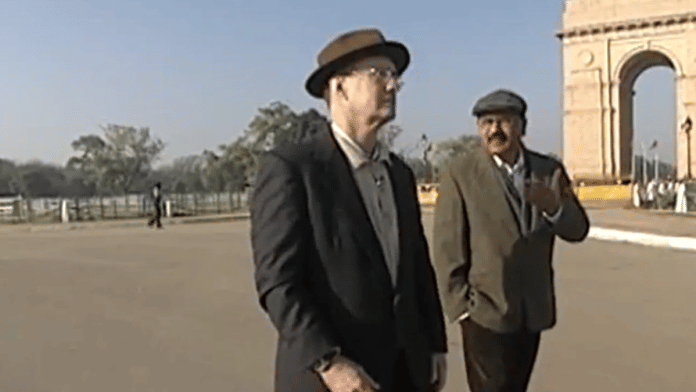
Strobe Talbott, former US Deputy Secretary of State and president of the Brookings Institution, was among the key figures involved in reshaping India-US relations at a particularly fraught moment in their shared history.
A reporter with Time magazine before entering government, Talbott accompanied then US Secretary of State Henry Kissinger on his 1974 visit to India, when relations between the two countries were strained by Cold War tensions and India’s nuclear ambitions.
In a 2004 episode of Walk the Talk, ThePrint Editor-in-Chief Shekhar Gupta spoke to Talbott about the thread of India-US relations, the 1998 nuclear tests, his talks with Jaswant Singh and the Clinton administration’s approach to India and Pakistan, Musharraf’s role in the peace process, and the threat posed by the proliferation of nuclear weapons.
Here is a complete transcript of the interview, edited for clarity:
Shekhar Gupta: Hello and welcome to Walk the Talk. I’m Shekhar Gupta, and my guest today, well, I can give you a long introduction: President of the Brookings Institution, former Deputy Secretary of State, one of the most respected writers, columnists and analysts on world affairs. Strobe Talbott, welcome to Walk the Talk.
Strobe Talbott: Thank you very much. And what a nice setting for us to be chatting here.
Shekhar Gupta: Knowing you as somebody who’s not just written about foreign affairs and given a new direction to so many ideas in the last quarter century, but as somebody who was a co-architect of a completely new Indo-US relationship.
Strobe Talbott: It’s wonderful to be back here.
Shekhar Gupta: And you’ve been an old traveller to India.
Strobe Talbott: It has been 30 years since I first came to India. It was in 1974. I was in your line of work as a reporter. I was accompanying Henry Kissinger when he came here to see Indira Gandhi in 1974.
Shekhar Gupta: A lot has changed since. Indira Gandhi and Henry Kissinger, those were very frosty days. I mean, as frosty as the weather today. Does it remind you of Washington?
Strobe Talbott: Yeah, but I remember the visit that he made quite well. There was actually quite a bit of mutual respect between them. I think the relations between Indira Gandhi and Henry Kissinger were better than the relations between India and the United States.
Shekhar Gupta: Or between Indira Gandhi and Nixon, for that matter.
Strobe Talbott: That’s for sure. Yes, absolutely.
Shekhar Gupta: But describe to me how exactly it was then, because in 30 years everything has changed completely. The year 1974 was Pokhran, the eve of the Emergency. It was a very different Mrs Gandhi in a very different India.
Strobe Talbott: Well, I think the big difference, of course, is that 1974 was still very much in the depths of the Cold War. And even though it was not literally the case, and shouldn’t have been the case, India and the United States ended up on opposite sides in the Cold War. That was the overall geopolitical context of what was not a good relationship for a very long time between our countries.
Shekhar Gupta: Well, Jaswant Singh said on this show some time back to me. I think the line that he quoted to me from Madeleine Albright, he said Madeleine said to me, “50 years in our relationship, the mice ate away.”
Strobe Talbott: Yeah exactly. I mean, there’s a phrase that’s come out of Washington in the last couple of years: “If you’re not with us, you’re against us.” But there was a little bit of that same attitude towards India going back to John Foster Dulles, when Prime Minister Nehru went to Bandung, was one of the co-founders of the Non-Aligned Movement.
In Washington, and particularly on the part of Secretary of State Dulles, the Non-Aligned Movement was seen as only slightly better than the other side in the Cold War. And India, in particular, was seen to be, to use a famous word, tilting more towards the Soviet Union than towards the United States.
Shekhar Gupta: Those were interesting years because I’ve read some of the stuff that Dulles has written, you know, stuff that’s been declassified by the State Department. I can see that he was truly fascinated by Nehru’s personality. In one place, for example, he writes a long note to Eisenhower on how Nehru had a tendency of getting excited in the middle of a conversation and climbing on the back of the sofa and sitting there. And he writes the whole three paragraphs in wonderment, saying, “How do you deal with this man?” Then there’s stuff from Eisenhower that says it’s quite well known that what works with Nehru is personal appeal, and not as much policy and ideology and stuff like that.
Strobe Talbott: Yes, but you know, Shekhar, President Eisenhower himself actually had a rather warm feeling towards India and Nehru. You may recall, indeed, that Eisenhower invited Nehru to his farm in Gettysburg. And while he didn’t make a great deal out of it publicly, Eisenhower wanted to have a somewhat better relationship.
Shekhar Gupta: That comes across because I think there are also descriptions of their discussions about China, on which Nehru had a very different take. But that’s a fact. Somehow India and the US have had a very different worldview over the past decades, except now, in the past five years or 10 years.
Strobe Talbott: Yeah. No, I think one of the reasons that President Clinton, whom I worked for for eight years, was so eager to have a better relationship with India was that he sensed the end of the Cold War created an opportunity that none of his predecessors had. He would have liked to have initiated a quantum improvement in the US-India relationship during his first term. For a variety of reasons, he just didn’t get around to it.
Shekhar Gupta: But if you were advising the President on his South Asia policy during the Cold War, would you have advised him to handle it differently?
Strobe Talbott: Well, in a way I did, since I was writing. I wasn’t in the capacity of a presidential adviser. I was a journalist, and as you know very well, we journalists give advice to anybody.
Shekhar Gupta: We’ve all heard about your book. I think it’s called Engaging India: Democracy, Diplomacy, and the Bomb. It’s a very pregnant title. Give me a teaser and tell me how this fits into this sort of Indian ideological upbringing.
Strobe Talbott: Well, of course, as you and your viewers know very well, the issue of the extent to which India’s defence was going to have a nuclear weapons component has been debated and deliberated in this country for a very long time. It was in the background, I would even say in the foreground, of Pokhran-I, which is to say the so-called Buddha smile test of 1974, the peaceful test. And indeed, that was one of the principal topics of conversation between Indira Gandhi and Henry Kissinger on that trip in 1974 that brought me to India for the first time. On the subject of nuclear weapons, and whether they are necessary and indeed imperative for a major country to both protect its own security interests and play a global leadership role, the United States and India have had a disagreement really for over 30 years. And that disagreement was muted and managed when India had what it claimed was only a peaceful nuclear capacity. But when India, in May of 1998, decided that it was going to have an unambiguous…
Shekhar Gupta: …had to give up the hypocrisy.
Strobe Talbott: Well, as I would put it, have an unambiguous. It’s undeclared. It was going to go from having an undeclared nuclear capability to having a declared nuclear capability. Then that disagreement became front and centre, and it really brought the relationship to perhaps the lowest point it had ever been, which is saying a great deal.
Shekhar Gupta: You mean worse than it was during the Bangladesh war?
Strobe Talbott: Oh, I think so.
Shekhar Gupta: The Seventh Fleet, Enterprise?
Strobe Talbott: Well, we didn’t have naval vessels off your shore. But in terms of the intensity, the importance, the stakes of the disagreement between us, I think it was a new low in a relationship that had never had very many highs. Now, it was against that backdrop that President Clinton decided we had to intensify our engagement.
Shekhar Gupta: And there was real anger in Washington.
Strobe Talbott: Fury, including on the part of the President of the United States, for all kinds of reasons. First of all, President Clinton felt frustrated and disappointed. He had wanted to use the second term of his presidency in order to have a much closer relationship with India. He felt that that was now going to be difficult, if not impossible.
Second, he attached a very, very high priority to non-proliferation, persuading countries throughout the world that having nuclear weapons was unwise and unnecessary in terms of advancing their own interests. And he was very concerned about what the consequences would be in the India-Pakistan relationship. Of course, one of the first things that all of us in Washington worried about when India tested was: Was Pakistan going to test? And the answer was yes, of course Pakistan would test, although we made an effort to persuade them not to.
Shekhar Gupta: So describe to me the first moments when the news came in.
Strobe Talbott: Well, it was a bad day, a bad way to begin a week. It was on a Monday morning in May of 1998. It’s the opening scene in my book. I came to the office expecting a more or less normal week, at least by State Department standards. And then, and this made the irony, of course, all the more painful, we learned what had happened quite a few hours before from CNN. In other words, we didn’t even get the news from our vaunted intelligence services.
Shekhar Gupta: It means CNN is getting better than the CIA.
Strobe Talbott: Yes. And when I heard the news from CNN, the first thing I did was to pick up the phone and call my counterpart at the CIA to get some more information. He didn’t know what had happened. So he was not only getting the information from CNN, he was getting it from the State Department, which had gotten it from CNN, which was about the worst of all possible worlds from his standpoint. But then we moved into very high gear to try to figure out.
Shekhar Gupta: In fact, one of your colleagues at Brookings and a well-known analyst in India, Steve Cohen, then said the problem with intelligence people is they don’t read anything that’s not marked classified. So if they’d only read the BJP’s election manifesto, they would have known what was coming.
Strobe Talbott: Yeah, but Shekhar, actually, let’s look at it a little more seriously than that. Yes, of course, if we had been listening very carefully to the hints that we had gotten, our level of expectation, if not suspicion, would have been much higher. Indeed, as you know, there were villagers around Pokhran who knew what was coming because of all of the preparations. There was even a story that had gotten into a Sikh community newspaper in Canada predicting the test. But here’s one of the reasons why we didn’t know. Our attention was focused elsewhere. This was a period when we had more or less a crisis going on Iraq. Huge problems in the Balkans. And it was simply a question of information overload and attention deficit.
Shekhar Gupta: But would you say that we Indians have been pretty good at keeping these secrets?
Strobe Talbott: Yeah, and for good reason from your standpoint. Because a couple of times previously, which I also recount in the book, India had been very close to testing, or at least keeping open the option of testing at Pokhran, and the United States had found out and used diplomatic channels, particularly Ambassador Wisner, when he was here, to persuade your government not to do it.
Shekhar Gupta: That was a well-known case during Narasimha Rao’s prime ministership.
Strobe Talbott: Yes. And, by the way, it was during precisely that episode, Shekhar, that I first became aware of the name Jaswant Singh, because he was a spokesman, of course, for the BJP. He had some rather forceful and eloquent things to say on the subject of what appeared to be American pressure to stop India from testing. And I remember being struck at the time by the eloquence and firmness of his comments.
Shekhar Gupta: We will come to Jaswant Singh. And how you changed the course of history. I think in 14 meetings, in seven countries, three continents over two years. But before that, tell me exactly what happened. There’s a lot of speculation here as to what happened during Narasimha Rao’s time, when we were about to test but did not test.
Strobe Talbott: Back during Prime Minister Rao’s premiership. Well, I think what happened is more or less what’s been in the press at the time. We, the United States government, took the information that we had, brought it to the Prime Minister through his personal secretary at the time, and said, “Here’s what we think you’re going to do. We think it would be a huge mistake.” President Clinton got into the exchange directly. There was no formal promise that the government wouldn’t test.
Shekhar Gupta: But you mean Clinton called Rao?
Strobe Talbott: Yes, yes. There was no formal promise. But there was clearly the message. The American message was received, and the test didn’t happen.
Shekhar Gupta: But did Clinton call Rao and hold out a threat?
Strobe Talbott: It wasn’t a threat. It was more a strong argument that this would just be contrary to everybody’s interests.
Shekhar Gupta: And what was your sense? Do you think Narasimha Rao actually wanted to test, or do you think it was some elaborate, clever game that he was playing? He was a clever leader.
Strobe Talbott: Yes, I actually discussed the issue of India’s possible test directly with Prime Minister Rao when he came to Washington to see President Clinton. President Clinton used his own private meeting with him in the Oval Office to make the case not to do it. And then President Clinton sent me in to see him in his hotel room afterwards to deliver the message even more clearly. I had the impression that he was genuinely torn. On the one hand, he was under considerable pressure from various forces within his own government. On the other hand, he understood the logic of the long-standing Congress party position of what might be called nuclear ambiguity.
Shekhar Gupta: That’s been one charge that the BJP has always laid at the door of the Congress party, that the Congress party buckled under American pressure and we did not. And if it was left to the Congress party, they would have compromised India’s nuclear interests.
Strobe Talbott: Well, my own view is that that’s a way of describing the situation with a point of view, that is, that it was absolutely right to test. You won’t be astonished, Shekhar, that I don’t happen to share that point of view. But this is a disagreement that’s now passed into history. Once India made a decision that it was going to test, and once it tested, we, the United States and the world, were confronted with a new reality. Then the question became not concentrating all of our rhetorical and political efforts on recrimination, but trying to figure out what to do next. Where now? How do you make the best of a situation which is far from ideal?
Shekhar Gupta: And that brought Jaswant Singh into the picture.
Strobe Talbott: Yes.
Shekhar Gupta: So tell me a little bit about how it started and how it went on. Fourteen meetings, as I said, seven countries, three continents, two years.
Strobe Talbott: Well, it started, I think, because of an important and positive decision at the level of the two leaderships, that is to say, Prime Minister Vajpayee and President Clinton. Both of these men, who did not have a close personal relationship at that point, and each had some reason for annoyance with the other. President Clinton was, as I say, not just annoyed but furious over India’s decision to do this because of what he saw as all the dangerous and negative consequences. Prime Minister Vajpayee had a reason to be annoyed at the United States because the United States immediately triggered every sanction.
Shekhar Gupta: Let me ask you the front-benchers’ question now. In this engagement, who got more for his country? You for the US or Jaswant for India?
Strobe Talbott: Well, I’ll answer that in two parts. The great American Secretary of State Dean Acheson once famously said that he never read a memorandum of conversation in which the author comes off second best. My book is an exception to that because, insofar as it’s an extended memorandum of conversation between myself and Jaswant Singh on the nuclear issue, on the non-proliferation issue, Jaswant comes off better than I do, in that he accomplished more of what I think was the Indian strategy in that dialogue than the United States did. Which is to say, he and the Indian side held firm against any significant concessions to or acquiescence in the strong requests of the United States.
But the more important point is that there was an overarching goal in the dialogue, and that was to get away from a zero-sum, win-lose dynamic between the two countries and see if we couldn’t find genuine common ground on which to do some good things. And in that sense, I think both of us made real accomplishments.
Shekhar Gupta: Well, that’s the point. Because, apart from the engagement on the nuclear issue, the fact is that Jaswant Singh brought in a completely new paradigm in the Indian worldview, which was not pro-West but which was Westernised in a way. And you know where he was coming from. There were 40, 45 years of socialism and aggressive non-alignment. So I think while he may have accomplished a bit more on the nuclear issue, the US and the West also gained a lot more because India changed its worldview entirely.
Strobe Talbott: Well, let me make one other point. I’ve conceded a considerable amount here, namely that my good friend and counterpart Jaswant Singh accomplished on behalf of his government more in the non-proliferation area than we on the American side wanted to accomplish. But the last chapter of the book is called “Unfinished Business”. This story is not over yet. There is still a big question out there: What will India do with regard to, in some sense, institutionalising its moratorium on the testing of nuclear weapons? What will it do in order to achieve a treaty that cuts off the production of fissile material? What will it do to constrain, and thus stabilise, the competition with its neighbours over ballistic missiles and nuclear weapons? And the fact that we did not achieve as much as we wanted during the Clinton administration doesn’t mean that that issue is off the table. I think your government is going to have to come back to that. And it’s a political issue now.
Shekhar Gupta: Now, if this change had not come about, you know, the nuclear issue being one part of it, this change in the way India looks at the US and the West, and the way Jaswant Singh and you together shifted this paradigm in Indian foreign policy, do you think India would have had the same relationship with the US post-9/11? Or would India have related to the US the same way after 9/11?
Strobe Talbott: I’d like to make two points. I’d like to think that the United States under President Bush was better able to engage with India, including after 9/11, than it would have had it not been for the dialogue conducted in the Clinton administration. But there’s another point, too. The Bush administration was able to engage quite effectively with Pakistan and with President Musharraf after 9/11.
That was possible, I think, in large measure because the United States under President Clinton remained engaged with Musharraf even after the military coup, even after Kargil, even after all the difficulties both between the US and Pakistan and between Pakistan and India. And we were under a lot of pressure, and certainly a lot of advice from our Indian friends, going back to Kargil and the coup in 1999, to basically wash our hands of Pakistan. I think it’s a good thing we did not do that. I think it’s a good thing that President Clinton made a brief visit to Pakistan after his long visit to India.
Shekhar Gupta: But is that where he wagged his finger?
Strobe Talbott: Well, yeah, he went there largely to wag his finger, although he’s not a finger-wagger. He talked. He gave a tough-love message, is the way I would put it.
Shekhar Gupta: Well, from Clinton wagging his finger at Musharraf to his becoming now the stalwart ally, he’s come a long way, Musharraf. How do you look at Musharraf? One of your old colleagues has described him to me twice in three years as a work in progress.
Strobe Talbott: Well, let’s hope it’s progress in the right direction, and let’s hope that the work continues. I had a chance to see President Musharraf, and be part of a group that met with him in Davos, Switzerland, just a little over a week ago.
Shekhar Gupta: Yes, we were all there.
Strobe Talbott: I am pleasantly surprised that President Musharraf, given his history as the architect of Kargil, as an unreconstructed revisionist on the subject of Kashmir, has been willing to get it right on the third try. That is, Pakistan and India had an opportunity for a breakthrough over Lahore. Pakistan basically ruined it. Agra was a disaster. Now there’s a third chance, and it seems to have some real promise. But I must tell you, Shekhar, I think I’m probably not the only one who feels that this whole situation is fragile. And it’s fragile in part because so much depends on President Musharraf himself. He’s already been the intended victim of several assassination attempts. And so the question arises: Is the peace process only one bullet away?
Shekhar Gupta: And that’s my last question. The peace process is only one bullet away, may or may not be. At the same time, is Al-Qaeda only one successful assassination attempt away from getting the bomb? All the revelations that have now come out, Abdul Qadeer Khan…
Strobe Talbott: I understand what you’re saying. There is obviously a nexus or a connection between the Pakistani nuclear weapons capability and the danger of the bomb getting into other non-state hands. As a matter of fact, there’s a danger of it getting into other state hands. And the name AQ Khan, which I’ve been hearing here in India as long as I’ve been coming here, has only recently made its way into the newspapers in the United States. So there seems to be a welcome but very belated effort on the part of some Pakistani authorities to get hold of a very dangerous situation. The question is, is it too late or not?
Shekhar Gupta: That’s why the question is: Is the Bush administration making a mistake by leaving it all to a man instead of institutions or the system? It’s a mistake. We always accuse you of America, right?
Strobe Talbott: I know it sounds like exactly the same criticism against the Bush administration that was made against our administration for continuing to deal first with the Nawaz Sharif government and then with the Musharraf regime. I do not think it’s a mistake. Whenever I hear a criticism of the kind you just suggested, I always want to ask the person who makes the criticism: What exactly is the alternative? What are you suggesting we should be doing instead? Very often, when it was the Clinton administration receiving this criticism, either about Nawaz Sharif or about Musharraf, the Indian answer was either a non-answer or the answer was, “Have nothing to do with them. Dismiss them as a failed state, treat them as the rogue nation they are, and deal only with us.”
And we always refused to do that. And the Bush administration refuses to do that, and I think both the Bush administration and the Clinton administration have been right. Just as engaging India is important, and that’s the title of my book, we have to do whatever we can to remain engaged with Pakistan. Otherwise, Pakistan will become a self-fulfilling prophecy of a very negative sort.
Shekhar Gupta: And a nuisance state.
Strobe Talbott: Yes, and we’ve already seen quite a bit of nuisance from that area. But what we have to do is work with those forces that want to make it…
Shekhar Gupta: All I can say in this equation, there will always be more questions than answers, and it’ll only make life much more fun for people like you and me. In fact, more like you, who’ve seen the picture from both sides. So I wish you all the very best.
Strobe Talbott: Thank you very much, Shekhar.
Shekhar Gupta: Your book tells us more about what happened in those mysterious years than we’ve known all this while.
Strobe Talbott: I think it will.
Also Read: 14 meetings, seven countries, two men. How Talbott and Jaswant Singh rebuilt India-US ties