



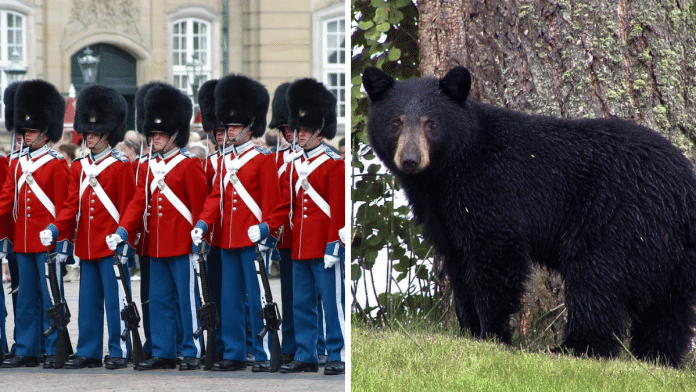
New Delhi: The tall black bearskin caps worn by soldiers outside Buckingham Palace are among the most recognisable symbols of British royal ceremonies. They are also at the centre of a renewed debate over the use of real animal fur in military uniforms.
A cross-party group of 18 MPs and a member of the House of Lords has urged the UK government to stop ordering bearskin caps made from real bear fur and move to synthetic alternatives.
In a letter to Ministry of Defence official Luke Pollard this week, the lawmakers argued that continued use of bearskin does not meet modern animal welfare standards. They also called for new orders to be halted while a suitable alternative is developed.
The intervention comes after a sharp increase in the number of caps ordered by the Ministry of Defence (MoD), according to Freedom of Information data obtained by animal rights group People for the Ethical Treatment of Animals (PETA) UK. The figures show that 96 caps were ordered in 2025, compared with 22 in 2024.
So, why are bearskin caps still being used, and what is stopping the UK from replacing them?
Why do British soldiers wear bearskin caps?
The tradition dates back to the 19th century and is closely linked to the British Army’s Foot Guards.
The tall caps were originally intended to make soldiers appear taller and more imposing on the battlefield. Their use in the British military became particularly associated with the Grenadier Guards after the Battle of Waterloo in 1815, when British forces defeated Napoleon Bonaparte’s Imperial Guard, which also wore tall bearskin headgear.
The tradition was eventually extended to all five Foot Guards regiments: the Grenadier Guards, Coldstream Guards, Scots Guards, Irish Guards and Welsh Guards.
Today, the caps are used for ceremonial duties rather than combat. The soldiers wearing them form the King’s Guard at royal residences, including Buckingham Palace and St James’s Palace, and take part in events such as Trooping the Colour and the State Opening of Parliament.
The caps are about 45 centimetres tall and can remain in use for decades with careful maintenance
Read Here: What China’s state media is saying ahead of Xi-Trump Summit
Where does the bear fur come from?
The caps are made from the fur of American black bears, with the UK government saying the pelts are sourced from legal and licensed suppliers in Canada.
The MoD has previously maintained that the bears are not killed specifically for the British military. Instead, it says the pelts are obtained from animals killed as part of legal hunting and wildlife-management culls.
Animal rights groups dispute the significance of that distinction. PETA argues that buying the pelts creates continued demand for bear fur and has campaigned for the military to switch to synthetic material.
The group says each cap requires the hide of at least one bear. It also estimates that the MoD has ordered hundreds of bearskin caps in recent years.
Read More: Trump says AI is now ‘super intelligence’. Why the new name matters
Why hasn’t the MoD switched to synthetic fur?
The government has said it supports replacing real bearskin with a synthetic alternative, but only if the material can meet the requirements of ceremonial use.
The MoD has identified five tests for a replacement: water absorption, water penetration, appearance, drying rate and compression.
The material must also retain its shape, remain comfortable and safe for soldiers and meet requirements around sustainability, affordability and durability.
This has proved difficult because the caps are worn outdoors for long periods and need to retain their distinctive shape even in wet weather.
Animal rights groups have backed synthetic alternatives, including material developed by French manufacturer ECOPEL. However, the MoD has previously said its own testing found shortcomings in proposed substitutes.
A legal challenge by PETA over the issue was rejected by the High Court in 2023, with the court finding that the MoD had discretion over its equipment standards and procurement decisions.
PETA UK has publicly voiced its opposition and actively campaigned against the Ministry of Defence’s use of real bearskin caps since 2002.
What happens next?
The latest parliamentary intervention puts fresh pressure on the government to find an alternative.
The lawmakers want the MoD to stop placing new orders for real bearskin while working with manufacturers to develop a synthetic replacement.
For now, there is no immediate end to the bearskin cap. Existing caps can remain in service for decades, meaning the Foot Guards’ familiar appearance outside royal residences is unlikely to change overnight.
The dispute is ultimately over how Britain balances military tradition and ceremonial symbolism with changing expectations around animal welfare. For the government, the challenge is finding a synthetic material that can reproduce not just the look of the bearskin, but its performance in rain, storage and years of ceremonial use.