


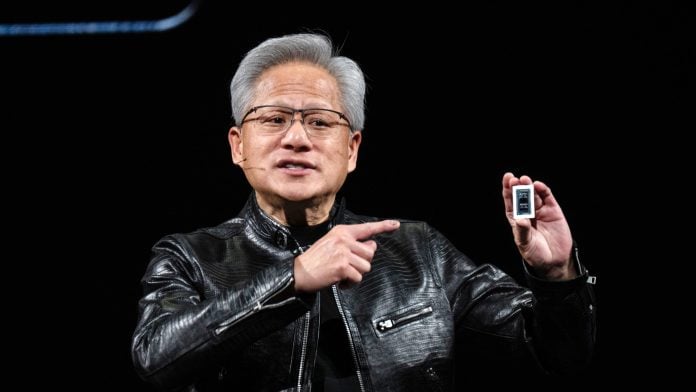
New Delhi: Nvidia chief executive Jensen Huang’s personal life has suddenly become a national security concern in Washington. The 63-year-old billionaire has admitted to having an affair with Alice Huang, a former executive at Singapore-based data centre company Megaspeed, whom US intelligence officials reportedly suspect of working for Chinese intelligence.
Nvidia’s board has launched an independent investigation into whether the relationship exposed company secrets or sensitive technology. The company has said it has no reason to believe either was compromised, while Alice Huang has pledged to cooperate with the inquiry. China has dismissed the espionage allegations as baseless.
The controversy has brought renewed scrutiny to Jensen Huang’s long-standing push for Nvidia to retain access to the Chinese AI market. According to a Reuters report on 10 November, citing The Information, Alice Huang and her associates allegedly helped facilitate at least $7.5 billion worth of Nvidia chip shipments to Chinese companies through a network of businesses. These claims have not been independently established, and the company’s investigation is still under way.
But the affair has also drawn attention to a much bigger contest playing out between Washington and Beijing. For years, Jensen has argued that restricting China’s access to American AI processors could push it towards domestic alternatives, eventually creating a rival technology ecosystem beyond US influence. He has repeatedly urged Washington to allow Nvidia to compete in China, one of the world’s largest technology markets.
At the centre of this dispute are Nvidia’s advanced AI chips, the computing engines behind some of the world’s most powerful artificial intelligence systems. Washington sees their unrestricted sale to China as a potential national security risk. Beijing, meanwhile, wants access to the processors to strengthen its own AI industry while reducing its dependence on American technology.
So why are these chips so important, and what makes their sale such a contentious issue?
Why are Nvidia’s chips so important?
AI models require enormous computing power to process information, recognise patterns and generate responses. This involves running thousands of calculations simultaneously, often across large clusters of processors.
Unlike conventional computer processors, graphics processing units, or GPUs, are particularly suited to these parallel calculations. Nvidia has built a commanding position in this market through its chips and the software ecosystem that developers use to train and run AI models.
Its H200 processor, for instance, is designed for demanding AI workloads and offers substantial memory capacity and bandwidth. It can help companies train larger models and run them more efficiently.
For China, access to these processors is important because domestic chipmakers, including Huawei, are still trying to match Nvidia’s performance, manufacturing scale and software ecosystem. Chinese companies want powerful chips not only to develop competing AI models but also to deploy them across cloud computing, research and commercial applications.
Why is Washington restricting sales?
The US restrictions are rooted in national security concerns. American officials argue that advanced computing technology can have both civilian and military applications.
Powerful AI systems can assist with intelligence analysis, surveillance, autonomous weapons, cyber operations and military research. Washington fears that giving Chinese institutions unrestricted access to advanced processors could accelerate these capabilities.
The restrictions began tightening significantly in October 2022, when the Biden administration introduced controls on advanced computing chips and semiconductor manufacturing equipment. These were expanded in subsequent years.
The objective was to slow China’s ability to develop advanced AI systems by restricting access to the hardware and manufacturing technology needed to build them.
However, the policy has also drawn criticism from Nvidia chief executive Jensen Huang, who has argued that excluding China could hand market share to domestic competitors and weaken America’s influence over the global AI ecosystem.
Has the US allowed Nvidia to sell chips to China?
The policy has shifted under President Donald Trump. On 8 December 2025, Trump announced that approved Chinese customers would be allowed to purchase Nvidia’s H200 chips under certain conditions.
In January 2026, the US Commerce Department formally changed its licensing policy, allowing applications for H200 and comparable AMD processors to be reviewed individually rather than automatically denied.
The conditions include independent testing in the US, safeguards against unauthorised use and assurances that exports will not reduce supplies available to American customers.
The most advanced Blackwell processors, however, have not received the same approval.
The decision has not resolved the dispute. Some American lawmakers argue that even conditional sales could strengthen China’s military and technological capabilities.
Why is China also reluctant to buy them?
Washington is not the only government restricting access. Beijing has also been cautious about allowing domestic companies to purchase Nvidia processors.
Chinese authorities have encouraged technology companies to develop and use home-grown alternatives rather than remain dependent on American suppliers. There are also concerns that US export rules could change again, leaving Chinese companies dependent on hardware they might suddenly lose access to.
The tension became clearer in January, when Chinese officials reportedly told companies to purchase H200 chips only when necessary.
Yet demand for Nvidia hardware has not disappeared. A Reuters investigation published on 11 November 2026 found that Northwestern Polytechnical University, a Chinese institution with defence links and a place on the US trade blacklist, had purchased two H200 processors through a domestic supplier. Reuters also found evidence of other Chinese institutions accessing restricted Nvidia chips through computing-service contracts.
The findings highlight how difficult it is to completely restrict access to advanced technology once it enters global supply chains.