


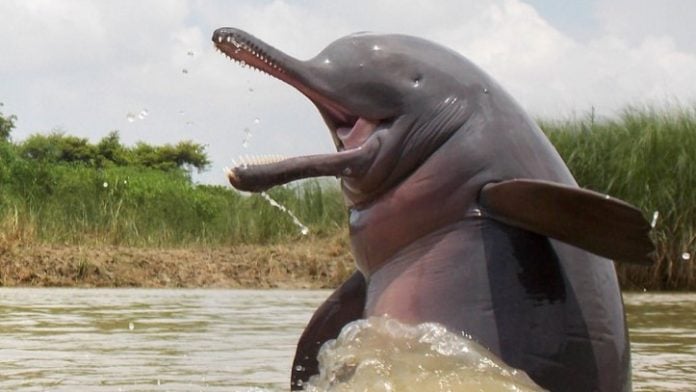
New Delhi: Imagine trying to save an animal without being able to see it clearly. The Ganges river dolphin spends much of its life in murky freshwater, is almost blind and relies on echolocation to navigate and hunt. It shares its habitat with millions of people, fishing boats, industrial waste and a river whose flow is increasingly shaped by dams and barrages.
Its survival depends on something much bigger than protecting the animal itself: restoring the river it calls home.
India’s Ganges river dolphin has become part of a global restoration effort recognised by the United Nations. The UN has designated the Namami Gange programme a World Restoration Flagship, acknowledging its work to revive the Ganga through sewage treatment, pollution control, reforestation and community participation. The programme also includes efforts to restore aquatic species such as dolphins, turtles, otters and gharials.
A World Restoration Flagship title is a global recognition by the United Nations Environment Programme (UNEP) and the Food and Agriculture Organization (FAO). It highlights pioneering, large-scale efforts that revive degraded natural ecosystems, support biodiversity, and create green jobs for local communities.
But recognition is not the same as recovery. The Ganges dolphin remains an endangered species, and its story offers a useful lesson in what it actually takes to bring wildlife back from the brink.
Why saving a river dolphin is so difficult
The Ganges river dolphin, scientifically known as Platanista gangetica gangetica, is one of the world’s few freshwater dolphin species. It is found in the Ganga-Brahmaputra-Meghna river systems across India, Nepal and Bangladesh.
Unlike oceanic dolphins, it cannot simply move into the sea when conditions in its habitat deteriorate. It depends on freshwater rivers, their currents and the fish populations that sustain it.
Its eyesight is extremely limited, so it uses echolocation: emitting high-frequency sounds and interpreting the echoes that bounce back from objects and prey. This biological sonar allows it to navigate and hunt even in muddy water.
The dolphin also has a slow reproductive cycle. Females generally give birth to one calf every two to three years. That makes population recovery difficult when adult animals are killed faster than new ones can replace them.
The threats are numerous. Dolphins can become entangled in fishing nets and drown, a problem known as accidental bycatch. They are also affected by pollution, declining fish stocks, vessel traffic and the construction of dams and barrages. These structures can divide populations, restrict movement and alter the flow and depth of the river.
The challenge, therefore, is not simply to stop people from hunting dolphins. It is to make sure the river can support them.
What has India done to help?
India declared the Ganges river dolphin its National Aquatic Animal in 2009 and launched Project Dolphin in 2020 to strengthen conservation efforts.
An important step has been establishing a clearer picture of how many dolphins remain. India’s first comprehensive river dolphin population estimation, conducted between 2021 and 2023, covered 58 rivers and around 8,500 km of waterways. It estimated 6,324 Ganges river dolphins in the country, alongside three Indus river dolphins in the Beas.
The survey provided a baseline for monitoring populations and identifying stretches where conservation efforts are most needed. A second nationwide estimation exercise began in January 2026, with researchers using boats, hydrophones and other methods to assess dolphin numbers and habitat conditions.
There is also an effort to tackle the threats around the mammal. Under Namami Gange, sewage-treatment infrastructure and pollution-control projects aim to improve river conditions. The government has reported the release of 203 lakh Indian major carp fingerlings into the Ganga to support fish populations, which also provide food for river dolphins.
In January 2026, India’s first dolphin rescue ambulance was inaugurated at the Wildlife Institute of India in Dehradun. The government said eight Gangetic dolphins had been rescued and released. Community networks, trained personnel and dolphin clubs are also being developed to report stranded or injured animals and improve awareness among people living along the river.
These measures illustrate an important principle: conservation needs monitoring, rescue capacity, local participation and habitat restoration to work together.
Also Read: Why Manipur’s newly discovered catfish is built differently
From almost extinct to returning: four conservation success stories
The Ganges dolphin is not the only species to have benefited from sustained conservation. Around the world, some animals have made remarkable recoveries after populations collapsed. Their stories show that there is no single formula for bringing a species back.
The scimitar-horned oryx: brought back after disappearing from the wild
The scimitar-horned oryx, a large antelope once found across North Africa, was declared extinct in the wild in 2000 after hunting and instability across its range devastated its population.
It survived in zoos and private collections, where captive breeding programmes maintained a population that could eventually be returned to its natural habitat.
In 2016, a major reintroduction programme began in Chad, led by the Chadian government, Environment Agency Abu Dhabi and conservation organisation Sahara Conservation. Hundreds of animals have since been released into the Ouadi Rimé-Ouadi Achim reserve.
In December 2023, the International Union for Conservation of Nature (IUCN) moved the species from Extinct in the Wild to Endangered. It was a striking example of how captive breeding, international cooperation and habitat protection can reverse even an extreme conservation crisis.
The mountain gorilla: recovery through long-term protection
Mountain gorillas in central Africa faced severe pressure from poaching, habitat loss, disease and conflict. By the 1980s, their numbers had fallen to around 250.
Their recovery has involved decades of protection in the Virunga Massif and Bwindi forests located in East-Central Africa along the edge of the Albertine Rift through veterinary interventions, anti-poaching patrols and close monitoring. Tourism has also generated revenue for conservation and local communities.
Their numbers have since increased to more than 604 in the Virunga population alone, with a separate population in Bwindi. The species remains endangered, but its recovery demonstrates the value of sustained protection rather than short-term interventions.
The California condor: when captive breeding becomes the last resort
North America’s largest land bird was nearly wiped out by hunting, habitat destruction and lead poisoning. By 1987, only 27 California condors remained, and all surviving wild birds were captured for a captive-breeding programme.
The decision was controversial, but it gave conservationists a chance to breed the birds and gradually release them back into the wild. The population has since grown into the hundreds.
However, the recovery is not complete. Lead poisoning from ammunition left in animal carcasses remains a serious threat.
The saiga antelope: a comeback after a mass die-off
The saiga, an antelope recognised by its distinctive bulbous nose, once roamed across vast stretches of Central Asian grasslands. Hunting, habitat fragmentation and disease caused its population to crash.
In Kazakhstan, conservation initiatives have protected migration routes and restored large areas of steppe and wetland habitat. Despite a mass die-off of around 200,000 saigas in 2015, the country’s population rose from fewer than 50,000 in 2006 to nearly four million in 2025.
The IUCN consequently moved the species from Critically Endangered to Near Threatened in 2025. The recovery shows how protecting an animal’s movement across a large landscape can be as important as protecting the places where it feeds and breeds.
What do these recoveries teach us?
These examples are very different. The oryx needed captive breeding and reintroduction; the condor required an emergency intervention to save the last surviving birds; the mountain gorilla benefited from sustained protection; and the saiga’s recovery depended heavily on safeguarding vast migration landscapes.
But they share a few ingredients: identifying what caused the population to collapse, reducing those threats, protecting the habitat, monitoring the animals and maintaining conservation efforts over decades.
They also show why a rise in numbers does not automatically mean a species is safe. The California condor still faces lead poisoning, mountain gorillas remain vulnerable, and reintroduced oryx need continued management.
The same caution applies to the Ganges river dolphin. India’s first population estimate provides a baseline, not proof that the species has recovered. Its future depends on whether conservation efforts can keep pollution under control, reduce deaths in fishing gear, maintain adequate river flows and allow dolphins to move between stretches of the river.
Ultimately, bringing a species back from the brink is not about creating a temporary pocket of safety for a few animals. It is about restoring the conditions that allow a population to survive without constant intervention. For the Ganges river dolphin, that means making the river itself a place where it can thrive again.