


A fish living in a mountain stream faces a problem that many freshwater species do not: the current can be strong enough to sweep it off the riverbed. For a small fish, staying in one place can be as important as swimming.
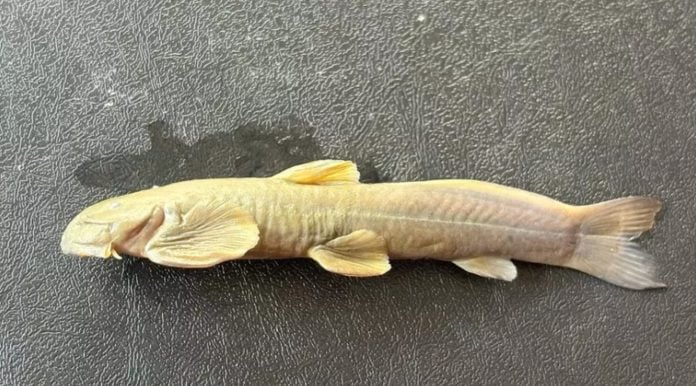
A newly discovered catfish from Manipur appears to have evolved a set of physical features suited to precisely this challenge. Named Exostoma nasibarbatum, the fish has a flattened head and body, enlarged fins with adhesive ridges and an unusually long whisker-like structure near its nostril.
Researchers identified the species during a survey of the Bupal stream in Chandel district. The stream feeds into the Dujang River, which is part of the Chindwin river system along the India-Myanmar border. The findings were reported in the Journal of Natural History on November 1.
But what makes this fish particularly interesting is not simply where it was found. It is how its body appears to be designed for life in turbulent water.
A body built to stay put
Unlike fish that spend much of their time swimming through open water, hill-stream catfishes such as Exostoma live close to the riverbed, where water rushes over rocks and boulders.
A streamlined body helps a fish move through water, but Exostoma nasibarbatum has another advantage: its head and body are strongly flattened. This allows it to remain close to the rocky surface, reducing the force of the current acting against it.
The enlarged paired fins are another important feature. These fins have structures known as adhesive striae—ridges that help the fish maintain contact with rocky surfaces. Rather than constantly swimming against the current, the fish can use its fins to hold its position.
Its flattened maxillary barbels, the whisker-like appendages near the mouth, also help it attach to rocky substrates.
The whisker that gives the fish its name
The most distinctive feature of the newly described species is also the one that inspired its scientific name.
Nasibarbatum combines the Latin words nasus, meaning nose, and barba, meaning beard. It refers to the fish’s prominent nasal barbel, a slender sensory appendage near the nostril that extends beyond the rear edge of the eye socket.
Barbels are not unusual among catfishes. These whisker-like structures contain sensory cells that help fish detect their surroundings. They can provide information through touch and chemical cues, helping a fish locate food and navigate its environment.
For a fish living close to a rocky streambed, such sensory structures are useful because the water is constantly moving and visibility can vary. The nasal barbel is therefore more than an unusual physical feature—it is an important part of how the fish interacts with its surroundings.
Its length also gives researchers a visible characteristic that helps distinguish it from closely related species.
How do scientists know it is a new species?
Finding an unfamiliar fish does not automatically make it a new species. Researchers have to establish that its features are sufficiently different from those of species already described.
In this case, the team examined specimens collected from Bupal stream and compared their physical characteristics with related members of the genus Exostoma. The combination of the flattened body, adhesive structures on the fins, flattened barbels and distinctive nasal barbel helped establish its separate identity.
This is particularly important because the genus already includes several recognised species. There are 23 valid Exostoma species across the Indian subcontinent and Southeast Asia, seven of which are recognised in the Chindwin-Irrawaddy drainage.
The researchers therefore had to distinguish the Manipur specimens from fish that were already known from the same broader river system. It was the combination of characteristics, rather than one unusual feature alone, that supported the description of a new species.