


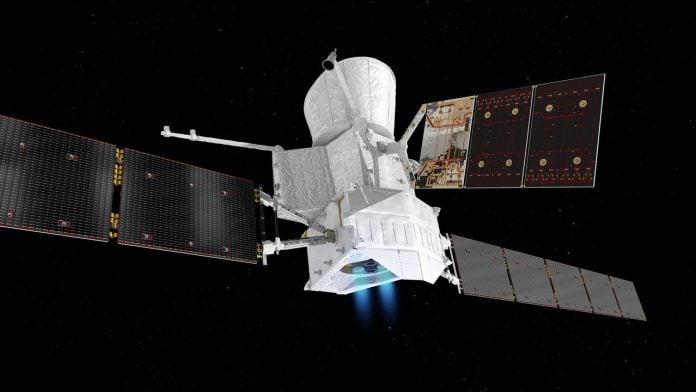
New Delhi: Mercury is the closest planet to the Sun, and it isn’t particularly far from Earth compared with the outer planets. Yet it took two spacecraft eight years, nine planetary flybys and a journey of billions of kilometres to finally reach it.
On 21 November, the European-Japanese BepiColombo mission successfully entered orbit around Mercury, becoming only the second mission in history to do so.
Launched in October 2018, the mission carries two spacecraft that will eventually separate and study the planet from different heights. Scientists hope to uncover why Mercury has such an enormous iron core, what lies beneath its surface and how ice can survive on a planet so close to the Sun.
But why did getting there take so long?
Why is reaching Mercury so difficult?
The biggest obstacle isn’t distance. It’s the Sun.
Earth travels around the Sun at nearly 30 kilometres per second. Any spacecraft launched from Earth inherits much of that speed.
To reach Mercury, which orbits much closer to the Sun, the spacecraft must shed a considerable amount of energy. Otherwise, it would race past the planet rather than settle into orbit.
Imagine trying to jump onto a moving train. Getting close enough isn’t sufficient. You also need to match its speed.
That’s essentially the challenge facing spacecraft approaching Mercury.
The Sun’s powerful gravity makes things even harder. As a spacecraft falls towards it, it naturally accelerates.
Engineers must therefore slow the spacecraft down without exhausting its limited fuel supply.
How did BepiColombo manage the journey?
Instead of relying entirely on its engines, BepiColombo used the gravitational pull of planets to change its course and speed.
This technique is called a gravity assist.
The spacecraft flew past Earth once, Venus twice and Mercury six times before finally entering orbit.
Each encounter helped adjust its trajectory, gradually bringing it closer to the right speed and position.
The mission travelled roughly 10 billion kilometres along its winding route.
On 21 November, its engines fired to slow it sufficiently for Mercury’s gravity to capture it.
The journey wasn’t a straight line from Earth to Mercury. It was an elaborate eight-year braking exercise.
Why send two spacecraft instead of one?
BepiColombo is a joint mission of the European Space Agency (ESA) and Japan Aerospace Exploration Agency (JAXA).
ESA’s Mercury Planetary Orbiter will examine the planet itself, including its surface, interior and chemical composition.
JAXA’s Mio spacecraft will study Mercury’s magnetic field and the particles surrounding it.
A magnetic field is an invisible region produced by magnetic forces. Earth’s magnetic field helps shield us from charged particles streaming from the Sun.
Mercury also has a magnetic field, despite being much smaller than Earth.
Scientists want to understand how it is generated and how it interacts with the Sun.
The two spacecraft are scheduled to separate in December, with their main scientific observations beginning in April 2027.
What makes Mercury so unusual?
For a small planet, Mercury has some extraordinary characteristics.
Its iron-rich core occupies an unusually large proportion of its interior. Scientists still debate how it became so large compared with the planet’s rocky outer layers.
Mercury also experiences extreme temperature differences.
Its sunlit surface can reach approximately 430 degrees Celsius, while temperatures at night can fall to minus 180 degrees Celsius.
Yet scientists have detected evidence of water ice inside permanently shadowed craters near its poles.
Because sunlight never reaches the floors of some of these craters, they remain cold enough for ice to survive.
What could the mission discover?
BepiColombo will build on the findings of NASA’s MESSENGER spacecraft, which orbited Mercury between 2011 and 2015.
Its instruments will map the surface, investigate the planet’s interior and study how solar radiation affects its thin surroundings.
Understanding Mercury could also help scientists explain how rocky planets form, including worlds orbiting other stars.
After eight years in space, BepiColombo has finally reached its destination.
But the most exciting part of the journey is only beginning.