



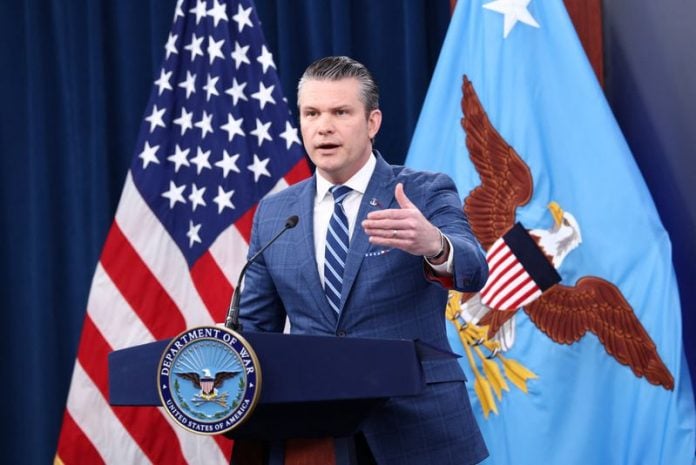
New Delhi: As Donald Trump remakes American power in his second term, Pete Hegseth has been carrying out a parallel upheaval inside the Pentagon. While the president has pushed a more muscular “America First” foreign policy, challenged old alliances, pursued US interests in Greenland and repeatedly sought to redraw the boundaries of what American power can do, his defence secretary has been busy reshaping the institution that is supposed to deliver that power.
Hegseth’s mission has been described in sharply different terms depending on who is describing it. He calls it accountability, reform and a return to the “warrior ethos”. His supporters see a long-overdue attack on an enormous bureaucracy that has become too slow, too expensive and too detached from the battlefield. His critics call it a purge, a political takeover of the military or even a threat to the professional officer corps. Hegseth himself has described his fight with the Pentagon bureaucracy as a “war of attrition”.
For defence ministries around the world, particularly those struggling with bloated headquarters and slow procurement, there is a lesson here whichever side they take: what to copy, and what not to do.
So, is there a method behind Hegseth’s apparent madness?
What has Hegseth actually done?
Hegseth has fired, forced out or accelerated the departure of more than a dozen senior military leaders since taking charge of the Pentagon, an unusually large turnover at the top of the US armed forces. The departures have included Gen. Charles “CQ” Brown Jr., then chairman of the Joint Chiefs of Staff; Adm. Lisa Franchetti, the Navy’s first woman chief of naval operations; Adm. Linda Fagan, the Coast Guard commandant; Gen. James Slife, the Air Force vice chief; and later Army chief of staff Gen. Randy George. Other senior commanders, including Gen. Chris Donahue, have also left earlier than expected. In several cases, the Pentagon has not publicly given detailed reasons for the departures.
Then Hegseth went beyond individual firings.
In September, he announced that the US military would cut 20% of its general and flag officer positions by 1 January 2027, doubling an earlier 10% reduction. That affects roughly 800 positions across the services. Hegseth argues that the military has too many senior officers and headquarters layers for the size of the force.
The symbolism is deliberate. Hegseth has repeatedly contrasted “generals” and “G.I.s”, arguing that the Pentagon should have fewer people at the top and more resources reaching those who actually fight.
But the cuts have not been restricted to men and women in uniform.
The Pentagon’s civilian workforce fell from more than 793,000 employees in January 2025 to 714,780 a year later, a reduction of about 10%. The Pentagon approved roughly 53,200 deferred resignations, while a hiring freeze also sharply reduced recruitment.
That is where one of the strongest arguments for Hegseth’s approach and one of the strongest arguments against it collide.
The Pentagon really is a vast bureaucracy. But the Government Accountability Office found that the department did not consistently assess the effects of the 2025 civilian cuts on workload, readiness and other functions. Officials also reported both benefits from organisational streamlining and problems caused by reduced capacity.
The less obvious part of the purge
Hegseth’s project is not simply about reducing headcount.
He has also tried to change what the US military considers important.
The Pentagon dismantled its diversity, equity and inclusion infrastructure, changed policies concerning transgender service members and pushed for sex-neutral physical standards for combat jobs. Hegseth has argued that the military should select people according to whether they can meet the requirements of the job, rather than demographic targets.
He has also targeted what he sees as an overly permissive military culture, including grooming standards and physical fitness.
Some of these measures are popular with conservative veterans and Trump’s political base. Others have been attacked as culture-war politics being imported into an institution that traditionally tries to keep partisan battles outside the chain of command.
Hegseth’s September speech at Quantico made that political character difficult to ignore. He attacked what he called the Pentagon’s previous “woke” culture and accused some senior officers of treating civilian control of the military as a “suggestion”.
He also created an Office of Religious Affairs reporting directly to him. The Pentagon says it will strengthen religious support and the military chaplaincy. Critics fear it could give evangelical Christianity disproportionate influence inside a military that includes people of many faiths and those with no religion.
But there is a serious strategy underneath it
This is the part that can get lost when Hegseth is reduced to the culture-war headlines.
Some of his objectives are hardly radical.
The US military does have an enormous bureaucracy. Its procurement system is famously slow. Its weapons can cost extraordinary amounts of money and take years to develop. And the wars in Ukraine and the Middle East have demonstrated how quickly drones, artificial intelligence, cheap autonomous systems and electronic warfare are changing the battlefield.
Hegseth wants the Pentagon to adapt to that reality.
His most striking move came in September, when he announced the creation of Autowarcom, a new four-star command focused on autonomous warfare, including drones and artificial intelligence. The Pentagon is also working on a broader review of future warfare involving Elon Musk, defence entrepreneur Palmer Luckey and former Republican House speaker Newt Gingrich.
The logic is straightforward: instead of relying predominantly on small numbers of extraordinarily expensive platforms, the US should also be able to produce large numbers of cheaper, intelligent and expendable systems.
That could mean drone swarms replacing some traditional battlefield functions, autonomous systems working alongside soldiers and AI compressing the time between identifying a target and acting on it.
Hegseth is also pushing to strengthen domestic defence supply chains and reduce dependence on vulnerable foreign sources, particularly where China could potentially exert leverage.
In that sense, the Pentagon overhaul is not simply a purge of people. It is also an attempt to change what the Pentagon buys, who it buys it from and how quickly it can put new technology into the hands of troops.
So why the backlash?
The biggest concern is not that Hegseth wants reform. It is how he is carrying it out.
The US military depends on a professional officer corps whose job is to give civilian leaders candid advice, including advice they may not want to hear.
Critics argue that repeatedly removing senior commanders without clearly explaining the reasons can create a different incentive: officers may become more cautious about disagreeing with political leadership.
Sen. Jack Reed, the senior Democrat on the Senate Armed Services Committee, has repeatedly accused Hegseth of politicising the military. Republican Sen. Thom Tillis has gone further. In a forthcoming memoir, Tillis called his vote to confirm Hegseth his “biggest regret” and criticised the secretary’s management style.
That makes the opposition unusual. Hegseth is not facing criticism only from Democrats or the traditional defence establishment. Some Republicans who supported his appointment are now questioning where the overhaul is going.
There is also concern about what happens when institutional knowledge disappears faster than it can be replaced.
A military headquarters may be bloated. But not every person working inside it is redundant. Civilian employees maintain weapons programmes, logistics, intelligence, contracts, bases and medical systems. The GAO has already identified cases where civilian reductions created staffing problems at remote military installations.
And then there is the media fight
Hegseth’s relationship with the press has been unusually hostile for a Pentagon chief.
His department imposed new restrictions on journalists covering the Pentagon, including rules governing access and the gathering of information. Major organisations including The New York Times, Washington Post, AP, Reuters, NPR and Fox News rejected the new arrangements rather than accept restrictions they considered incompatible with independent reporting.
Hegseth has repeatedly attacked journalists who publish stories critical of his management of the Pentagon or the Trump administration’s wars. At his latest Quantico address, he devoted part of his speech to attacking what he called “anti-American losers” in the news media.
Supporters see this as Hegseth refusing to let Washington’s traditional defence press dictate the agenda.
Critics see it as a serious problem for democratic oversight: if the Pentagon becomes harder for independent journalists to penetrate, Congress and the public have fewer ways of knowing what is happening inside it.
Who is actually with Hegseth?
Trump, above all.
The president has given Hegseth considerable freedom to reshape the Pentagon and shares his distrust of what both men describe as an entrenched Washington establishment.
Hegseth also has support among conservative veterans, military commentators and online personalities who believe the US armed forces became too bureaucratic and too focused on issues such as DEI rather than combat readiness.
The Pentagon has increasingly drawn figures from that conservative military-media ecosystem into government roles, blurring the old distinction between military commentary and military policymaking. That has alarmed some traditionalists, who fear that the officer corps is being divided along political lines.
But there is a less ideological constituency for some of Hegseth’s reforms too: defence technologists and people inside the military who have long complained that the Pentagon struggles to adopt commercial technology quickly enough.
The drone and AI push therefore has supporters who have little interest in the culture war.
What is at stake?
The real test of Hegseth’s Pentagon will not be whether he can fire generals.
It will be whether he can replace an old system with a better one.
If cutting headquarters layers frees money and talented people for weapons, training and frontline units, Hegseth could eventually be credited with doing something previous defence secretaries talked about but failed to accomplish.
If faster procurement gets useful drones and AI systems into the hands of soldiers years earlier than conventional programmes would have, his argument will look stronger still.
But if experienced officers leave faster than new leadership can be developed, civilian cuts weaken essential functions, promotions become associated with political loyalty and independent scrutiny becomes harder, the Pentagon could emerge smaller but not necessarily stronger.
That is why armies around the world are watching.
Every major military has the same basic problem Hegseth has identified: large defence bureaucracies accumulate layers, programmes and habits that are difficult to remove.
The American experiment is now testing two very different propositions at once.
The first is that a powerful military can become more effective by cutting deeply into its hierarchy and bureaucracy.
The second is that this can be done without damaging the professional institutions, expertise and dissent that made that military powerful in the first place.
Hegseth believes both can be achieved.
His critics think he may prove the first point by breaking the second.
That is the real wager behind the Pentagon purge.