





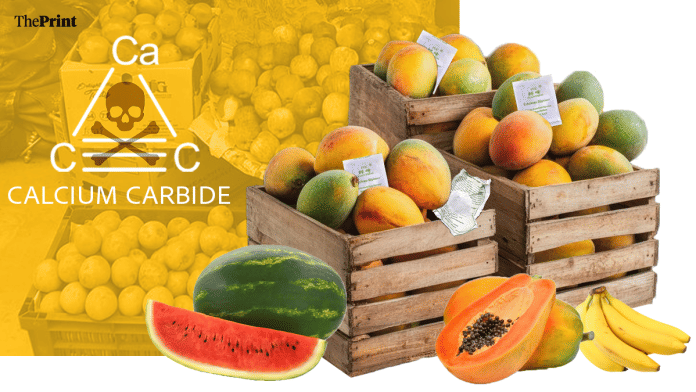


New Delhi: As India enters peak mango season, the country’s top food regulator has once again asked states to crack down on the use of Calcium Carbide, a banned chemical commonly used to artificially ripen fruits, warning that its mere presence near fruit crates is grounds enough to prosecute a trader.
It’s not just mangoes. Bananas that yellow overnight, tomatoes that are unnaturally deep red, papayas that ripen within hours—across India’s fruit markets, the use of chemicals to ripen as well as colour fruits has become alarmingly commonplace, raising serious health concerns.
Doctors say such chemicalisation of India’s fruit basket poses serious health risks to people such as “organ failure and even cancer”.
Ripened mangoes sold at fruit markets, just at the start of the season could mean that it has been artificially ripened using Calcium Carbide, an industrial-grade chemical that is known as “masala” in the trade market.
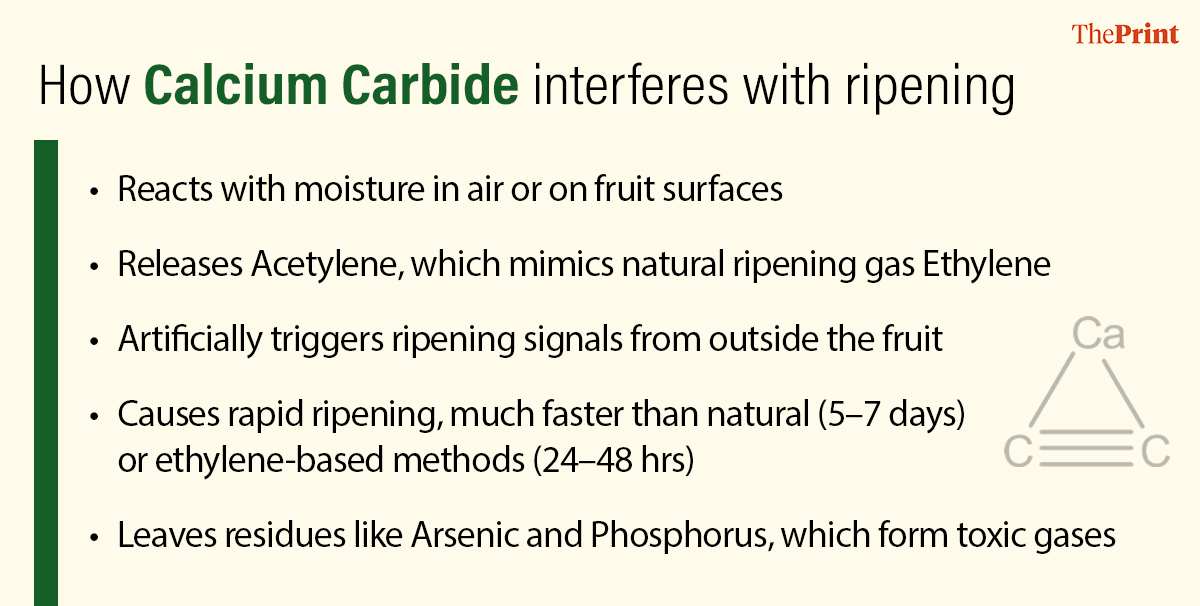
When Calcium Carbide comes in contact with moisture in the air or the fruit, it releases Acetylene gas and triggers ripening. Similarly, artificially ripened bananas could mean that they have been ripened using Calcium Carbide. An overly red watermelon could mean the use of an adulterant such as Erythrosine B.
Apart from Calcium Carbide, other chemicals commonly used to ripen fruits include Ethylene gas, which is a naturally occurring plant hormone that triggers the ripening process. Ethephon, a compound that releases ethylene once it decomposes in contact with the fruit, is also used.
While Calcium Carbide is banned in many countries because it contains traces of arsenic and phosphorus that are harmful to health, Ethylene is considered safe and is permitted for use in artificial ripening.
Despite the repeated directives, issued every summer season, the practice of artificial ripening using Calcium Carbide appears to be rampant in India.
‘Most traders who use carbide have little understanding of what it does to human body or that they are violating law,’ Sarika Agarwal, MD, Food Safety Works.
After a similar directive last year, the country’s top food regulator, the Food Safety and Standards Authority of India (FSSAI) on 16 April 2026, instructed food safety commissioners across states and Union territories to intensify inspections at fruit markets, mandis, godowns and storage facilities.
Food safety experts say that enforcement gaps allow these practices to persist.
“Most traders who use carbide have little understanding of what the chemical does to the human body or that they are violating the law,” Sarika Agarwal, the Managing Director of Food Safety Works, a Bengaluru-based food regulatory and standards consulting company, told ThePrint.
Calcium Carbide (CaC₂) is sold in powder form by the kilogram in the open market for as little as Rs five to 10, making it a more enticing option.
The science behind food ripening
Fruits fall into two broad categories—climacteric fruits and non-climacteric fruits.
Climacteric fruits include mangoes, bananas, papaya, pears and tomatoes. They produce Ethylene gas naturally that makes them continue to ripen after harvest. This also means they soften and spoil quickly once ripe.
A fully ripe Alphonso, for instance, cannot survive a 48-hour truck journey from Maharashtra’s Ratnagiri to Delhi. But an unripe one can. So traders harvest green, ship raw, allowing the fruit to the destination. The entire supply chain of India’s fruit economy is built around this logic.
Non-climacteric fruits, including grapes, oranges, pineapples, and strawberries, do not ripen after picking. Whatever colour, sweetness and flavour they have at harvest is what reaches the consumer. Artificial ripening is neither possible nor relevant for them.
However, some limited post-harvest changes occur depending on factors such as storage conditions.
It is the climacteric group that drives the problem of chemical use.
When a climacteric fruit begins to ripen naturally, it triggers a cascade of biological changes from within. The fruit produces Ethylene gas, which acts as a hormonal signal, switching on enzymes that break down the starch in the flesh into sugars, softening the cell walls, developing the characteristic aroma, and changing the skin colour from green to yellow, orange or red.
The process is self-sustaining. The more Ethylene the fruit produces, the faster it ripens, which is why placing a ripe fruit next to an unripe one speeds up the ripening process for the entire container. Temperature, humidity and air circulation all determine how quickly and evenly this process unfolds.
However, artificial ripening works by introducing Ethylene—or a chemical that mimics it — from outside the fruit, triggering the same process before the fruit would naturally begin it.
If done correctly, using Ethylene gas at controlled concentrations, the fruit’s internal chemistry responds as it would on the tree, and the result is largely indistinguishable from natural ripening.
Agarwal explained that when Calcium Carbide is used to ripen, it releases Acetylene gas, which is chemically similar to Ethylene and triggers the ripening signal in the fruit.
The ripening process is the same, except that Acetylene gas can contain traces of Arsenic and Phosphorus as impurities. These traces react with moisture to produce Phosphine and Arsine, which are highly toxic, carcinogenic, and can cause serious adverse health effects, including dizziness, headaches, and long-term organ damage.
Explaining how Calcium Carbide is used in mandis, a senior FSSAI official told ThePrint that lumps of carbide powder are wrapped in newspaper packets and placed between fruit crates inside a room. The fruits are then covered to maintain warm temperatures. This causes the fruits to ripen faster.
Calcium Carbide can ripen fruits faster than the 24 to 48 hours required by Ethylene, and far faster than the five to seven days natural ripening takes. For a trader trying to move stock, that difference is everything.
The FSSAI permits the use of Ethylene gas at a concentration of up to 100 parts per million (PPM), a method formalised in August 2016.
Compliant methods include Ethylene gas cylinders, spray cans with compressed Ethylene, and machines that convert liquid Ethanol into Ethylene gas—all designed to release Ethylene into the air of a ripening chamber, never onto the fruit itself.
But there are strict conditions for the use of chemicals for fruit ripening. Bananas require 15 to 18 degrees Celsius temperature with 90 to 95 per cent humidity for 24 to 48 hours; mangoes need 20 to 22 degrees Celsius under the same humidity.
CO2 inside the chamber must stay below 5,000 parts per million, and fruit must not fill more than 75 per cent of the chamber space. Besides, Ethylene-releasing agents should never come in direct contact with the fruits.
For small traders operating out of a rented room in a wholesale mandi, maintaining these conditions is an expensive proposition. Carbide, at five rupees a kilo, wins every time.
What it does to your body
The Arsenic and Phosphorus residues from Calcium Carbide settle on the fruit’s surface. The ripening they produce is cosmetic—the skin yellows while the flesh inside may remain hard and sour.
‘Even permitted colouring agents are chemicals, & if consumed in excess, they can pose serious health risks such as organ failure & even cancer,’ Dr Manish Itolikar, Fortis Hospital, Mumbai.
Dr Manish Itolikar, a consultant internal medicine physician at Fortis Hospital, Mumbai, said the chemicals present in these ripening agents are toxic in excess, and the immediate effects on the body are hard to miss.
“Acutely, there can be vomiting, diarrhoea, nausea, headache and dizziness,” he said.
He warned that repeated exposure to Arsenic and Phosphorus residues, accumulated over years of eating chemically ripened fruit, can cause kidney failure, liver failure, and even cancer as some of these compounds are carcinogenic.
Regarding coloring agents, he said, “Even permitted colouring agents are chemicals, and if consumed in excess over a long period, they can pose serious health risks such as organ failure and even cancer.”
“The ‘permitted’ only means they are safe within a specific limit—problems arise when that amount is exceeded regularly over time,” Dr Itolikar said.
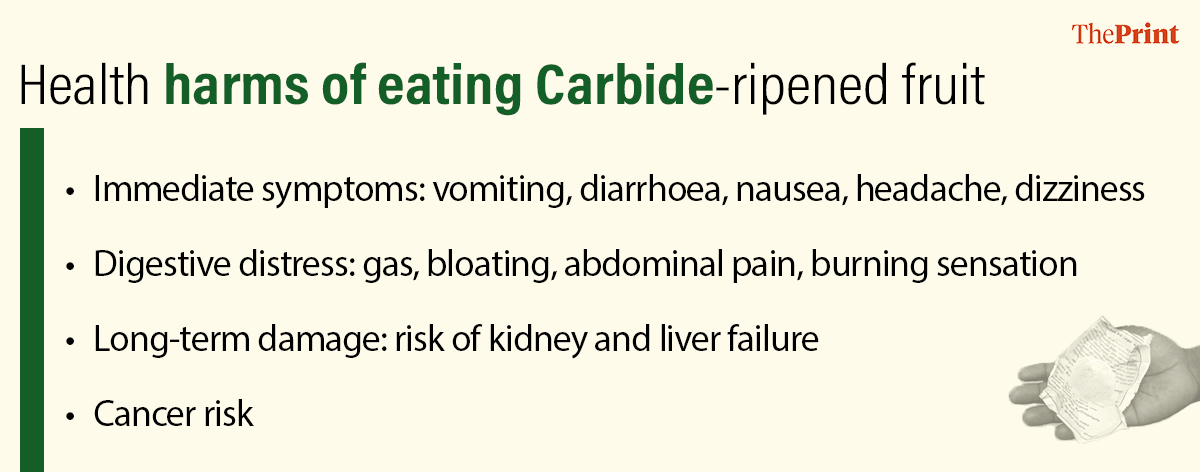
Dr. Rishab Sharma, Consultant in gastroenterology at Manipal Hospital, Jaipur, said people who consume such fruit commonly report gas, bloating and upper abdominal pain.
“Sometimes it is a burning sensation, sometimes sharp pain. If a large quantity has been consumed, there may also be nausea and vomiting,” he said.
Children and the elderly are particularly vulnerable. Dr Sharma explained that children’s digestive systems are still developing, making them less equipped to handle partially unripe or chemically treated fruit.
Older adults, meanwhile, often already contend with slower gut motility (stretching and contractions of the muscles in the gastrointestinal tract), acidity or constipation — conditions that chemically ripened fruit can significantly aggravate.
“Consuming chemically ripened, partially unripe fruit can worsen these conditions,” he said.
Delhi-based nutritionist Divya Gandhi points to the nutritional cost. Calcium Carbide ripening degrades the fruit’s vitamin content significantly, particularly vitamin C and vitamin A— nutrients that are naturally abundant in the red, yellow and green pigmentation of ripe fruit, but decline sharply when ripening is chemically forced.
“The vitamin content is also affected — levels of vitamin C tend to be lower, and vitamin A can decline when ripening is induced artificially,” she said.
Clinically, she added, the effects tend to show up as acidity, nausea or persistent headaches linked to underlying gut irritation.
Ethylene-based ripening, done correctly, avoids all of this because it works with the fruit’s own biology rather than overriding it.
“Ethylene triggers the fruit’s own ripening enzyme,” Gandhi said. “Colour, flavour, texture, nutrients—they develop naturally.”
Enforcement lapses
The use of Calcium Carbide has been prohibited under the Food Safety and Standards (Prohibition and Restrictions on Sales) Regulations, 2011, for well over a decade. Sub-regulation 2.3.5 explicitly bans artificial ripening using acetylene gas that Calcium Carbide produces.
Yet repeated FSSAI directives indicate that the enforcement has not worked.
Agarwal pointed to several reasons why Calcium Carbide continues to to be used despite being banned.
The first is the cost involved. Agarwal explained that even if the traders know that Ethylene gas is the legal alternative, the infrastructure required to use it correctly — sealed ripening chambers, temperature and humidity controls, gas cylinders — is expensive and largely inaccessible to small vendors operating out of makeshift storage rooms.
She said that the lack of awareness among traders about safe ripening practices and the health consequences of using carbide, together with its easy availability, weak traceability and limited accountability all contribute to poor compliance.
Weak traceability here means it’s difficult to track where the fruit came from and how it moved through the supply chain from farm to trader to market.
The problem, as Dr Itolikar notes, is country-wide. “It is everywhere, because the use, supply and demand ratio is currently in such form that they have to ripen in a short time, large quantity, so that is why excess use is being practised,” he added.
How can artificial ripening be detected
Inadequate enforcement and regulation by the authorities have led researchers to come up with innovative ways, including use of Artificial Intelligence (AI) to address the menace.
Navdeep Kaur, a research scholar at the Department of Computer Science and Applications at Panjab University, Chandigarh, published a paper in Springer Nature’s European Food Research and Technology journal in December 2025.
The paper reviews the existing artificial intelligence and machine learning techniques being developed to detect artificially ripened fruits without cutting them open or sending them to a lab.
Titled ‘A Systematic Reviewof Artificial Fruit Ripening: Detection Methods, Ripening Techniques, Regional Trends, and Regulatory Disparities’, the paper maps the state of research globally and points to where the field needs to go next.
The techniques her paper reviews include hyperspectral and multispectral imaging, which use specialised cameras to capture information about a fruit beyond what the human eye can see, and then apply machine learning algorithms to classify whether the fruit was ripened naturally or chemically.
These cameras can detect surface and internal changes in the fruit that are invisible to the naked eye. However, the problem is cost. “These hyperspectral cameras are very costly—their cost is Rs five to 10 lakh,” Kaur said.
In such a scenario, a mobile application is more economical.
“We are working to create an Artificial Intelligence-based mobile application that can determine if a fruit was artificially ripened after a user uploads its picture,” she told ThePrint.
She said the plan is to train the model on a large dataset of mobile-phone images showing both naturally and artificially ripened fruits, enabling it to recognise visual differences from a standard photograph, and eventually deploy it as a consumer-facing app for use in markets.
The biggest obstacle, she says, is the lack of data. “There is no publicly available dataset that we can use to train our model and check accuracy.”
Every research group working on this problem currently has to run its own controlled ripening experiments, photograph each fruit, and build a dataset from scratch, she explained.
“Without a shared, standardised pool of images, the models being built in different countries cannot be compared or validated against each other,” she added.
Similar work is underway in Bangladesh, Nepal, Pakistan, and Nigeria, where artificial ripening is equally widespread, but the field remains fragmented.
Until such a tool exists, consumers have to rely on visual and sensory cues.
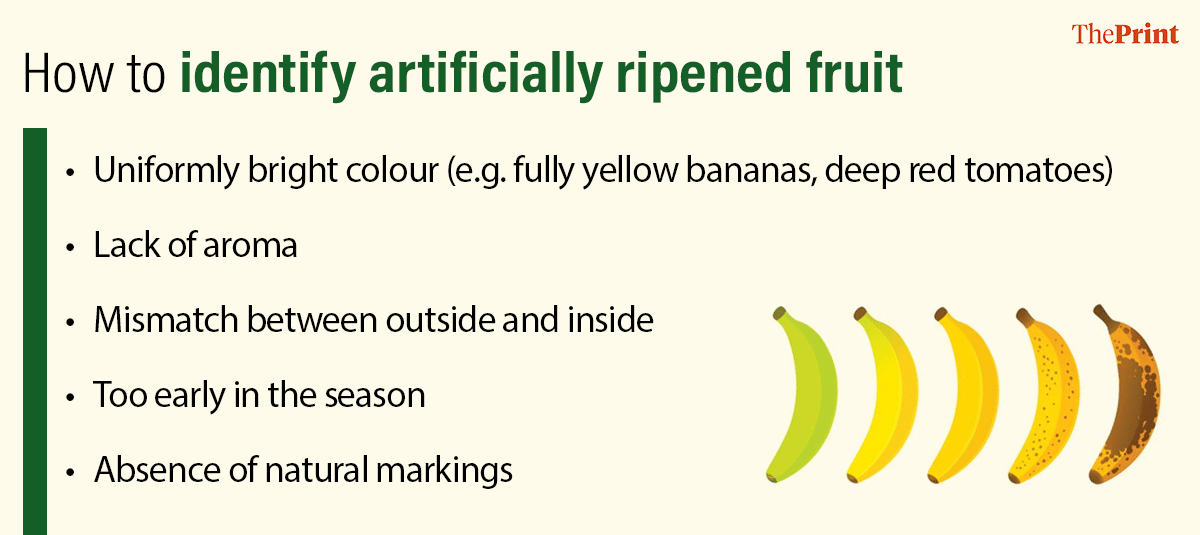
Nutritionist Divya Gandhi advises looking at the colour first. “A naturally ripened banana will have small dark spots and slight colour variation across its surface,” she said.
She explained that a uniformly bright yellow banana with no blemishes is almost certainly artificially ripened. A chemically treated fruit will either have no aroma at all or will carry a faint smell.
(Edited by Ajeet Tiwari)