






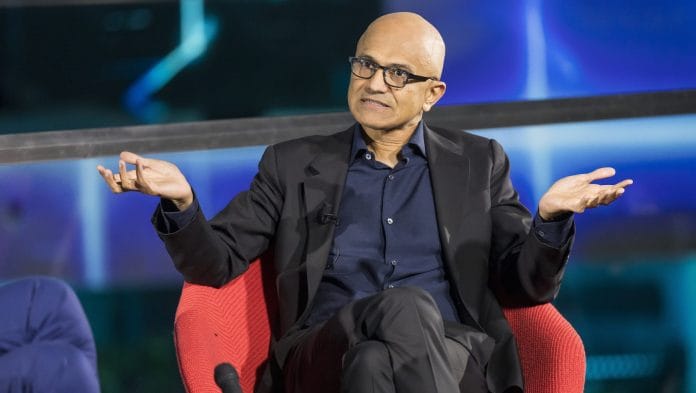



Over the Christmas holiday, Satya Nadella, the chief executive officer of Microsoft Corp., decided to launch a side project: a personal blog called “sn scratchpad.”
The tagline says it will be his place for “notes on advances in technology and real-world impact.” The blog was entirely his idea, a senior communications source at the company told me.
In the first post, published on Dec. 29, “sn” opines on how AI will evolve in 2026. “Ultimately, the most meaningful measure of progress is the outcomes for each of us,” Nadella writes.
The content of the post is far less interesting than the nature of the blog itself and what it signals. The site doesn’t live on Microsoft’s corporate website or even on social network LinkedIn, which it owns. Instead, Nadella opted for a minimalist, cookie-cutter blog template with zero bells and whistles. Nadella’s name doesn’t even appear on the site, though there are two links to his social media profiles.
He’s still on company servers, at least: The site was made with Github Pages, a free publishing tool within the popular Microsoft-owned coding platform. To make it easier to find, on Dec. 17 the snscratchpad.com domain name was bought through the domain registry company GoDaddy. In other words, this site was set up as cheap and cheerfully as possible — hardly the way one might expect the boss of a $3.5 trillion tech giant to go about creating his own web presence.
But the low-budget aesthetic is the point, part of a playbook fast on its way to becoming a cliché. One part of it is the mantra — codified (though not invented) by leading tech PR consultant Lulu Cheng Meservey — of “going direct.” This is the idea that the internet has freed company founders and executives from needing to deal with “third parties with misaligned interests,” such as pests like me in the mainstream media.
The far bigger part is the vibe. Nadella is mimicking a number of his peers who have carefully tended a no-frills space on the web and seen the benefits. Sam Altman has maintained his own personal blog since long before his days as OpenAI CEO, using it to position himself as a big AI thinker worthy of billions of dollars in investment cash despite not being a software engineer himself. Paul Graham, the founder of Silicon Valley startup incubator Y Combinator, has been writing on his website since 2001, with no noticeable design enhancements or upgrades to adapt to mobile phones. Graham is considered one of tech’s most prominent thought leaders, a status achieved as much by his engaging essays as his successful investments.
In Nadella’s case, the bare-bones setup, and low-rent presentation, where punctuation is apparently optional, belies the careful strategy underneath. The site is intended to become a written record of evidence Nadella is a big idea kind of guy. A cynic might call it kind of intellectual cosplay, though that’s not to say Nadella won’t have interesting things to say. Had he got the blogging itch 20 years ago, he might have been laying down his bang-on predictions on the direction of cloud and platform-agnostic computing — foresight which made him CEO and led to the turnaround of the company. For this, Nadella is ranked among the most highly respected executives in Silicon Valley.
However, his reputation in AI circles is more as a shrewd dealmaker — he invested in OpenAI before ChatGPT was launched — than a visionary. Becoming a thought leader is necessary to attract the brightest engineers in a still-raging AI talent war. One of the many reasons Mark Zuckerberg had to dig deep on salaries last year was a perception among engineers and researchers that he lacked vision; he is a man who built one hugely successful product — motivated by wanting to meet girls at college — and then acquired his way to staying relevant in the years that followed.
The most talented generally gravitate to those they feel will offer meaningful work, not just a big paycheck (these days they tend to get both). These people are the primary target of Nadella’s blog. Like academics, nerds seem to respect the flex of a site so lacking in functionality as to almost be entirely static. A clean design, one that harks back to a simpler time on the internet, is intended to convey a certain clarity of thought. And as the traditional media fragments further — into political factions, behind paywalls and swallowed by AI slop — it makes ample sense for figures like Nadella to have their own self-controlled space for unadulterated posting on their own terms.
By blogging in a personal capacity, Nadella is also seeking to emphasize that the topic at hand is beyond “work.” As an analogy, if visiting a corporate website is like a trip to that company’s office, and a social media profile is hobnobbing with them at a stuffy networking event, the personal blog of a billionaire CEO is meant to feel like an invitation into a personal study.
Whether the intended audience in the AI community buys it, I’m not sure. I’m told Nadella’s post, which ran to only 477 words, was at least written by him before being run by just two senior figures within the company before publication. Then, the firm’s Rapid Response PR team had the job of reassuring journalists that the blog did indeed belong to Nadella. The minimal oversight is a risk: Just because it’s a personal blog doesn’t mean the stakes are any lower. What Nadella shares on his “scratchpad” will be heeded just as closely as anything else.
Disclaimer: This report is auto generated from the Bloomberg news service. ThePrint holds no responsibility for its content.