



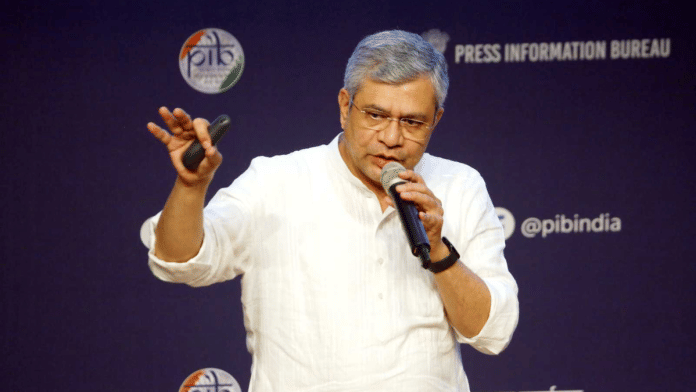

New Delhi: The Minister of Information and Broadcasting, Ashwini Vaishnaw, had called for revisiting the “safe harbour” provision that shields online intermediaries from liability for user content, a parliamentary committee has recorded, while asking the ministry to spell out what action it has taken after its response confined itself to restating existing rules.
The report comes as the same committee, chaired by BJP MP Nishikant Dubey, is engaged in a standoff with Meta over the temporary removal of a Facebook video posted by Prime Minister Narendra Modi. The committee gave Meta three days to take action against those responsible for the takedown and insisted that CEO Mark Zuckerberg himself issue a public apology, warning of action if accountability is not fixed.
Dubey said that if Zuckerberg did not apologise, “the safe harbour protection under Section 79 should be withdrawn from him”. The row followed an August 3 meeting of representatives from the MHA and MeitY and platforms including Meta, Google, X, Snapchat and YouTube on platform regulation, with Meta officials meeting government officials, including Vaishnaw, on 5 and 6 August.
In its twenty-eighth report, presented to the Lok Sabha and laid in the Rajya Sabha on 6 August, the Standing Committee on Communications and Information Technology (2025-26) examined the government’s action taken on the panel’s earlier report on ‘Review of mechanism to curb Fake News’.
Also Read: Govt now examining review of ‘safe harbour’ shield that lets social media giants off the hook
‘Safe harbour’ and the revenue model
The report states that Vaishnaw had, on one occasion, “called for accountability in digital media to combat fake news and safeguard democracy and had suggested that in changing media landscape and India’s diverse social and cultural context, there is a need for revisiting the ‘safe harbour’ provision for the social media intermediaries.” The provision, under Section 79 of the Information Technology Act, 2000, exempts an intermediary from liability for third-party information, data or communication links hosted by it, subject to certain safeguards.
The Committee recorded that stakeholders had raised concerns about the clause during its examination. It noted that “for most of the digital news publishers on major social media intermediary platforms, the revenue model is such that the sensational and potentially fake content gets more traction and the algorithms of such platform further amplifies such content”.
The Ministry, it said, had itself acknowledged that platforms “often prioritise such content, which sometimes are fake or misleading”.
The panel also recorded that Vaishnaw had pointed out that algorithms driving digital platforms prioritise content that maximises engagement, “inciting strong reactions and, thereby, defining the revenue for the platform”, and that “since such biases have social consequences, particularly in a diverse nation like India, there is a need for platforms to come up with solutions to eliminate such biases”.
The Committee noted that when MeitY was asked for its views on issues related to user-generated content, “MeitY did not provide any suggestion, instead it merely stated that under the given Rule/Act, the subject falls under MIB”. It urged the Ministry to ensure an inter-ministerial coordination mechanism, and endorsed enforcing transparency in algorithms, stricter fines, penalties for repeat offenders, an independent regulatory body, and the use of tools like AI. It recommended that the ministry work with MeitY to address issues related to big technology companies and individual content creators, come out with concrete solutions on ‘safe harbour’, and have a dedicated nodal officer based in India in such companies.
In its reply, the ministry did not directly address the ‘safe harbour’ question, and instead listed the additional due diligence obligations for significant social media intermediaries—defined as those with over 50 lakh registered users in India—under Rule 4 of the IT Rules, 2021.
These include appointment of a Chief Compliance Officer, a nodal contact person and a Resident Grievance Officer, all based in India; a physical contact address in India; traceability of the first originator of information on messaging services; deployment of automated tools to identify unlawful content; voluntary verification of user accounts; and the government’s power to call for additional information.
The Committee said it wished to be informed of “the action taken against SSMIs who have not deployed technology-based measures or automated tools or other mechanisms as stipulated under Rule 4(4)”, and desired to know the “effectiveness of the implementation of these due diligence obligations, including the number of cases handled under these Rules since the notification of ‘IT Rules, 2021’.”
Loss of protection for non-compliance
Separately, in its reply on penal provisions, the ministry set out how the exemption can be lost. It said Section 79 “establishes a conditional exemption from liability for intermediaries with respect to third-party information”, operating only when the intermediary complies with due diligence requirements and acts expeditiously to remove unlawful content on receiving actual knowledge. It cited Rule 7 of the IT Rules, under which an intermediary that fails to comply “loses the protection of Section 79 and becomes liable for punishment under any extant law”.
The ministry gave the example of Section 353 of the Bharatiya Nyaya Sanhita (BNS), which criminalises dissemination of misinformation that creates false alarm or panic, stating that an intermediary which does not remove such content after receiving actual knowledge “may also be prosecuted under Section 353 of the BNS, alongside the individual who posted the content”.
New tools
The ministry said the PIB Fact Check Unit is developing an AI-powered chatbot with the National e-Governance Division to allow citizens to verify claims in real time and to serve as a digital archive of previously verified fact-checks. It said an AI-driven system for real-time detection of fake and digitally manipulated content is also being conceptualised.
It added that the unit had examined multiple open-source tools, but that “none of the available tools have been found sufficiently effective or reliable to surpass the accuracy and judgment achieved through manual verification by trained personnel”.
The report also notes that MeitY released draft amendments to the IT Rules on 22 October, 2025, to define “synthetically generated information”, require labelling and metadata embedding, and mandate that such content be marked over “a minimum 10 percent visual or initial audio duration coverage”, along with verification obligations for significant social media intermediaries.
The Committee said it hoped the amendments “will soon become part of the original Act by passing it in Parliament”.
Definition of fake news
The ministry said the term ‘fake news’ is not defined under any statute, and that it is “currently examining the dimensions and parameters related to the term to explore the feasibility of defining the term ‘fake news’ while maintaining the delicate balance of combating misinformation and protecting freedom of speech”.
It cited provisions of the BNS and the Norms of Journalistic Conduct, 2022, as existing measures.
Case disposal, Press Council
On the Press Council of India, the report records that under Section 14 of the PCI Act, 865 cases were filed in 2022-23 and 29 adjudicated; 775 filed and 103 adjudicated in 2023-24; and 898 filed and 41 adjudicated in 2024-25.
Under Section 13, 273 cases were filed in 2022-23 and 11 adjudicated.
The ministry attributed the backlog to the Council not being in existence for nearly two years now, as its 14th term ended on 5 October, 2024. Five members of the 15th term were notified on 19 December, 2024, and nine on 2 December, 2025. It said the tenure of the last Chairperson ended on 16 December, 2025, and that “the meeting of the Committee to nominate new Chairperson is yet to be convened by Hon’ble Chairman of Rajya Sabha”. The Committee urged the ministry to appoint a Chairperson as soon as a vacancy arises in future.
The ministry said it had written to the PCI on 31 July, 2025, seeking suggestions for amending the Press Council Act, 1978. The PCI informed that the matter would be placed before the Council for consideration once it is constituted.
Broadcasters, self-regulation
Against private satellite television channels, the report states that action taken reduced from 101 cases to 4 over 2019-2025, with one case till 29 April, 2025.
Action was taken against broadcasters in 21 cases over five years for violation of the programme code.
Of 919 television channels permitted as on 30 November, 2024, 543 were not members of any self-regulatory body.
The Committee sought the implementation status of a May 2023 advisory directing all broadcasters to join a self-regulatory body.
On penal provisions, the report notes that digital media fines under the IT framework extend to Rs 25,000, and that self-regulatory fines for broadcasters range up to Rs 25 lakh. The Committee said the amount of fine “can be increased so as to make it deterrent enough for creators/publishers of fake news”.
Of the 12 recommendations, nine were accepted by the government and three were categorised as interim.
(Edited by Amrtansh Arora)
Also Read: Rana Ayyub, X Corp & the battle for safe harbour: The broader implications of the case in Delhi HC