





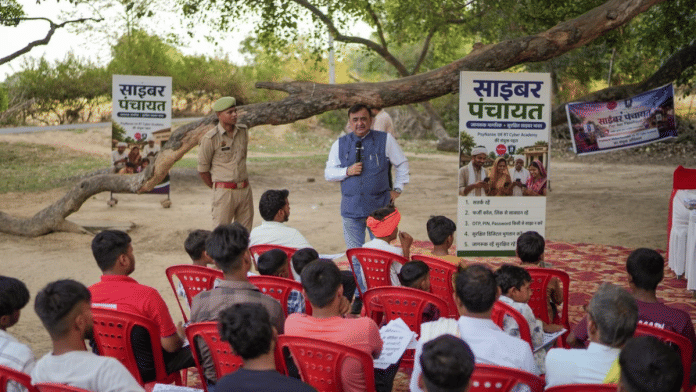


Lucknow: In a bid to strengthen cyber security awareness in rural areas, cyber crime experts and self-help groups have collaborated with the Uttar Pradesh authorities for a ‘Cyber Panchayat’. The initiative aims to educate villagers about the growing threat of cyber fraud and guide them on how to protect themselves from online scams.
As part of the campaign, a two-day ‘Cyber Panchayat’ was organised Tuesday and Wednesday in Gram Kathwara of Bakshi Ka Talab in Lucknow district. The programme brought together villagers, cyber safety experts and social organisations to discuss the increasing penetration of cyber crime into rural India and ways to counter it.
Uttar Pradesh reported 11,073 cyber crime cases in 2024, averaging nearly 30 incidents a day, according to the latest National Crime Records Bureau (NCRB) data.
The NCRB figures indicate a consistent rise in cybercrime cases in the state over the last three years. The state recorded 10,117 cases in 2022, which rose to 10,794 in 2023 and further increased to 11,073 in 2024. This is an addition of 279 cases compared to 2024.
According to a senior UP Police official, cyber crime is no longer confined to urban areas. “Cyber fraud now reaches villages through smartphones and digital platforms. Farmers, homemakers, students, shopkeepers and senior citizens have increasingly become targets. This campaign is led by self help groups with the backing of UP police aimed at ensuring that rural communities are not left vulnerable in the digital age. After conducting workshops they will adopt villages as a pilot project to make them ‘cyber crime-free village’. The role of police will be to provide permissions and resources from local police stations, the official said.

Awareness on digital arrest & OTP fraud
The workshop Wednesday was jointly organised by Psy-Naree, a mental health and women empowerment organisation, and RT Cyber Academy along with UP police.
The session was led by noted cyber safety expert Rakshit Tandon, a cyber crime adviser to the UP Police and founder of RT Cyber Academy. Through practical examples and real life case studies, Tandon explained how cyber fraudsters target ordinary citizens through fraudulent calls, fake messages, investment scams and social engineering tactics.
Another session was hosted by retired Colonel Sanjeev Sahai, founder of Ikigai and mentor of Psy-Naree. Addressing the gathering, he highlighted the connection between cyber crime and the psychological stress experienced by victims. He urged villagers to remain vigilant and seek support in case they fall prey to fraud.
The discussions focused on practical measures that villagers can adopt to stay safe online. Participants were advised never to share sensitive information such as OTPs, PINs, passwords, CVV numbers or banking details with anyone. Speakers also warned about fraudsters impersonating police officers, bank officials, customer care executives and government agencies to deceive people.
Special emphasis was laid on emerging cyber threats such as “digital arrest” scams, video-call blackmail and the misuse of bank accounts for illegal transactions. Villagers were informed about the risks of sharing their bank accounts, a practice that can unknowingly make individuals part of criminal networks.
The session also covered common online traps, including fake job offers, fraudulent KYC update requests, lottery scams, bogus government schemes and investment frauds promising quick returns. Organisers stressed that victims of cyber crime should not be ashamed and should report incidents immediately rather than suffer in silence.
To make the message relatable, short films based on real cyber fraud cases were screened. The visual presentations demonstrated how scammers operate and the precautions that can help prevent financial losses.
One of the highlights of the programme was a cyber safety pledge administered by Rakshit Tandon. Villagers collectively pledged to safeguard their personal information, spread awareness among family members and promptly report cyber crimes through the cyber helpline 1930. Organisers believe it may be among the first such cyber safety pledges administered at a village level in Uttar Pradesh.
Looking ahead, Sahai announced that Psy-Naree, in association with Ikigai, plans to adopt Kathwara as a pilot project and work towards transforming it into a ‘cyber-crime free village’ through sustained awareness campaigns, mental health initiatives and women’s empowerment programmes. The initiative aims to create a model for rural cyber safety that can be replicated across other villages in the state. More such events are planned in the coming weeks.
(Edited by Viny Mishra)