




New Delhi: India’s Artificial Intelligence (AI) companies face a structural trap with no clean exit, senior government officials and tech experts warned Tuesday. These companies, they said, are building on open-source models that will soon plateau, or renting intelligence from foreign Clouds that can be switched off without notice.
“One fine day, anybody can feel very upset about you and switch it off,” said Amit Shukla, Joint Secretary in the Cyber Diplomacy Division of the Ministry of External Affairs, speaking at Bharat Digital Samvad 2026 in New Delhi. “That is the lay of the land which we are facing.”
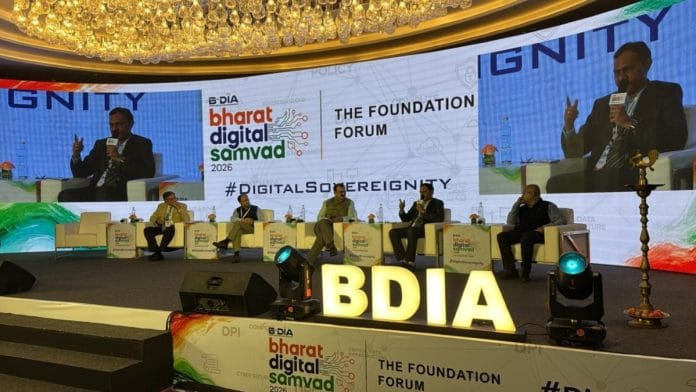
Organised by the Bharat Digital Infrastructure Association (B-DIA), the annual conclave brought together government officials, semiconductor industry executives and academics to debate digital infrastructure and sovereignty. Tuesday’s edition, themed ‘Architecting India’s Digital Sovereignty’, comes when India is simultaneously ramping up domestic AI investment, negotiating trade terms with the United States, and watching its startups build products almost entirely on foreign model infrastructure.
Speaking in his personal capacity, Shukla traced how India arrived at this moment. The late 1990s brought the phone booth and Business Process Outsourcing wave, he said. The 2010s brought Aadhaar and Unified Payment Interface—systems that now touch 1.4 billion people and reach, in his words, “the remotest person in a small hamlet on a hill, village in Himachal or desert village in Rajasthan or an island in Lakshadweep”.
By the mid-2010s, India was heavily dependent on digital platforms for government services, which is precisely when it began asserting itself at United Nations forums on Information and Communication Technology (ICT) governance, inserting itself into the Group of Government Experts on ICT security and subsequently the Open Ended Working Group, he said, adding that the pattern is being repeated with AI now, except that the window to assert is narrower and the stakes are higher.
Shukla’s concern with open-source models is specific. It is not ideology but economics, he explained. “It doesn’t make sense for people to spend billions of dollars and continue doing that, and then release it openly,” he said. The pressure to monetise will win, he said. “The general understanding is that the development of open source models will plateau very soon.” For companies that have built their entire stack on that foundation, the reckoning will arrive quietly and then all at once, Shukla said.
The proprietary Application Programming Interface route is no safer, he said, as foreign models run on foreign clouds. “They are not going to share their code with you to run in your own cloud,” Shukla said, making the point that the result, in a year or two, is a national economy substantially powered by AI it neither owns nor controls. Sovereignty, he argued, does not necessarily require building everything from scratch—an alliance of countries co-developing shared infrastructure could qualify—but it requires one thing above all: “It should not be switched off without our consent, our wish.”
Sandeep K. Shukla, Director of the Indian Institute of Information Technology (IIIT) Hyderabad, put a sharper edge on the issue, warning of what he called cognitive colonialism—a drift where citizens stop exercising independent thinking and outsource cognition to foreign AI systems. On hardware, he rejected arguments that India could exercise meaningful control without manufacturing its own compute stack.
India’s most widely deployed cybersecurity products—firewalls, intrusion detection systems, antivirus software—carry virtually no Indian brand, he said. “You cannot have control without having actual manufacturing, actual ability to produce the compute stack yourself,” he said, flagging that an estimated 60 to 70 percent of government data currently runs on international servers, meaning root keys, data orchestration and storage pipelines are outside Indian jurisdiction.
Ashok Chandak, President of both SEMI—the global semiconductor industry association—and the India Electronics and Semiconductor Association (IESA), said the framing of the Make in India initiative misses the point entirely. “It is not a question of make in India. It is more about design in India, build in India, secure in India and make India trustworthy,” he said. Acknowledging that no Indian name appears alongside NVIDIA, Advanced Micro Devices Inc. (AMD) or Intel in the global AI compute conversation, Chandak noted that Indian engineers staff the design centres of every one of those companies. When those minds generate intellectual property owned by Indian entities, he said, the picture changes.
The government has moved to install 37,000 Graphics Processing Units for shared research use, accessible to researchers, academics and industry on a rental basis, with a target of 100,000. Data centre investments are materialising in Andhra Pradesh and Maharashtra. But, Chandak was candid about the limits. “No country is 100 percent self-sufficient,” he said, adding that India’s goal should be enough presence in global supply chains that “arm-twisting cannot happen in future”.
Running beneath the entire discussion was a legal vacuum that several speakers returned to. India has no dedicated AI law, no cybersecurity law, and its primary digital legislation—the Information Technology Act—dates to 2000 and makes no mention of artificial intelligence. The government has produced a seven-point AI governance framework through the Ministry of Electronics and Information Technology, and recently constituted a new group to work toward a consolidated regulatory approach, but enforceable rules remain absent.
Meanwhile, the International AI Accountability Forum concluded in New Delhi just last week, producing both the New Delhi Compact on Artificial Intelligence Accountability and a Universal Declaration of AI Accountability Rights—global standard-setting happening in India’s own backyard while domestic law lags years behind.
Pavan Duggal, senior advocate at the Supreme Court of India who moderated the session, noted the irony of the moment. India has no cybersecurity policy since 2013. It has no AI legislation. And yet it is being looked at as a model. “What India does today,” he said, “will become a benchmarking standard for the Global South tomorrow.”
(Edited by Nardeep Singh Dahiya)
Also Read: India missed out on AI and now its run as market darling may be over