



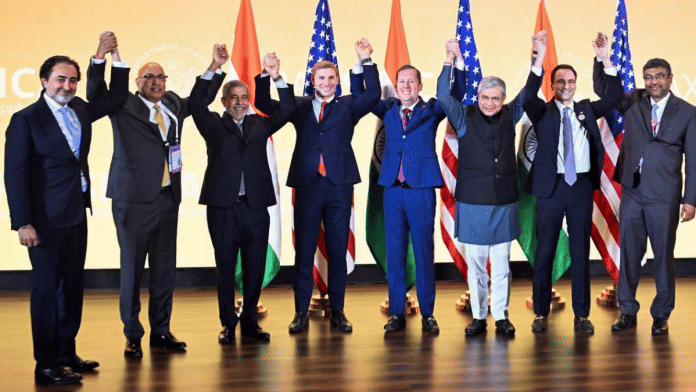

New Delhi: The AI Impact Summit 2026 concluded Saturday with the adoption of the New Delhi Declaration endorsed by 88 countries, and guided by the principle “Sarvajan Hitaya, Sarvajan Sukhaya”—Sanskrit for ‘welfare for all, happiness for all’.
Among the signatories are the United States, United Kingdom, China, Germany, France, Japan, Australia, Canada, Brazil, Italy, Spain, South Korea, Saudi Arabia and Russia, along with the European Union and the International Fund for Agricultural Development (IFAD). The summit was held in the national capital from 16-20 February, with the expo extended by a day till 21 February.
The New Delhi Declaration sets out a shared vision for “collaborative, trusted, resilient and efficient AI.” It calls for strengthening international cooperation and multi-stakeholder engagement while respecting national sovereignty, and emphasises that the benefits of artificial intelligence should be equitably shared.
The document is structured around seven pillars, or “chakras”, that form the foundation of cooperation.
Under the first pillar, ‘Democratising AI Resources’, the declaration underscores the importance of robust digital infrastructure and affordable connectivity as prerequisites for AI deployment. It takes note of a ‘Charter for the Democratic Diffusion of AI’, described as a voluntary and non-binding framework to promote access to foundational AI resources and support locally relevant innovation ecosystems.
On ‘Economic Growth and Social Good’, the declaration recognises the role of AI in driving economic transformation and social development. It references the Global AI Impact Commons, a platform aimed at enabling the adoption, replication and scaling up of successful AI use cases across regions.
The ‘Secure and Trusted AI’ pillar highlights the importance of security, technical robustness and trust in AI systems. The declaration acknowledges industry-led voluntary measures and appropriate policy frameworks, and notes the development of a Trusted AI Commons—a collaborative repository of technical tools, benchmarks and best practices.
In the ‘Science’ pillar’, participants recognise the need to expand access to AI research infrastructure and strengthen international scientific collaboration. The declaration refers to the ‘International Network of AI for Science Institutions’, a collaborative platform announced at the summit, intended to connect research communities and pool AI capabilities to accelerate research and development.
Under ‘Access for Social Empowerment’, the document focuses on enabling individuals and communities to benefit from AI through improved access to knowledge, services and opportunities. It notes the development of a collaborative platform to facilitate exchange of learning and scalable practices.
The ‘Human Capital’ pillar stresses the importance of AI literacy, education, workforce development and reskilling initiatives. It references voluntary guiding principles for reskilling in the age of AI and a playbook on AI workforce development to support preparation for AI-driven economies.
The final pillar—Resilience, Innovation and Efficiency—addresses the growing energy and infrastructure demands of AI systems. It underscores the need for energy-efficient AI technologies and refers to voluntary guiding principles on resilient and efficient AI, along with a playbook on advancing resilient AI infrastructure.
A day before the declaration was adopted, the United States signalled its position on AI governance during a session at the summit. Michael Kratsios, White House technology adviser, said on Friday that the US “totally rejects global governance of artificial intelligence”, arguing that AI adoption “cannot lead to a brighter future if it is subject to bureaucracies and centralised control”.
Speaking at a session titled “Partnering on American AI Exports, Powering the Future”, Kratsios said the Trump administration had reaffirmed America’s commitment to AI leadership soon after returning to office last year. He said President Donald Trump had repealed the previous administration’s “diffusion framework”, which had restricted AI exports and placed partner nations such as India in a “second tier”.
“As the Trump administration has said many times, we totally reject global governance of AI,” Kratsios said. “AI adoption cannot lead to a brighter future if it is subject to bureaucratic oversight and centralised control.”
The New Delhi Declaration, adopted Saturday, states that the summit will contribute to strengthening international cooperation and advancing shared priorities through voluntary and non-binding guidelines and principles. Participants affirmed their commitment to continued collaboration to translate the declaration’s objectives into action.
(Edited by Shashank Kishan)
Also Read: AI Summit is a snapshot of today’s India — intelligence, competence in short supply