


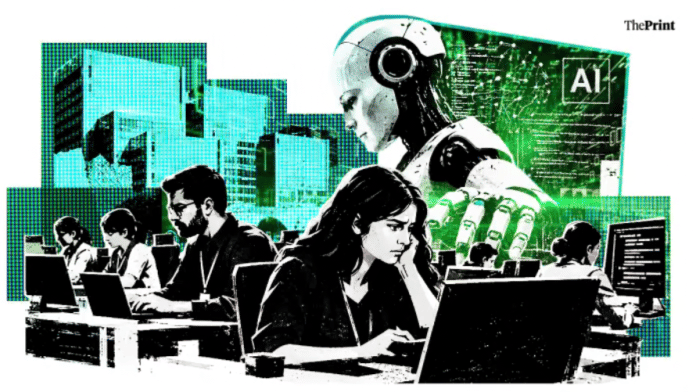
New Delhi: Deutsche Bank has warned that artificial intelligence could do to India’s outsourcing jobs what factories in China once did to factory jobs in the US and Europe. In the same report, it said those fears were “overdone”.
After China joined the World Trade Organisation (WTO) in 2001, its factories could make goods for far less than factories in the West. Towns across the US and Europe lost millions of jobs, and most never came back. Economists call it the “China shock”.
India built its IT and outsourcing business the same way, by doing work for the West at lower cost. AI can now do much of that work for even less.
The report, ‘Who really wins from AI? Ask India’, released by the bank’s Research Institute on 19 November, comes at a time when TCS has 23,460 fewer employees than it did a year ago.
“As markets agonise over who will win the AI race, India is quietly testing whether it even matters,” analyst Adrian Cox wrote in the report.
What the jobs data shows
India handles about 40 percent of the world’s business-process outsourcing. That covers call centres, coding, software testing and back-office work, which AI tools are already doing in many companies.
Deutsche Bank, however, said the numbers did not point to a collapse yet. The tech sector employs 5.8 million people, less than 1 percent of India’s workforce.
Tech job openings touched 130,000 this month, up 27 percent from a year ago, according to staffing firm Xpheno. A survey of 650 IT companies by think tank Indian Council for Research on International Economic Relations (ICRIER) found “no evidence to support apocalyptic predictions” of job losses. What it did find was slower hiring of freshers.
That slowdown worries the bank too. If companies stop hiring juniors now, it says, they could run short of senior engineers a few years down the line. Nasscom expects 12 to 18 months of slower growth while firms move to AI-based work.
The US has made things harder. On 8 October, the Department of Labor barred eight companies, including Infosys, TCS, Wipro, HCL Technologies, from the Program Electronic Review Management (PERM) scheme, citing a probe into possible visa fraud.
The bank sees a silver lining here. The number of top AI researchers leaving India peaked in 2022 and has dropped since, as the US has tightened its doors.
Investors appear to be reading the situation in two ways. Foreign investors have bought $9.5 billion worth of Indian shares in November, a record for any month, after pulling out $26 billion between January and September. But they have largely skipped IT stocks. The Nifty IT index has fallen about 4 percent this month, while the Nifty 50 has risen nearly 10 percent.
Also Read: Humans no longer needed? OpenAI says its AI agents are now helping build future models
Why India doesn’t need to build AI
The bank’s larger point is that India can profit from AI without inventing it.
The US and China make nearly all the models and chips. American tech companies are spending around $800 billion on data centres this year, and the figure is expected to cross $1 trillion next year. India has less than half a percent of the world’s GPU computing power. The US has three-quarters of it, China 14 percent.
According to the report, every dollar the two countries spend to bring down the cost of AI ends up helping buyers like India. Since India is not tied to either side, it can bargain with both. If the race to build superintelligence leaves the US and China with more data centres than they can use, the report said, “all the better for India”.
That said, India is building some of its own. Under the IndiaAI Mission, the government has set aside over Rs 10,000 crore for computing power, data and skills. On 3 November, it released three models developed by Soket Labs and ZenteiQ. One of them, EKA-1, works in all 22 scheduled languages. The other two can run on a phone without an internet connection.
Reliance has announced $110 billion of investment over seven years, and Adani $100 billion by 2035. Amazon, Microsoft and Google have together committed $67.5 billion. Property consultant JLL expects India’s data centre capacity to triple to 6 GW by 2029.
The 1.5 billion advantage
Earlier this month, OpenAI CEO Sam Altman told podcaster Raj Shamani that India has more ChatGPT users than the US. In February, he put the figure at 100 million weekly users, second only to the US. On the same podcast, he said Americans were “unusually negative” about AI.
Data from the University of Melbourne and KPMG puts India first in the world on trust in AI and on its use at work.
The report said India can roll AI out on systems it has spent a decade building, like Jan Dhan accounts, Aadhaar, cheap mobile data and UPI. In 2014, just over half of Indians had a bank account; today it is close to 90 percent.
It gave the example of a bank that uses AI to chase borrowers who miss loan payments. The system talks to each borrower in their own language, decides whether to call or text and at what time, and gets firmer if the payment still doesn’t come. The bank recovers more money with the same staff, and so it can give out more loans.
Agriculture is another area. Pests and disease destroy roughly 30 percent of India’s crops every year, and Indian farms produce about half as much per hectare as American ones. In June, Syngenta tied up with Annam.AI to build tools that forecast pest attacks and heat stress. These are meant to reach 150 million farmers for free.
And, there are problems the report doesn’t play down. Only 23 percent of formal businesses in India use AI, compared with 43 percent in the US. A Mercer study found that only 43 percent of graduates were ready for a job straight out of college. The Ministry of Power expects AI data centres alone to add over 26 GW of electricity demand by 2031-32, around 7 percent of peak demand.
For now, Deutsche Bank sees Indian stocks as a hedge for investors worried about swings in AI stocks. That appeal, it said, would fade if AI stocks bounce back.
(Edited by Tony Rai)
Also Read: UP’s AI platform tender allows private AI models, sets rules on government data use