


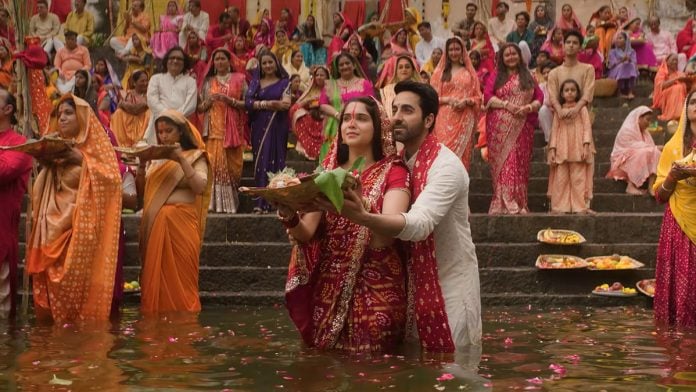
Sooraj Barjatya’s new film, Yeh Prem Mol Liya, released in theatres Friday. Its lead character Prem, played by Ayushmann Khurrana, decides to move in with his wife’s family, taking his own family along. The movie also stars Sharvari and earned about Rs 5 crore at the box office on opening day.
ThePrint asks: Is Sooraj Barjatya’s ‘Yeh Prem Mol Liya’ woke, or just another joint family drama?
Barjatya’s Yeh Prem Mol Liya starts with an interesting, progressive idea. It questions conventional marriage norms and the expectation that women must always adjust after marriage. The director deserves credit for bringing these conversations into mainstream family cinema. The film also attempts to address changing attitudes toward relationships, women’s independence, and the idea of equality within a marriage.
Yet, Barjatya has failed to move beyond his elaborate joint-family drama formula. The familiar Rajshri Productions elements are still very much present, from the pallu and cheesy dialogue to elaborate family gatherings and traditional family values. There is a contradiction between the film’s modern ideas and its conventional presentation. Barjatya questions certain patriarchal conventions, but he doesn’t completely move away from the traditional family structure. The film is a traditional family drama trying to accommodate progressive ideas, as did his earlier films.
To understand Barjatya’s latest film, it is important to look at the larger legacy of Rajshri Productions. Established in 1947 by Tarachand Barjatya, the nearly 80-year-old production house has consistently drawn from Indian religious texts and epics, particularly the Ramayana.
This influence can be traced back to Dosti (1964), which I watched during my childhood on Doordarshan. Despite having no big stars, its emotional core, built around the commitment between two friends, makes it an engaging watch. Rajshri also developed a distinct middle-class cinema, working with filmmakers such as Basu Chatterjee and directors influenced by Bengali literature and storytelling.
When Barjatya made his directorial debut in 1989, Hindi cinema was undergoing a transition. The Amitabh Bachchan era of action films was losing its dominance, while a new generation of stars, including Sanjay Dutt, Sunny Deol, Anil Kapoor, and Jackie Shroff, was emerging. Romantic films such as Qayamat Se Qayamat Tak (1988) had also established a new audience.
The 1990s brought another shift through globalisation and liberalisation, with brands and consumer culture becoming increasingly important. Barjatya understood this changing landscape and presented the joint-family drama through an ideal family rooted in traditional Indian values but also reflecting the aspirations of a changing society.
The Ramayana becomes particularly important here. Barjatya takes his ideal family from the epic and presents ‘Prem’ as a modern-day representation of Ram. He adapts characters, relationships, and situations from the Ramayana into contemporary, urban stories, effectively modernising traditional Indian values.
His first phase, particularly Maine Pyar Kiya (1989), Hum Aapke Hain Koun..! (1994) and Hum Saath-Saath Hain (1999), reflects this approach. These films combine wealthy, business-oriented families with traditional customs and relationships. Hum Saath-Saath Hain makes the Ramayana connection particularly explicit through its characters and references to the Ramcharitmanas.
Weddings, festivals, Karva Chauth celebrations, and family rituals also became central to his storytelling. Much like Ekta Kapoor was doing on television, Barjatya understood the family audience and turned these traditions into an important part of popular culture, creating opportunities for brands to associate themselves with them.
Naren Sahay is an assistant professor of Film Studies at the Delhi School of Journalism. Views are personal.
(By Harsh Tiwari)
Also read: Yeh Prem Mol Liya gives the bride a choice, but doesn’t give her a voice
Also read: Yeh Prem Mol Liya would be truly woke if Prem left his family to live with his wife