








New Delhi: The standard post-tournament recipe of bizarre claims and sheepish put-downs runs out as former Pakistan cricketers praise Team India’s performance and the system behind it.
India won at Ahmedabad, but the spirit of the game seems to have triumphed across borders. The home team’s steamroller win over New Zealand in the ICC T20 World Cup 2026 final in Ahmedabad didn’t spawn the usual recriminations and hand-wringing across Pakistani media panels, with post-match discussions staying largely balanced and respectful.
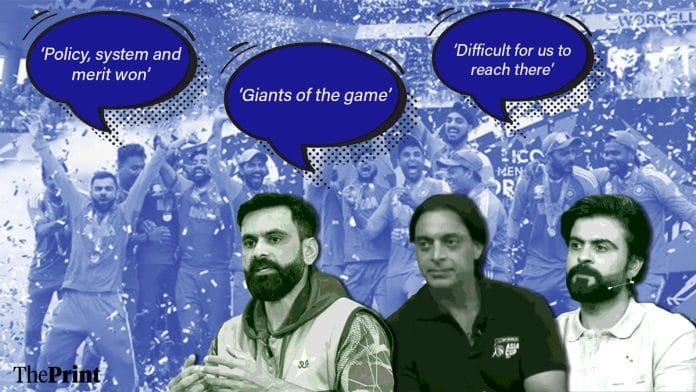
The pitch kept true: gone was the drama, and gone was the standard seasoning of bizarre claims. Most experts focused on analysing how Indian cricket has evolved and where teams like Pakistan and even New Zealand have fallen behind. Former Pakistan fast bowler Shoaib Akhtar set the tone with his opening spell on Outside Edge, the post-match analysis show. “Their policy, system and merit have won,” is what he opened with.
Fiery pace was replaced by gentlemanly accuracy. “If the 2027 world cup is available today, please take it,” Akhtar said, emphasising how far ahead Indian cricket has pulled. India’s strong cricketing ecosystem became the focal point of these discussions. Akhtar praised the rapid growth of India’s administration and highlighted the investment made in infrastructure, stadia, policies and grassroots development.
Former Pakistan captain Mohammad Hafeez went further, comparing the current Indian side to Australia’s golden era team. “They have won four trophies in the last two years in different conditions. This is not a conditional team; it reminds us of the great Australian team of 1999, 2003, 2007 which was ahead of the game and others would chase it… must watch and learn from them,” Hafeez said. “They have become the giants of the game in the cricketing world,” he added.
On another show, the indelicately named Haarna Mana Hai hosted by Tabish Hashmi on Geo News, former Pakistan cricketer Ahmed Shehzad directly compared the two teams. He said that while Pakistan has plenty of talent, it lacks the strong structure and discipline that India has built over the years. Shehzad, who has backed India throughout this campaign, unlike his co-panelist and former Pakistan bowler Mohammad Amir, also praised India’s domestic cricket system. He added that Pakistan should stop celebrating wins against lower-ranked teams like Zimbabwe, Uganda and Kenya, and focus on building a stronger cricketing structure instead.
“Now, what level of cricket are you playing in Pakistan? And you just keep doing this, calling Zimbabwe and beating them, calling Kenya and beating them, calling Uganda and beating them,” Shehzad said. He suggested that Pakistan should have separate ICC rankings against weaker teams like Zimbabwe, Kenya, and Uganda, instead of competing against top teams like India, Australia, and England. “Make our rankings separate, in which there is only Kenya, Uganda, Zimbabwe,” he said.
Also Read: How ‘underdogs’ Shivam Dube, Axar Patel powered India’s T20 World Cup win
Medical system as important as cricket
Jasprit Bumrah has always earned praise from Pakistani cricketers. Many call him a once-in-a-generation bowler. Akhtar, for instance, described him as a “honest fast bowler” who is “unplayable”. But this time, the discussion around Bumrah was not just about his skill. It also focused on how well the Indian system has managed his career, and how Pakistan’s medical and management systems have contributed to their own struggles.
Former Pakistan cricketer and coach Saqlain Mushtaq pointed out that when Bumrah suffered a back injury during the Australia series in January 2025, the Indian management carefully handled his recovery and workload. According to Mushtaq, back injuries have ended the careers of many fast bowlers, including those from Pakistan.
“If Akhtar was used well, he could have played for a couple of more years. He could have done wonders,” Mushtaq said.
Panelists also stressed that Pakistan needs serious medical reforms in its cricket structure. They said proper rehabilitation systems must be built within the country’s cricket framework. Mohammad Hafeez shared his own experience. When he suffered a groin injury, he said the PCB’s medical head told him to either quit cricket or continue playing through the pain. “I invested in myself. When I got the treatment outside, got my surgery done and came back and played just the way I used to,” he said.
Hafeez added that proper medical care can save the careers of talented cricketers and criticised the system, saying PCB officials often don’t even know the difference between a physio and masseur.
The discussion also touched on India’s strong batting performances. After a disappointing outing against South Africa where India were bowled out for 111, the team bounced back with 255 against Zimbabwe, 253 against England in the semi-final and 256 against New Zealand in the final. If the 195-run chase against West Indies is included, Indian batters scored about a thousand runs in their last four matches of the tournament.
“There is no rigidity in their plans,” said former Pakistan cricketer Sana Mir. She explained that when India’s original playing XI did not work as expected, the team made changes by bringing Sanju Samson into the side. The impact was immediate, as Samson ended up winning the Player of the Tournament award despite playing just four matches.
The panel also repeatedly spoke about the respect India’s dressing room shows towards its former players. Akhtar said that the team management invited three former captains — Kapil Dev, MS Dhoni and Rohit Sharma — to be around the squad. Sana Mir also referred to Samson’s post-match interview, where he spoke about staying in regular touch with Sachin Tendulkar for guidance.
“Why should such systems not lift world cups? Where you respect your heroes, let them go on their own terms. They deserve to win,” she added.
‘Pakistan cap has become easy’
Former Pakistan cricketer and coach Rashid Latif called India’s cricket of “highest level”, especially in the last two matches. “It is difficult for us to even reach there,” he said on Haarna Mana Hai.
Latif has been a constant presence on the show during the ICC World Cup 2026 campaign. Latif often praised India’s batting line-up, particularly Sanju Samson and Ishaan Kishan: when co-panelist Amir called Abhishek Sharma a “slogger” for getting a duck against USA, Latif said he “wished Pakistan had two sloggers like him”.
Amir usually backs the team playing against India. But even he couldn’t hold back this time around. For him, India broke the myth that fast bowlers win tournaments; batting prowess can also do the same, he said, highlighting how India put up a 250+ score. “New Zealand couldn’t handle the pressure. I have never seen them under so much pressure in my life,” he said.
Comparing India and Australia, Shahzad was brutal, pointing out that Australia isn’t getting talent lately. He backed his statement with the fact how Australia brought Matt Renshaw who is a proven Test player, and how their T20 squad includes old players like Glenn Maxwell.
“They don’t have talent. Pakistan has but the system is flawed. They (India) have both talent and system,” he said. Amir also highlighted India’s clarity in terms of team selection according to format. “Don’t make a khichdi. Keep T20 players in T20. But Pakistan brings Test players in ODI, and ODI players in T20. You will see an entirely different team of India in ODI, Rohit will be there, Virat, Jadeja, Iyer and Gill will come in. Had we won, our same team would have gone for the ODI,” he explained.
The Haarna Mana Hai trio also discussed how entry into the Indian squad is tough, as a player like Kishan was dropped on disciplinary grounds. He got a place in the squad for the 2026 World Cup only after he proved himself in the domestic circuit. But, according to them, there are a lot of short-cuts to enter the Pakistan team, hence the craze around the sport has gone down among the public. Shehzad also pointed out how, in Pakistan, some players manage to break into the national level after playing just a handful of matches.
“I can take you, you play three matches and you can come in Pakistan’s team… this is what it is. Our journey hasn’t been anything like this… we started playing from the age of 13,” Shehzad said, before being interrupted by Amir. Without naming anyone from the current squad, the former Pakistan cricketer also recalled a conversation with a player who had admitted that “Pakistan’s cap has become very easy”.
(Edited by Nardeep Singh Dahiya)