





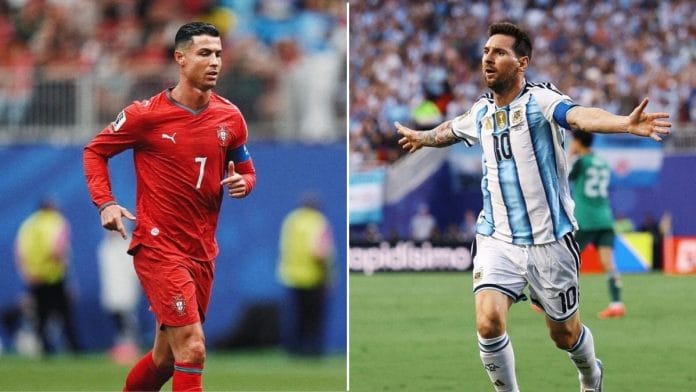


New Delhi: As Lionel Messi and Cristiano Ronaldo began what is likely to be their final FIFA World Cup campaigns, their opening matches offered a glimpse into how two of football’s greatest players have adapted to the realities of age. While the goals tell one story, the movement tells another.
Argentina’s 3-0 victory over Algeria belonged to Messi, who scored a hattrick within 80 minutes. Portugal’s 1-1 draw against DR Congo featured an ineffective Ronaldo, whose influence was felt more in his positioning than in the final outcome.
The numbers provide an interesting starting point. Messi covered 6.81 km in his 80 minutes on the pitch, a figure that projects to roughly 7.33 km over a full match. Ronaldo covered 7.41 km across the entire 90 minutes.
These distance figures highlight a classic contrast in playstyles between the two legends, showing Messi’s highly efficient, playmaking-focused movement compared to Ronaldo’s greater physical ground coverage. On paper, the difference appears marginal. On the field, however, the contrast in how that distance was covered was striking. These numbers are a far cry from their numbers (closer to 8 and 9 km per match) in the earlier world cups.
The divergence is less about effort than about effectiveness.
The change in movement
Messi’s 6.81 km were notable not for their volume but for their timing. Rather than constantly seeking possession, he often remained on the fringes of play before appearing in dangerous areas when Argentina attacked. His hattrick was as much about anticipation and positioning as it was about flawless execution. At 38, Messi no longer dominates matches through relentless involvement. Instead, he increasingly shapes them through carefully chosen moments.
Much of the workload he has relinquished—dribbling, carrying the ball from midfield into advanced areas, and repeatedly driving at defenders—has been absorbed by Rodrigo De Paul, Lautaro Martínez and Julián Álvarez. Their relentless running, decoy movements and off-the-ball work create spaces from which Messi can operate. While Messi’s projected full-match distance was 7.33 km, his supporting cast covered around 35 km between them, ensuring that Argentina’s captain remained fresh and creative for as long as he was on the pitch.
Ronaldo’s 7.41 km reflected a different role altogether. Portugal largely stationed him in advanced positions, where he operated as a focal point for attacks. Rather than dropping deep to knit moves together or carrying the ball over long distances, he spent much of the match occupying defenders and searching for openings inside and around the penalty area. His movement was concentrated, purposeful and largely confined to the spaces where Portugal hoped chances would emerge.
The contrast was evident in their output. Messi registered five shots, four of them on target, and converted three. Ronaldo managed three attempts but failed to test the goalkeeper. One repeatedly arrived at decisive moments; the other spent much of the evening waiting for them.
Yet reducing the comparison to statistics alone would miss the larger story.
Also read: Canada’s tactics contrast European, South American teams. Its 6 goal in World Cup is proof
The Messi-Ronaldo influence
What stands out is how both players have evolved without surrendering their importance. Neither is asked to perform the all-action role that marked their peak years. Instead, Argentina and Portugal have built systems that maximise their strengths while limiting unnecessary physical demands.
For Argentina, that means preserving Messi’s ability to influence matches in decisive attacking phases. For Portugal, it means positioning Ronaldo where a single chance can still alter the course of a game.
What emerges is not a competition between greats, but two different paths to the same solution. Neither Messi nor Ronaldo can play today as they did a decade ago. Yet both remain central to their teams’ ambitions because they have adapted rather than resisted change.
Messi’s influence now comes in concentrated bursts. Ronaldo’s influence rests on positioning and presence inside the penalty area. Different methods, perhaps, but both are reminders that football intelligence takes over when speed drops.
(Edited by Saptak Datta)