





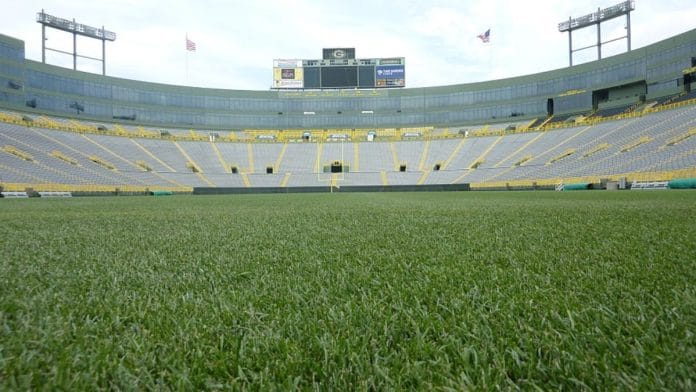

New Delhi: The 2026 FIFA World Cup has been living up to its expectations with Canada walking away with a stoppage-time winner against South Africa in their Round of 32 clash at the Los Angeles Stadium early Monday. However, beneath the surface at these dramatic finishes, there is another lesser-known story, under the players’ cleats—a specially grown natural-grass pitch that has travelled hundreds of miles to be in North America this summer.
According to TIME, it took seven years to specially engineer the grass for this year’s FIFA World Cup. One may wonder why the grass had to be “engineered”, given that most stadiums in use at the tournament have been around and functional for years. But as it turns out, they were designed and built for American football, and not soccer.
As a result, eight of the 16 stadiums in use in the US have artificial turf, and not grass, covering the pitches. FIFA mandates that pitches for the FIFA World Cups be covered in natural, living grass. On top of that, five stadiums, including the Los Angeles Stadium, have a roof, which is not ideal for growing grass.
Carpet hybrid grass in the World Cup
So what has FIFA done to work around this logistical hurdle to football’s biggest event? They specially designed a variety of grass that is suitable for hosting matches of the showpiece event.
“It’s called a carpet hybrid,” said Justin Lang, FIFA’s Pitch Venue Manager, in TIME’s video. “We grow it on a sod farm in Washington state. It’s a 19-hour truck drive (from Los Angeles), and it’s been on the sod farm for 12 months.”
This grass is a unique hybrid variety—5 per cent artificial and 95 per cent natural grass.
After the grass is harvested, it is transported to the stadiums inside refrigerated trucks. Once it reaches the football field, it is laid out by the team of specialists and officials.
“It’s pretty much ready-to-play turf,” added Lang.
Also read: Africa’s World Cup moment arrives. 9 teams qualify for Round of 32 in historic first
‘We treat this as our children’
This grass is the result of an intense collaboration between several universities, who had to get the science absolutely right to match up to FIFA’s strict norms.
“The grass is artificial at the bottom, and that helps stabilise the product,” Lang said.
Managing this specially cultivated grass does become a bit of a challenge for the pitch managers at the event.
“So you can imagine when you harvest it (the grass) at the farm, roll it out, put it on a truck, bring it down, lay it out, it could become a little bit unstable,” Lang said.
Apart from there not being much rainfall at the World Cup venues this summer, the roofs at many of the stadiums mean that sunlight often cannot travel all the way down to the pitch. Even when transparent roofs do allow some light to go through, it is a reduced amount. Here, the specialists and officials step in, and the venues of this year’s event have artificial light rigs around the pitch to “supplement any deficiencies in sunlight.”
Every day, especially before a game, pitch managers also thoroughly inspect their fields for hardness, traction, and moisture. During matches too, they keep a watchful eye on the proceedings.
“We treat this almost like one of our own children,” Lang said.
(Edited by Saptak Datta)