





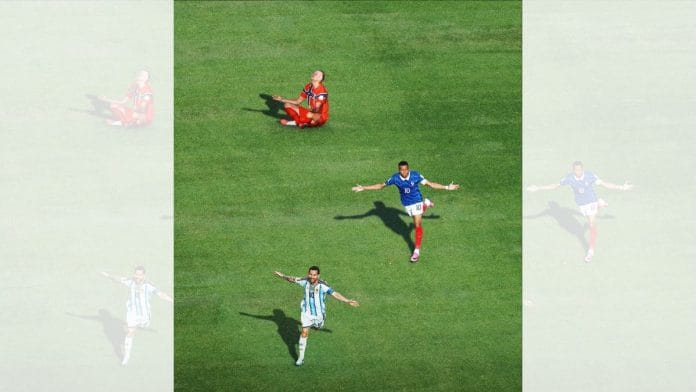


The 2026 FIFA World Cup is almost at its end. Curtains will be drawn on 39 days of non-stop drama, highs and lows after Argentina faces Spain in the final early Monday. While politics, propaganda and provocation tried to grasp this edition, in the end, it was football that had the last laugh.
This year, the world’s biggest football tournament has had its fair share of geopolitics and off-field controversies. It’s nothing new; football has always been political. But as always, the spectacle on the pitch trumped all the noise.
The 2026 World Cup, co-hosted by the US, Mexico and Canada, is happening at a time when immigration is the biggest issue in American politics and wars are reshaping global alliances. On 11 June, even before the first whistle was blown, many people (who only follow football on reels) had given their verdict—the game would not remain the main attraction this year.
It was a genuine concern. What else could be expected when US President Donald Trump loomed over the tournament? From strict security protocols for certain teams, especially Uruguay and Iran, to voicing his concern over a red card in the US national team. Notably, the red card was overturned by FIFA just before the US faced Belgium in the knockout rounds, marking a significant decision from the football body.
Nonetheless, after thumping the US, Belgium mocked the host nation with an “overturn this” post, and on-field players celebrating with a Trump-style dance. Politics may have made headlines for a few hours, but Belgium’s football made it into the history books.
Trump was not the only American to give his “expert comments”. New York Mayor Zohran Mamdani also pitched in when Argentina sent Egypt home after overturning a 2-0 deficit, winning 3-2, to qualify for the quarter finals.
After the match, he said, “Egypt were robbed yesterday.”
He should stay in his own half. After all, his Left wing is causing enough defensive problems already.
The World Cup, however, reminded them, at each turn, that it was all about football.
Also read: Why France’s 2026 World Cup ended without a medal despite a star-studded attack
Iran to Argentina
Iran’s team arrived at the tournament when the country is at war with the host nation. The result? It was not allowed to camp in the US. It had to set up its base in Mexico with strict after-match protocols.
The war shaped Iran’s World Cup preparations. But, football shaped its exit.
With three draws, Iran were unbeaten in the group stage, but could not qualify for the knockout stages. By the time their campaign ended, fans were debating missed chances rather than missile strikes on West Asia.
Meanwhile, defending champions Argentina had to face a difficult high-line counter-attack both on the pitch and off the field. Every deserved win from them was followed by a wave of conspiracy theories. Every decision involving the defending champions became “proof” that FIFA had already decided who would lift the trophy. Edited videos circulated within minutes and fake clips surfaced as “new” evidence.
La Albiceleste’s victories once again brought familiar accusations that referees were favouring Lionel Messi. Rest assured, these people have never seen an entire match and rely only on Instagram reels.
It’s understandable. He is 39 and doing things that your idols can’t even imagine.
Football had the last laugh with each of Argentina’s knockout stage late wins.
And, this is the beauty of the 2026 FIFA World Cup. Not the hashtags, not the online rage, but the stories woven in each match, which will stay with the fans for the rest of their lives.
Also read: FIFA unveils special ‘Championship Rings’ for 2026 World Cup winners
Cabo Verde to Lionel Messi
The biggest success story in the 2026 FIFA World Cup is undoubtedly Cabo Verde, a small island nation with a population of 5.5 lakh. It’s the only team to hold finalist Spain scoreless for 90 minutes. Even Argentina could only edge it out in extra time. Then there was Morocco, which proved that its fairy tale run in Qatar was not a one-off campaign.
Norway reminded everyone why underdogs remain central to football’s appeal, while African teams collectively showed that the gap separating them from Europe’s elite continues to shrink.
These stories mattered to football because they were genuine. They didn’t have an agenda.
Then came the individual brilliance that fans have drooled over for a month.
Spanish teenage sensation Lamine Yamal showed that football’s future has already arrived. Yamal, who turned 19 on 13 July, played with confidence, carrying Spain into another final while making even elite defenders look ordinary.
On the other hand, stood Messi, who pulled off his best World Cup performance at 39. With eight goals and 25 chances created, Messi proved age is just a number. He still sees passes others cannot, he still changes the momentum right at the end of the match.
Kylian Mbappe became the highest goalscorer in the tournament, after netting twice against England in the third-place match. Erling Haaland finally got his chance to prove his worth at a World Cup.
Record attendances, dramatic extra-time winners, penalty shootouts and impossible comebacks reminded everyone why the World Cup remains unmatched as a sporting spectacle.
When fans look back at the 2026 tournament, they will remember Cabo Verde refusing to accept its defeat, they will remember Morocco’s resilience, they will remember Yamal announcing himself to the world, they will remember a vintage Messi, and they will remember the Copa America and Euro champions walking out for their first-ever clash at the World Cup final.
When the final whistle blows early Monday, politicians, wars, immigration debates, political statements and online conspiracy theories will be pushed back where they belong—to the sidelines.
Views are personal.
(Edited by Theres Sudeep)