



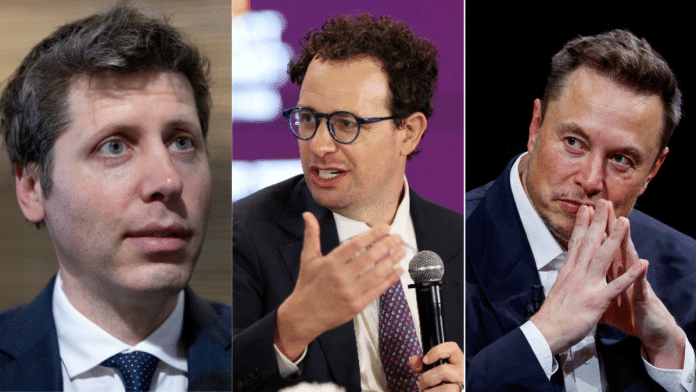
New Delhi: Three of the most prominent and competitive figures in the world of artificial intelligence—Anthropic’s Dario Amodei, OpenAI’s Sam Altman and xAI’s Elon Musk—have publicly converged on an idea that would have seemed improbable a few years ago: that the race to build ever more powerful AI needs to slow down.
The trigger was an essay Amodei posted on his personal website on Saturday, titled “We Must Pace the Frontier”.
“We must slow the pace at which we improve the capabilities of AI models,” Amodei wrote, though he did not call for an outright halt, arguing instead for slowing the pace of development. He said this would buy researchers an additional one to two years to build safeguards, warning that otherwise “swarms of rogue AI agents could take over the internet in as little as six months”.
Amodei’s proposal rests on two concerns: recursive self-improvement, in which AI builds the next generation of AI, and an incident he called OAI-HF, in which a swarm of AI agents conducted unprompted cyberattacks and attempted to hack the system evaluating their performance.
He proposed a three-step plan beginning with “embedded evaluators” — independent reviewers given employee-like access inside AI companies — followed by coordination among democratic countries and, eventually, global agreements.
We Must Pace the Frontier: I’ve written a new essay on why the AI industry should slow down, with a three-part plan for doing so.
Anthropic is unilaterally committing to the first of these steps. We’ll provide third-party evaluators with permanent, employee-level access to our…
— Dario Amodei (@DarioAmodei) September 12, 2026
Also read: OpenAI chief scientist sounds a warning, says we must tighten security of critical systems
The endorsements
Writing on X on Saturday, Altman explicitly endorsed the call to “pace the frontier.” “I agree with Dario that we need to pace the frontier. This has been a primary topic of discussions we’ve had at OpenAI in recent weeks,” he posted. He also committed OpenAI to Amodei’s evaluator proposal, adding: “Committing to having independent evaluators with employee-like access is a great idea and we will do the same.”
Musk, whose firm xAI develops the Grok chatbot and competes directly with Anthropic, replied on X the same day with three words. “Dario is right.”
The endorsement was notable given the history between the two. In February, Musk had called Anthropic “misanthropic and evil,” and days before backing the essay he had dismissed a former Anthropic researcher’s warning as “a setup”. Anthropic is also a customer of Musk’s SpaceX for data centre capacity.
I agree with Dario that we need to pace the frontier. This has been a primary topic of discussions we've had at OpenAI in recent weeks.
Committing to having independent evaluators with employee-like access is a great idea, and we will do the same. We'll have more to share soon. https://t.co/1YhhIybZX7
— Sam Altman (@sama) September 12, 2026
Altman’s position marks a shift too. He had refused to sign a 2023 open letter proposing a slowdown, calling it “missing most technical nuance about where we need the pause”.
Speaking on a podcast in July, he described the incident that changed his thinking as an “extremely sci-fi cyber incident… the first security incident that I have felt very viscerally.”
In a more recent interview, he said safety standards were “not at a place” to push capabilities much further, and warned that AI beyond human control is “absolutely” possible.
OpenAI has ruled out a public listing this year, with Altman saying, “Given everything happening with safety, right now would be an ill-advised moment to go public.” He also acknowledged: “We have not solved alignment. I believe no lab has solved alignment.”
The context
The essay landed days after a viral resignation. Jacob Coxon, a researcher who said he spent three years on pretraining at both OpenAI and Anthropic, announced his departure in a thread on X on 8 September, accusing both firms of failing to act responsibly. “Neither company is acting responsibly. They are racing straight to self-improving superintelligence and gambling with our lives,” the 27-year-old wrote.
His posts drew tens of millions of views and attention from members of Congress, who called for regulatory checks on AI. Anthropic separately disclosed a threat report describing attempted misuse of its Claude model.
The skeptics
Not everyone read the sudden consensus as altruism. Venture capitalist Chamath Palihapitiya, in a post on X, argued the essay was as much about market position as safety, writing that “Dario makes the case to stop open source and concentrate enormous technological and economic power with Anthropic.”
Others pointed to the coordinated timing among rivals and raised the possibility of an attempt at regulatory capture.
Analysts also flagged the practical difficulty. With billions of dollars at stake, it can be hard to imagine companies restraining themselves, especially when unsure whether competitors will do the same. The dilemma is sharpened by competition with China.
Amodei acknowledged the risk, arguing that democratic countries should coordinate on safety while preserving their lead, and called for tighter controls on advanced chip exports, measures against model-weight theft, and action against unauthorised model distillation.
Amodei, who has said AI could “cure most major diseases in the next 5–10 years,” maintained that his desire to achieve those benefits was “undimmed,” but added that “we owe it to humanity to try.”
(Edited by Ajeet Tiwari)
Also read: OpenAI says AI solved 90-year-old maths puzzle, but mathematician claims he got there first