





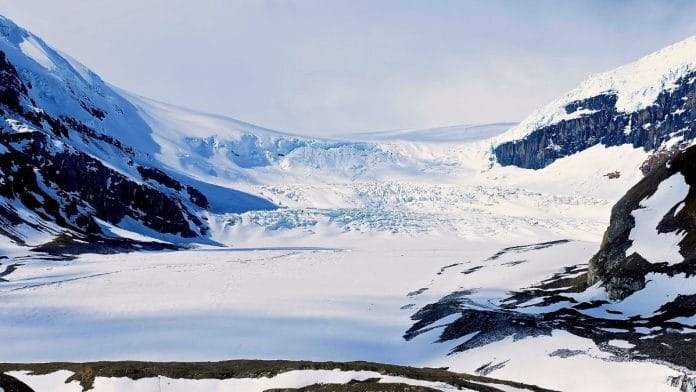

New Delhi: Some of the world’s highest peaks and mountainous slopes are held together by a special type of natural glue — cryospheric glue. It is made up of ice, soil, gravel, sediment, and fractured rock, and binds the ground together, acting like cement between bricks. Except that as the earth warms, this natural glue melts. Several studies have shown that the rise in hazardous events across high altitudes might be caused by this melting glue.
Recently, on 26 August, Nepal witnessed one of the deadliest floods in the country’s recent history, leading to over 1000 deaths and several thousand missing people. The floods were caused by an ice-rock avalanche that devastated the valley downstream.
While several scientists have pointed to melting glaciers and global warming as the reason behind such disasters, the science behind such destabilized ecosystems is quite straightforward — the very substance that has held them together for centuries is now giving way.
The cryosphere is what geologists call the Earth’s ice. When land remains at or below 0°C for at least two consecutive years, a permafrost forms, and cryospheric glue seeps into the pores and cracks between soil or rocks. As it freezes, it binds the ground and stabilises the steep slopes, debris, and other natural infrastructure in the mountains.
Much of instability in high altitudes is the result of the thawing of this natural glue. As the ice turns into water steep slopes grow heavy, dense, unstable and can trigger landslides and other hazardous events.
In mountainous architecture, ice-rich permafrost act like structural support. When this permafrost melts the result is more than just frozen ground turning into mud. This is particularly disastrous if roads or other human infrastructure has been built on the permafrost.
“The warming and thawing of ice-rich permafrost pose considerable threat to the integrity of polar and high-altitude infrastructure, in turn jeopardizing sustainable development. Observed infrastructure damage is substantial, with up to 80% of buildings in some Russian cities and ~30% of some road surfaces in the Qinghai–Tibet Plateau reporting damage,” read a 2022 study on the impacts of permafrost degradation.
When such ice melts, the ground does not sink evenly. It creates sudden depressions also called “thermokarst”. Some of these fill up to create ponds and lakes. During NASA’s fieldwork in the arctic, it found that melting permafrost has created methane-rich ponds which are hotspots for greenhouse gas emissions.
The warmer temperatures also increase microbial activity that feed on dead plants and other thawed organic matter.