





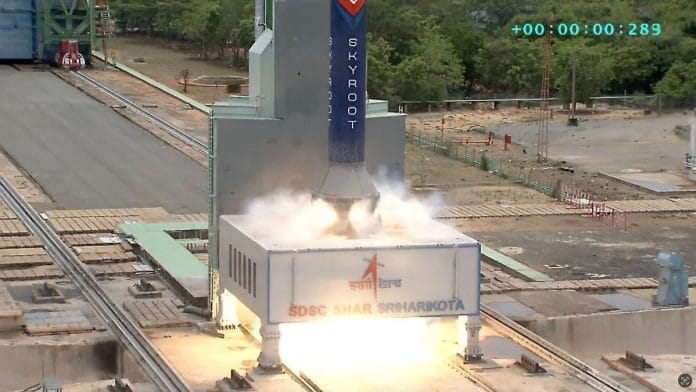


New Delhi: In a first for the Indian private space sector, Skyroot Aerospace’s Vikram-1 rocket successfully launched from Sriharikota and reached the Low Earth Orbit on Saturday morning. This is the first private rocket launched from India, and it was Skyroot’s second successful launch.
After the launch, Prime Minister Narendra Modi, who was watching the launch virtually, called Skyroot co-founder Pawan Kumar Chandana to congratulate him.
“With this achievement, not just in space, on the ground too, you have strengthened the roots that will give Indian youth motivation,” PM Modi told Chandana after the launch. “I congratulate you and your team for this grand endeavour.”
“Since your handwritten card is in space, Vande Mataram is in orbit,” said Chandana in response.
PM Modi also took to X to announce “a historic new frontier for India’s space journey!”
“This mission highlights the talent, determination and entrepreneurial spirit of our youth,” he wrote.
The launch event, from ISRO’s Sriharikota launch pad in Andhra Pradesh, attracted dignitaries such as ISRO Chairman V Narayanan, INSPACe Chairman Pawan Goenka, former ISRO Chairman S Somanath, and astronaut Shubhanshu Shukla. Union Minister of Science and Technology Jitendra Singh joined the launch event on video call.
Congratulating Skyroot on the successful launch, Singh said that this was an reiteration of India’s grand entry as a global space power.
“Today’s feat was achieved because around five years ago, Prime Minister Narendra Modi took a heroic decision to open up India’s space sector to private players,” the minister said, adding that this was only the beginning of India’s promising space journey in the coming years.
Vikram-1, a four-stage, seven-storey rocket designed and built indigenously by Skyroot, took off at 12:05 pm on Saturday, 35 minutes after its designated launch time of 11:30 am.
About 20 seconds after the lift-off, the rocket conducted a pitch manouevre, which enabled it to tilt toward its desired orbit, rather than going straight.
Two minutes later, it officially entered space, which means it crossed the Karman line i.e. 100 km above sea level. As it continued to accelerate, the rocket burned off two of its stages after utlising the fuel, to make the rocket more efficient and lighter.
After completing its different stage separations and orbital insertion burn, it reached its orbit, at an altitude of 450 km above Earth, at 11:45 am.
The rocket is carrying six different test payloads from Indian and foreign companies, including two payloads from a German company Dcubed. There is also a lab-grown diamond called Cosmic Bloom by Indian company Cosmos Diamonds, as well as a miniature 18-karat gold rocket made by Telangana artists.
With this launch, Skyroot became the first company after the Indian Space Research Organisation to be able to launch rockets in India. After the first Vikram-I launch, the company has also planned multiple other test flights in 2026 and 2027.
“This is a defining moment for India’s private space ecosystem. It is a symbol of India’s rising space aspirations,” said Shubhanshu Shukla, astronaut designate for Gaganyaan Mission, during the launch.
Also read: ISRO is losing scientists to private space sector. How NASA solved this problem 40 years ago
A maiden orbital flight
Vikram-1’s launch was also the first successful launch from Sriharikota this year, and only the second launch attempted in 2026. The other launch was the PSLV-C62 mission, which faced an anomaly in its third stage and eventually failed.
For 8-year-old Skyroot Aerospace, founded in Hyderabad by Pawan Kumar Chandana and Naga Bharath Daka, this was their maiden orbital flight. In 2022, they had launched the Vikram-S rocket, which had reached the threshold of space, but it was a suborbital flight that did not go beyond the Karman line.
Before even launching Vikram-I, Skyroot Aerospace in May 2026 became India’s first space-tech unicorn, after being valued at $1.1 billion. This valuation came after the start-up raised $60 million in its latest round of funding, months after inaugurating its expansive ‘Infinity’ campus to scale up manufacturing of rockets.
After more test flights, Skyroot plans to ready Vikram-I for commercial launches by 2027. According to Chandana, around 80 per cent of their payload customers will be global. From communications to Earth observation, the rocket will cater to all use cases for the Low Earth Orbit and the Sun-synchronous orbit.
Skyroot also has a Vikram-II rocket in the works, which will have a cryogenic engine and a larger payload capacity of 900 kgs. However, the Vikram-II test flight will not happen before the end of 2027.
“This launch is going to change the space sector in a big way,” said S Somanath, former chairman of ISRO, at the launch.
(Edited by Aamaan Alam Khan)