



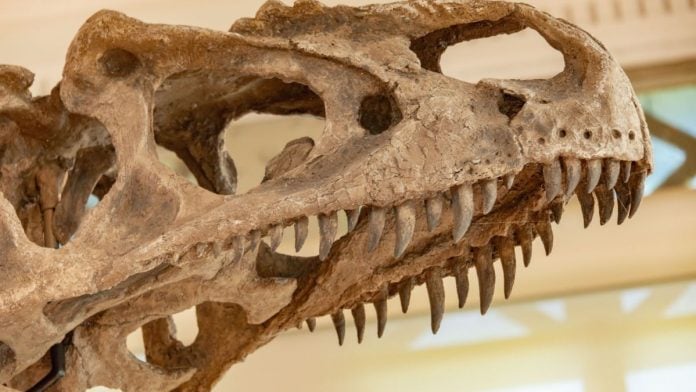
New Delhi: An international team of paleontologists has found a type of dinosaur that preferred eating fruits instead of meat or grass. This newly identified creature, which scientists predict was the size of a turkey, is the first of its kind that had developed chewing muscles to mash soft food.
The dinosaur, called Infernogallus jamesi, meaning “hell chicken”, was a feathered bird that lived in North America around 66 million years ago, towards the end of the Cretaceous period. It belonged to a group of toothless, bird-like dinosaurs called caenagnathids that weighed about 12 kg.
The findings were published in Nature Communications on 10 October by a team of researchers from Stony Brook University, the Royal Ontario Museum and the North Dakota Geological Survey. The team studied the dinosaur’s skull to understand how it ate. They found that the dinosaur had adapted to mash soft, fleshy fruit using an unusual chewing mechanism.
“We knew dinosaurs evolved to fill so many different roles in ecosystems in the Cretaceous, but we never expected to discover fruit-eating dinosaurs. For more than 100 years, we didn’t know what the skulls of these animals looked like. Now, we know they were even weirder than we could have predicted,” lead author Greg Funston, Assistant Professor at Stony Brook University, said in a statement.
Also read: Mice developed Parkinson’s-like symptoms after pesticide exposure. Then they recovered
A skull built for chewing
The discovery began with a rare fossil of a nearly complete skull and parts of the skeleton. Scientists then reconstructed the skull using CT scans which allowed them to digitally examine the dinosaur’s bones and how its jaw muscles might have worked.
Unlike the “up and down” bite of many dinosaurs, this one seemed to have moved its lower jaw backwards and forwards while chewing. The room of its mouth had an unusual shape, which changed the position of its chewing muscles. This resembles the feeding mechanism of today’s fruit eating parrots.
“It’s pretty rare for animals to become specialized for a diet of fruit, so when it happens, it comes with some remarkable adaptations. The anatomy of Infernogallus is bizarre among dinosaurs, and we quickly realized that we were dealing with something special,” co-author Thomas Dudgeon, a postdoctoral research fellow, said in the statement.
During the Cretaceous period , flowering plants grew more popular, making fruits an alternative source of food for animals. Animals that ate these fruits helped spread their seeds and allow the plants to grow in newer areas.
“Complete remains of small dinosaurs like Infernogallus are very rare in the fossil record. The strange skull of Infernogallus is an exciting find because it reveals surprising insights into dinosaur evolution and feeding specialization. This discovery shows that we still have a lot to learn about the world of T. rex, and about dinosaurs more generally,” senior author David Evans added.