


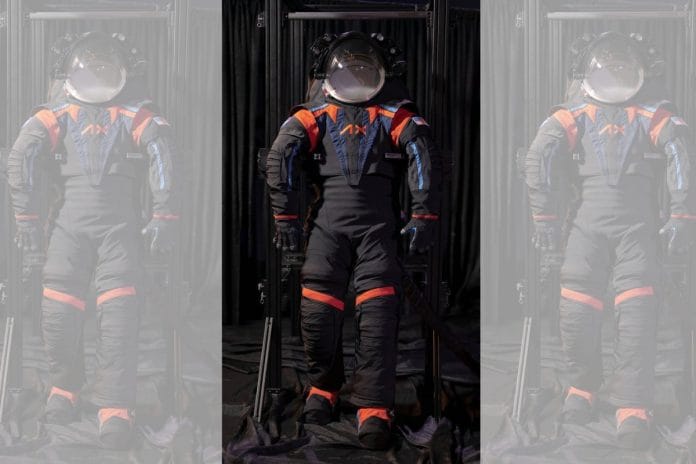
New Delhi: NASA astronauts are a step closer to getting a new generation of spacesuits for missions to the Moon and the International Space Station. Private space company Axiom Space announced on 13 November that it had completed the Critical Design Review of its next-generation spacesuit, the Axiom Extravehicular Mobility Unit, bringing it closer to the production and testing stages required for NASA certification.
The AxEMU is being developed to support NASA’s moon exploration programme, Artemis, and future spacewalks. It is designed to provide astronauts with greater mobility and protection against the harsh conditions of the lunar surface, while accommodating a wider range of body sizes.
A spacesuit for the Moon and beyond
Under the revised Artemis timeline, Artemis III, scheduled for 2027, will test key systems and capabilities in low Earth orbit, including spacesuit technology. Artemis IV, currently targeted for early 2028, is planned to carry astronauts to the lunar surface.
This spacesuit, which will also be worn by the first woman to land on the Moon under Artemis IV, is designed for enhanced mobility and greater protection against the hazards of the Moon.
“NASA’s partnership with Axiom is critical to landing astronauts on the Moon and continuing American leadership in space,” said NASA administrator Bill Nelson in a press release. “Building on NASA’s years of research and expertise, Axiom’s next-generation spacesuits … will open opportunities for more people to explore and conduct science on the Moon.”
Apart from the AxEMU, Axiom Space is also working on the Sortie Spacesuit, which is a slightly different version of the original suit but configured for earlier missions to the Moon. Since NASA’s Artemis Program has five parts, the Sortie spacesuit can be used for the short-duration Moon missions, while the AxEMU is built to withstand longer periods of lunar exposure.
The two configurations are intended to give NASA flexibility to meet the different requirements of individual missions.
Also read: Voyager 1 is nearly a light-day away. NASA’s message will take 2 days to get a reply
What is different about the new spacesuits?
NASA has sent over 300 astronauts to space since 1959, and their spacesuits too have undergone major overhauls. While the garment itself is made of special polymers and stretchable fabrics, NASA spacesuits also include a life-support system attached as a backpack, which has everything from electricity and gas to a carbon dioxide removal system and water coolant necessary to keep the suit running.
The last major upgrade for NASA spacesuits was in 1979, titled the Extravehicular Mobility Unit. This was then upgraded again in 2002, and has been in use since, and has different versions depending on whether it’s a space shuttle flight or a trip to the ISS.
Axiom, which began working on the Ax-EMU in 2025, said that their spacesuit has been designed to accommodate a wider range of the general population and allows for safe extravehicular activities such as spacewalks.
This is the first time that NASA has awarded the contract to a private company to build, own, and maintain its spacesuits, while NASA will only rent them from Axiom for its missions. According to the Axiom press release, their design has incorporated the help of sewers, technicians, engineers, and medical personnel for the Ax-EMU.
Since the Critical Design Review of the spacesuit is over, the next part of the process is to conduct qualification testing. This will be rigorous performance testing, thermal vacuum and vibration testing, as well as additional life-cycle testing, before the suit is ready to be presented to NASA.
(Edited by Maryam Hassan)