


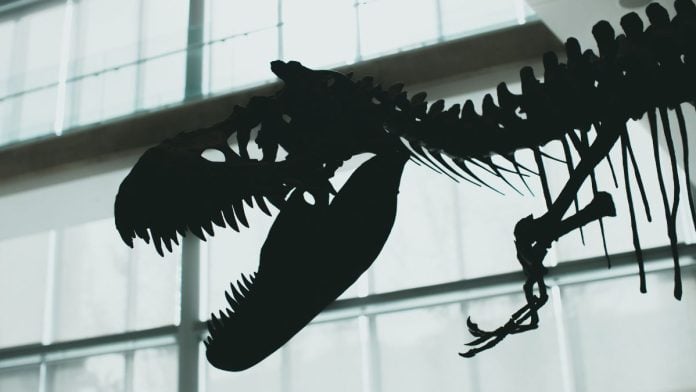
New Delhi: For the first time, scientists have discovered fossilised red blood cells and amino acids of collagen in the leg bone of a 115-million-year old dinosaur.
The team of international scientists including researchers from Australia, Japan, Brazil, and the US published their findings in the Proceedings of the National Academy of Sciences (PNAS) on 2 November. While similar findings have been reported earlier, scientists had struggled to prove that the blood belonged to the dinosaur and not to any other creature.
This time however, scientists observed those molecules under the microscope and used other forms of chemical analysis to make sure that their discovery was indeed dinosaur blood. They even found fossilised blood canals inside the bones.
“To detect intact heme derived molecules in 115-million-year-old red blood cells is astonishing: this really is a landmark discovery. It not only extends the known fossil record of blood, but also offers a direct molecular window into the physiology of long-extinct animals so we may better understand them and the world they lived in,” lead author Kliti Grice, founding director of Curtin’s Organic and Isotope Geochemistry Centre, said in a statement.
Also read: Earth’s frozen regions face centuries of damage if warming crosses 1.5°C
Exceptionally preserved
The fossilised blood belongs to a theropod dinosaur called Aratasaurus museunacionali, whose remains were found in Brazil in 2008. According to the scientists, shortly after its death the dinosaur was buried in a low-oxygen environment rich with microbes, allowing it to be “exceptionally preserved”.
Until this discovery, scientists had long assumed that compounds like blood degrade over millions of years and could not become fossils. Even when they first came across the “blood” they were skeptical. It could have been remains of fungi or any other microbe that had entered the bones of the creature after its death. But they found no filaments, spores, or any such proof.
What they found instead was a lack of contaminants along with the very compound that is a key molecule in blood – heme, the molecule that helps transport oxygen.
“These findings challenge longstanding assumptions that certain biomolecules such as haemoglobin cannot survive deep time. It opens exciting new avenues for molecular-level palaeontology, allowing us to investigate the evolution of blood, metabolism and even activity levels in ancient animals,” Grice said.