


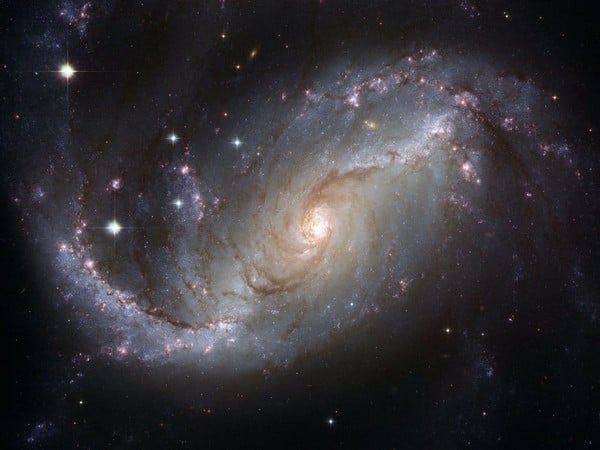
New Delhi: Powerful shock waves near the centre of the Milky Way may be producing new stars in a region, where such activity would ordinarily be suppressed, according to a study that could change how astronomers understand the galaxy’s spiral structure.
Published in Nature Astronomy on 20 November, the study suggests that a group of young, massive stars, previously thought to belong to the Norma spiral arm, may instead be forming along a shock front generated by the Milky Way’s central stellar bar.
By comparing astronomical observations with computer simulations of galactic evolution, researchers at the University of Sydney discovered that the Milky Way may be behaving differently from most other barred spiral galaxies.
Why this is ‘extraordinary’
At the centre of the Milky Way lies an elongated concentration of stars known as the Galactic bar, whose rotation exerts gravitational forces on the surrounding gas. As the gas encounters these forces, powerful shock fronts develop, compressing it in a process similar to the formation of shock waves in air.
Although compression can sometimes encourage star formation, the shock fronts in most nearby barred galaxies are so turbulent that they prevent gas clouds from collapsing into new stars.
Yet, the researchers found evidence of precisely this activity along the Milky Way’s bar shock front, placing it among a relatively small group of galaxies where stars appear to form under such conditions.
Lead researcher Hillary Davis explained in a press release from the University of Sydney that “in most similar galaxies, star formation very commonly occurs along spiral arms. What’s extraordinary is seeing this happen in a different region of our Galaxy, where shocks are usually so strong that star formation is often suppressed.”
The team investigated the phenomenon by examining masers, naturally occurring sources of concentrated microwave radiation associated with the formation of massive stars. When their positions were compared with the shock fronts predicted by computer simulations, the researchers noticed a striking alignment.
Could the discovery change our map of the Milky Way?
Previously attributed to the Norma spiral arm, the masers appeared to follow a shock front along the leading edge of the Galactic bar. This raises the possibility that at least part of what astronomers have identified as the Norma arm is actually a star-forming region associated with the bar itself.
The discovery may also help resolve longstanding uncertainties about the Galactic bar’s size and rotation, both of which are difficult to measure from Earth. Our position within the Milky Way, combined with the dust obscuring its centre, makes it particularly challenging to reconstruct the galaxy’s overall structure.
Based on their simulations, the researchers estimated that the bar extends approximately 14,000 light-years from the galactic centre along its longer axis, supporting the existence of a relatively long, slowly rotating structure.
For now, however, the proposed reinterpretation remains dependent on how well the simulations match existing observations. Additional measurements will be necessary to determine how much of the Norma arm is associated with the shock front and whether astronomers need to revise their current maps of the Milky Way.
(Edited by Aakriti Handa)