





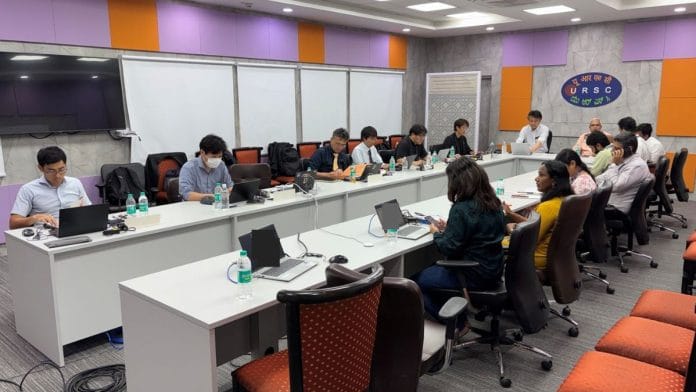


New Delhi: In a move to speed up the India-Japan lunar exploration mission, Lunar Polar Exploration or Chandrayaan-5, a team of scientists from the Japan Aerospace Exploration Agency is visiting Bengaluru’s UR Rao Satellite Centre. The meetings focus on finalising the onboard scientific experiments and instruments, and outlining the interface between the ISRO lander and the Japanese rover.
“We are currently conducting technical coordination regarding the ICS (interface control specifications) between the ISRO lander and JAXA (Japan Aerospace Exploration Agency) rover, as well as the ICS for the observation instruments onboard the rover,” JAXA said in a statement confirming the meeting.
The statement added that the Japanese and Indian teams are collaborating to advance concrete discussions toward the launch of the Lunar Polar Exploration (LUPEX).
The mission
The India-Japan space partnership will mark a new aspect of lunar exploration and will be the fifth in a series of Indian missions to the moon. After the successful landing of Chandrayaan-3, India became the first country to land a probe on the lunar south pole. The country is already working on Chandrayaan-4, which aims to bring back samples from the moon to Earth.
Chandrayaan-5, which is called LUPEX by the Japanese partners, aims to acquire water resource data to reveal the potential use of lunar water as a resource. The Japanese space agency is responsible for the lunar rover, while ISRO is handling the lander that will carry it.
Both countries have proved their technical capabilities with successful moon missions in the past. After Chandrayaan-3, Japan’s Smart Lander for Investigating Moon (SLIM) also made a successful landing on the lunar surface. The SLIM mission aimed to demonstrate accurate lunar landing techniques embodied in a small explorer and to accelerate the study of the moon and other planets using the lighter exploration system.
According to the last mission update, LUPEX is also likely to carry observation instruments from the US’ National Aeronautics and Space Administration (NASA) and the European Space Agency (ESA), further enhancing its scientific capabilities.
According to ISRO and JAXA, LUPEX will not only confirm the presence of water on the moon but will also investigate its quantity and distribution on the lunar surface as well as below ground. It will also explore the form of the water, analysing the level of mixing with dry regolith—the layer of loose unconsolidated rock and dust that sits atop a layer of bedrock in the vicinity of a Permanently Shadowed Region (PSR) in the lunar south pole.
The mission will be launched by JAXA on board its H3-24L launch vehicle, carrying the ISRO-made lunar lander. It will carry the Mitsubishi Heavy Industries (MHI), Japan-made lunar rover.
In a statement issued in May this year, ISRO said that scientists from both countries have been conducting regular meetings to expedite the mission.
“ISRO, apart from developing the lunar lander, is also responsible for developing a few scientific instruments for the mission. The approval for the Chandrayaan-5/LUPEX mission was received from the government of India on March 10, 2025, in the form of financial sanction,” the ISRO statement read.
(Edited by Prasanna Bachchhav)
Also read: IN-SPACe releases new guidelines for atmospheric reentry of space objects