






New Delhi: The Indian Space Research Organisation (ISRO) will likely attempt the third landing experiment of its Reusable Launch Vehicle (RLV) — Pushpak — by the end of this week.
The landing test, initially scheduled for the first week of June, was rescheduled because of poor weather, officials from the space agency confirmed.
“We are waiting for good weather. The test may happen by the end of this week,” ISRO chairperson S. Somanath told ThePrint Monday.
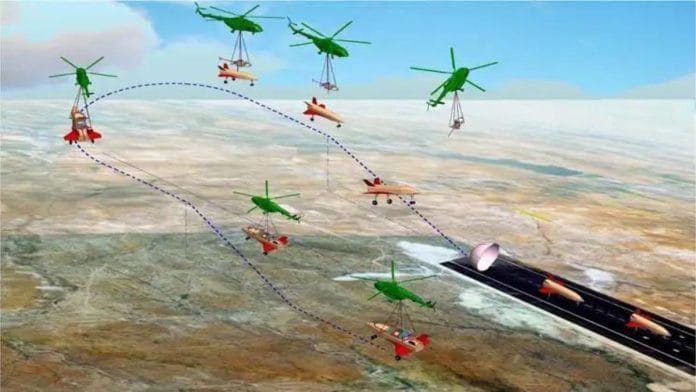
The RLV-LEX-03, or the third landing experiment for ISRO’s reusable launch vehicle, will be carried out in Karnataka’s Challakere on board the Indian Air Force’s Chinook chopper.
The landing test aims to improve the launch vehicle’s performance and landing capabilities.
Also read: Pune astronomers identify galaxy in Milky Way’s neighbourhood as ‘explosive factory’ of gamma rays
What an RLV is
ISRO’s RLV-TD (technology demonstrator) is one of the most challenging endeavours towards developing essential technologies for a fully reusable launch vehicle to enable low-cost access to space.
The configuration of RLV-TD is similar to that of an aircraft and combines the complexity of both the launch vehicle and the aircraft.
The winged RLV-TD — configured to act as a flying test bed to evaluate various technologies, including hypersonic flight, autonomous landing and powered cruise flight — will be scaled up in the coming years to become the first stage of India’s reusable two-stage orbital launch vehicle.
The RLV-TD, however, is not the first such launch vehicle. Government and private players worldwide have experimented with partial and fully reusable technology for their launchers for cost-effectiveness and efficiency.
Blue Origin’s New Shepherd is an example of a functional reusable launcher that undertook a sub-orbital flight in 2015. SpaceX’s Falcon 9 is a two-stage reusable rocket capable of transporting crew and cargo to the International Space Station.
The Indian launcher has a fuselage (body), a nose cap, double delta wings, and twin vertical tails. It also features symmetrically placed active control surfaces — elevons and rudder.
This technology demonstrator was boosted to Mach-5 by a conventional solid booster (HS9) designed for a low burn rate.
Senior ISRO scientists said that selecting materials like special alloys, composites, and insulation materials for developing an RLV-TD and crafting its parts is a complex process demanding highly skilled manpower.
Earlier tests
In May this year, the Indian space agency conducted the second landing experiment for Pushpak, RLV-LEX-02, at the Aeronautical Test Range (ATR), Chitradurga, Karnataka.
The RLV-LEX-02 demonstrated the autonomous landing capability of RLV from off-nominal initial conditions at release from the helicopter. In the test flight, the RLV undertook challenging manoeuvres with dispersions. After corrections of the cross-range and downrange, it landed on the runway in fully autonomous mode.
The space agency conducted the first landing experiment, RLV-LEX-01, with a scaled-down version of the RLV-TD last year. Once the aircraft attained the predetermined pillbox parameters covering position, velocity, altitude, etc., during the demonstration, based on the RLV’s mission management computer command, it was released mid-air at a down range of 4.6 km.
“Developing a technology from scratch takes time. We are progressing at a good pace, and in a few years, we will be able to launch missions on an Indian-made RLV,” Somanath said.
(Edited by Madhurita Goswami)