


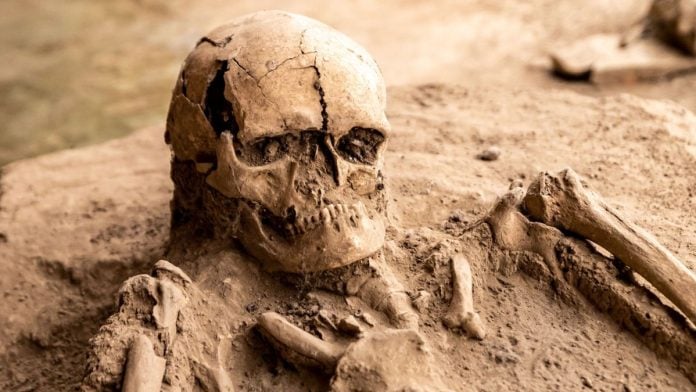
New Delhi: A team of international researchers has found that Homo erectus, the most important ancestor to human beings, existed for nearly 200,000 years more than scientists earlier thought.
The findings, published as two studies in Nature on 18 November, were led by a team of scientists from China, France, Australia, Denmark, Japan. In the first, researchers examined ancient teeth, and in the second they studied how Homo erectus might have survived the extra millenia.
“On the Asian mainland, the species was thought to have largely disappeared around 400,000 years ago. So it’s very surprising to find evidence showing that they persisted much later,” co-author Frido Welker, Associate Professor at the University of Copenhagen, said in a statement.
Homo erectus was believed to have emerged around two million years ago and was the first human species to travel from Africa into Asia and Europe. Other humans, such as Neanderthals, Denisovans, and Homo sapiens, eventually evolved from the Homo erectus.
Scientists believed Homo erectus thrives in grasslands and savannas at a time when a lack of rainfall had left large expanses of such arid land across the globe. However, as the environment changed, allowing jungles and rainforests to take over again, historians assumed Homo erectus struggled to survive. The two studies have now challenged this theory.
Also read: Night shifts may alter heart structure, affect heart muscles, finds study of 42,000 people
Nine fossil teeth
The study’s main findings came from analysing nine fossil teeth which were discovered in two caves in southern China. To date the teeth, researchers used various modern techniques that can now examine the proteins preserved within the tooth’s enamel. While DNA disintegrates within a few thousand years in warm environments, proteins can survive much longer.
“A 300,000-year-old protein is extremely degraded, making it very difficult to analyse. Just ten years ago, nobody would have believed it possible to recover such detailed protein information from fossils this old. But our methods have advanced dramatically, allowing us to investigate crucial chapters of human history that were previously beyond our reach,” Welker added.
However, one of the teeth was unlike the rest. It did not match the Homo erectus teeth proteins and did not correspond to any other historically known creature either, suggesting that another type of human species lived in the area at the time.
“We can say with a high degree of confidence that the tooth did not belong to Homo erectus,” said Welker. “But we cannot yet determine which human species it belonged to. That is what makes the discovery so exciting, because it shows that at least two different human groups lived side by side in the region.”
Analysing chemical traces in the teeth and the nearly 18,000 fossils found in those caves, revealed that Homo erectus would have lived in a tropical rainforest, where food might have been difficult to find, and dense vegetation would have made movement challenging.
“We now have the first evidence that other human species also lived in this type of environment. This shows that Homo erectus was far more adaptable than previously thought. Our study demonstrates how new discoveries continue to reshape our understanding of our ancestors,” Welker added.