



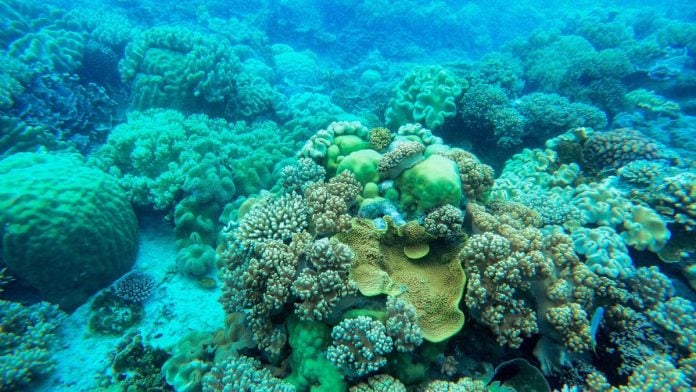
New Delhi: With rising ocean temperatures, the survival of coral reefs is at risk. However, scientists have now found that installing temporary shades over corals helps them recover from heat stress and avoid the bleaching caused by marine heatwave
The study, published in Frontiers in Marine Science by researchers in Florida, documented an attempt by researchers to set up underwater shade for two Caribbean corals during the particularly hot summer of 2024.
“Heat-related coral bleaching is probably the biggest threat to reefs worldwide, and we absolutely have to address climate change to have any hope of reefs as we know them existing in the future,” lead author Karen Neely of Nova Southeastern University, said in a statement.
In 2024, Neely and her team set up little custom-made “umbrellas” over 10 different colonies of two species of corals — Pseudodiploria clivosa and Colpophyllia natans in Florida Keys, an archipelago in Florida. They also identified 20 similar corals which could act as the control group that was not protected from sunlight.
“Solutions like shading can offer temporary protection on small scales. The 2023 coral bleaching event in Florida essentially wiped out branching corals, and at some inshore sites had a devastating impact on brain corals. This study stemmed directly from that event: we wanted to provide proof of concept for tools to save targeted corals in similar future events,” Neely added.
Also read: There is a new penguin in Antarctica. It was hiding among the Gentoos
Underwater umbrellas
For the experiment, the team made shades using nylon cloth attached to pipes, and temporarily attached the structure to the sea bed. According to the study, these “umbrellas” reduced 60 per cent of the light that would earlier reach the corals. Every two weeks, divers would visit the site and track the changes in the colour of the corals and even take coral tissue to monitor its health.
It is important to note that corals are not plants or rocks, they are marine invertebrates belonging to the phylum Cnidaria, cousins to jellyfish and sea anemones. They have a symbiotic relationship with the algae that grows inside them, provides them with food, and even lends them their colour. When corals turn white under heat stress, it often means that the relationship between the coral and its inner algae is suffering and the coral is starving.
“Shades reversed the observed bleaching, but the event wasn’t severe enough to cause mortality on control or shaded corals. However, we know that even bleaching that doesn’t cause mortality can impact corals’ future disease susceptibility and reproductive capacity. It would be interesting to quantify if and to what extent shade structures benefitted these corals after their removal by tracking disease and reproductive output,” said Neely.