


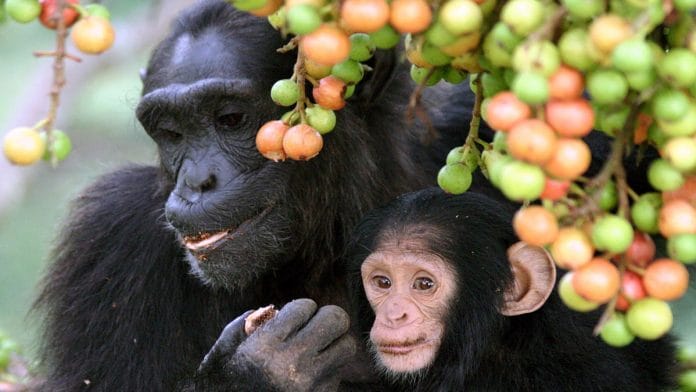
New Delhi: Scientists have long studied the key differences in how human and chimpanzee brains evolved. Now, a study has traced this difference to an ancient virus that infected the ancestors of chimpanzees millions of years ago.
The study, which was published on 23 October in Science Advances, discovered that the genetic material left behind by the virus “switched off” a gene involved in brain development that remains active in humans.
“The virus we investigated specifically affected chimpanzees. Yet humans and chimpanzees have largely the same genetic makeup,” Johan Jakobsson, professor of molecular neurogenetics at Sweden’s Lund University and one of the authors of the study, explained in a press release.
To investigate the ancient ancestor of the chimpanzee, the scientists focused on an endogenous retrovirus called PTERVE1 in chimpanzee brains. Endogenous retroviruses (ERVs) are remnants of viruses that inserted their genetic material into host DNA, which was subsequently passed down to later generations. ERVs are said to comprise up to 3-8 per cent of the human genome.
While these virus-derived genes no longer cause infections, they can influence the genes around them and affect their function.
The team found that more than 150 regions of modern chimpanzee DNA where viral insertions affected methylation, a process that aids in regulating gene activity. One particular insertion on chromosome 19, the researchers found, prevents the expression of a gene named LINC00662, which is active in humans during early brain development.
Gene editing confirms viral influence
To understand the effects of this specific viral insertion on LINC00662, the researchers developed miniature models of chimpanzee and human brains, known as organoids, with stem cells extracted from both species.
“The gene was strongly expressed in the human organoids, but not at all in the chimpanzee organoids,” Patricia Gerdes, postdoctoral researcher at Lund University, said in the press release.
The team then removed the PTERVE1 viral sequence in chromosome 19 in the chimpanzee stem cells using the CRISPR-Cas9 gene-editing technique. This removal caused LINC00662 to become active again.
“This shows that it is in fact the viral insertion that is responsible for the gene being switched off in chimpanzees,” Gerdes concluded.
To understand the function and importance of LINC00662, the researchers turned it off in the human brain organoids in a separate experiment. They observed reduced activity in genes associated with the creation of connections between neurons and nerve-cell deployment.
The findings suggest that inherited viral sequences may have influenced the evolution of chimpanzee brains by regulating the expression of genes. A limitation is that stem cells and lab-grown brain organoids cannot reproduce the full complexities of brain development.
The research team now aims to find other examples of viral sequences affecting brain development and whether they can be linked to various neurological diseases.
(Edited by Prasanna Bachchhav)
Also read: Vaccines during pregnancy may lower risk of premature birth, Australian study finds