



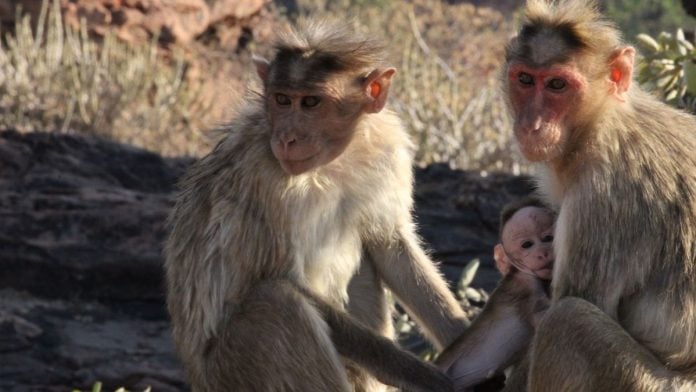
New Delhi: Humans are not the only ones who grow wary when they sense the threat of a disease. Macaque monkeys that lived through a deadly disease became more conscious about eating food that seemed contaminated, even though the disease did not spread through food, found a new study.
The findings were published in the Royal Society Open Science on 21 October by researchers at the University of California San Diego. Researchers conducted two studies to examine how early-life experiences and exposure to diseases shape the ways macaques avoid diseases.
According to the study, animals have several ways they avoid infections even before germs have entered their bodies. In the research lingo, this is sometimes called the “behavioural immune system”. This often includes avoiding sick people and staying away from food that looks contaminated. Among humans, it is often disgust which protects us from infections by making us avoid things like faeces, rotten food, and other sources of germs.
“We can show now, in non-human primates, that this is the same for them. Even with no knowledge of how disease is transmitted, being exposed to others getting sick and dying changes the likelihood of engaging in behaviors that potentially could lead to some form of sickness,” senior author, Federico Rossano, associate professor in the Department of Cognitive Science at UC San Diego’s School of Social Sciences, said in a statement.
Also read: High-nicotine vapes make quitting harder for young adults, study finds
Avoiding illness
The research project came out of a strange event that occurred at a Primate sanctuary in southern Texas where behavioural studies are usually conducted. In 2020, some of the macaque groups experienced simian retrovirus Type 2 which causes an AIDS-like immunodeficiency. The disease was mainly transmitted through bites and scratches.
To deal with the outbreak, the sanctuary separated the monkeys into three groups leading to an unusual experiment where three groups experienced the outbreak, but one did not.
In the first study, researchers tested 54 macaques from seven species in different settings to observe their behaviour. They were offered grapes either on a clean surface or one seeming contaminated by faeces. They found that monkeys that had grown up with their mothers were less likely to eat food from the contaminated looking surfaces.
“Groups have histories, and those histories show up in behavior. Living through the disease outbreak appears to have made those monkey groups more cautious around food that looks contaminated,” co-author Stephan Kaufhold, doctoral researcher in cognitive science, said in a statement.