



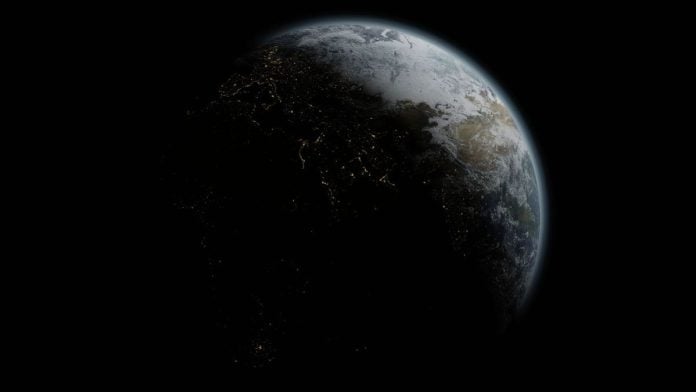
New Delhi: There is an invisible barrier around the Earth which prevents high energy particles from reaching the planet. Scientists have now found these high energy particles well within the bounds of that barrier.
The discovery was first made in 2024 by Japan’s Arase space probe. Now, two years later, researchers at Nagoya University have published a study in Geophysical Research Letters, that explains that these particles did not enter the Earth from an outer radiation belt, but rather were “accelerated locally”.
“This discovery highlights the need to understand and predict how energetic electrons behave under extreme space weather conditions. Such knowledge is important for assessing radiation risks to spacecraft and improving future space weather predictions,” lead author Yoshizumi Miyoshi, a professor at the Institute for Space-Earth Environmental Research (ISEE) at Nagoya University, said in a statement.
Usually, the energetic charged particles heading towards the Earth are trapped in two donut-shaped belts called the Van Allen radiation belts. Scientists consider these particulars dangerous because they can damage the hardware and electronics inside spacecraft. When these particles collide with other particles at high speeds, they can displace its electrons and tamper with its electrical charge.
Also read: Humans and birds share song rhythms and acoustic patterns, new study finds
The invisible wall
In 2014, scientists realised that at the inner edge of the Van Allen belt, these charged particles would come up against a wall. The scientific community is yet to understand what is the source of this barrier.
Nearly 10 years after the discovery of the barrier, observations during and after a solar “superstorm” revealed a sudden flux of high energy charged particles. Some of these particles were even moving at the speed of light containing enough energy to go breach satellite shields.
“One of the key questions was how these highly energetic electrons appeared inside the barrier. Were they transported inward from the outer radiation belt, or were they accelerated locally within this region?” Miyoshi said.
Further investigations revealed that these particles had not gotten through the “invisible barrier” but that existing particles within the barrier had slowly been gaining energy. In addition to the charged particles, scientists also found that the superstorm had eroded the plasmasphere, a layer of cool, electrically charged particles that interacts with the radiation belts beyond the Earth.
Researchers highlighted that further models are needed to understand just how these particles are accelerated and what its long term consequences could be.