





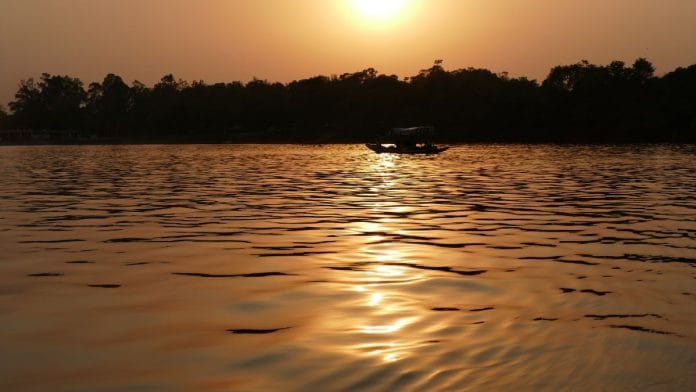



Hyderabad: A day after the Supreme Court pulled up authorities over the drying up of the iconic Sukhna Lake in Chandigarh, environmental experts called for a retrospective action against officials who were in charge during periods of degradation and to take strict action against them.
“The law is very clear. What is missing is accountability. Judgment and Constitution clearly guides how to tackle instances such as this. Authorities must identify officials who were in charge during periods of degradation and take strict action against them. When no one is held responsible, violations become routine,” said Lubna Sarwath, a Hyderabad-based environmental advocate and activist.
The Supreme Court, Sarwath said, has raised a fundamental question that applies to water bodies across the country.
The court on Wednesday flagged the drying up of Sukhna Lake, saying that builder mafias, in collusion with bureaucrats, have completely damaged it.
A three–judge bench led by Chief Justice of India Surya Kant made the remark during the hearing on the ongoing Aravalli hills definition case, which deals with environmental degradation and illegal construction in ecologically sensitive zones.
“There are illegal constructions in collusion and connivance with bureaucrats there in Chandigarh, and some political entities in Punjab (and) the lake is completely on the verge of destruction,” the bench said.
Also read: Space insurance is gaining traction among Indian startups. PSLV failure highlights the need
Protecting the lake
The Sukhna Lake and its catchment area lie within the administrative jurisdiction of Chandigarh, but its eco-sensitive zone (ESZ) extends into Punjab and Haryana. This places the responsibility of protecting the lake on two states and a Union Territory. The lake is rain-fed and depends on seasonal inflows from its catchment area, which environmental groups and courts have repeatedly flagged as being under threat.
AV Ranganath, Commissioner of the Hyderabad Disaster Response and Asset Protection Agency (HYDRAA), an agency created to protect public assets and water bodies in Hyderabad, said the authorities need to be swift and act early.
“Whatever the reasoning, the first thing is to safeguard the lake. By getting into bureaucratic wrangles, shifting blame from this to that, the ecosystem itself gets disturbed,” he said.
Having dealt with multiple encroachment demolitions and lake reclamations, the commissioner said that when a lake gets encroached and regular people are involved, it becomes more difficult to reverse the damage. “If you start delaying the mitigation process, the damage gets more deep-rooted.”
Sarwath suggests that if the inflow channels of the lake are left unobstructed, the lake will not dry up.
“Water levels naturally recede and expand depending on rainfall, but the full tank level (FTL) and catchment boundaries do not change,” she said.
Sarwath, who has worked for over a decade on urban lake conservation, said that “construction in summers when water recedes is scientifically and legally incorrect.”
She further cited the Supreme Court’s landmark 2001 judgment in Hinch Lal Tiwari vs Kamala Devi, which held that it is the duty of governments and revenue officials to protect water bodies as part of the right to life under Article 21 of the Constitution. The judgment described ponds, lakes, forests and other commons as nature’s bounty that maintain ecological balance and warned authorities against allowing allotments in non-abadi land.
(Edited by Aamaan Alam Khan)