


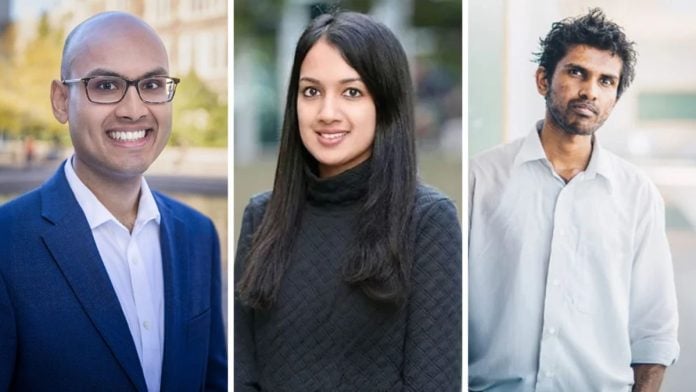
New Delhi: The Infosys Science Foundation on Thursday announced six winners of the annual Infosys Prize, awarded to Indian scholars and researchers under 40 in Economics, Life Sciences, Physical Sciences, Mathematics, Engineering and Computer Science, and Humanities.
“We must respect our teachers and researchers, pay them better, equip them well, and honour them. They are the role models for our young people. That is why we instituted the Infosys Prize in 2009,” said Narayan Murthy, Founder of Infosys, during his prize announcement ceremony.
The 18th edition of the prizes, which awards a gold medal, a citation, and a prize purse of $1,00,000 to each of the winners, recognised contributions from environmental economists, legal scholars, and biochemists this year, based in India and abroad.
“The (winners’) work demonstrates how rigorous research and the pursuit of new knowledge can deepen our understanding of the world and help address some of humanity’s most complex challenges,” said Srinath Batni, President, Infosys Science Foundation, in a statement. “I hope this recognition inspires more young minds to embrace research and push the boundaries of discovery.”
Economics winner
Karthik Sastry, an associate professor of economics and public affairs at Princeton University, US, won the Infosys Prize in Economics this year for his “pioneering contributions to the field of climate change, technological innovation, and business fluctuations.”
Thirty-one-year-old Sastry got his PhD in economics from MIT and studies how societies adapt to climate change through technological innovation and policy changes. His recent work includes studying how global warming has affected deforestation and agricultural land use around the world by using census data in Brazil.
Sastry won the John Witherspoon Bicentennial Preceptorship Award in 2026 at Princeton, which is awarded to outstanding junior faculty members for their research and scholarship.
Also read: Early animals had necks, but couldn’t turn their heads. Here’s why
Mathematical Sciences winner
In mathematics, the Infosys Prize 2026 went to Riddhipratim Basu, an associate professor at the International Centre for Theoretical Sciences (ICTS) at the Tata Institute of Fundamental Research (TIFR) in Bangalore. Basu received his PhD from the University of California, Berkeley, and works on probability theory and statistical physics.
The Infosys announcement states Basu’s work “resolved the longstanding slow-bond problem and established new large deviations asymptotics.”
He focuses on understanding rare events and fluctuations in random systems, as well as how local disruptions could affect large-scale behaviour. This work in statistics and probability has huge implications for machine learning and the behaviour of large, data-driven models.
Before joining TIFR, Basu was a Szegö Assistant Professor, Department of Mathematics, at Stanford University.
Physical Sciences winner
The Infosys Physical Sciences award this year was awarded to Manoj Kumar Joshi, “for his pioneering work with trapped ions, creating programmable quantum machines that reveal how complex quantum systems behave.”
Joshi is an assistant professor of quantum technology at Singapore University of Technology and Design, and he received his PhD at Imperial College, London.
His work revolves around experimental quantum physics, which is one segment of quantum mechanics. He studies interactions between trapped ions, which are charged particles, using specialised quantum computers, to answer fundamental questions about how quantum states evolve and how different parts of a quantum system become interconnected through entanglement.
This experimental work, according to the Infosys jury, “unites” fundamental quantum discovery with technological innovation.
Also read: A robot has built a structure in space for the first time. Here’s why it matters
Engineering and Computer Sciences winner
In engineering sciences, Swarun Kumar, a researcher at Carnegie Mellon University in the US, received the Infosys Prize 2026. The award recognises his work in wireless communication, specifically in low-power wireless networks.
Kumar is a Sathaye Family Foundation Professor at Carnegie Mellon University’s ECE department and is working on making wireless networks more ‘intelligent.’ He is building next-generation wireless systems, which can “connect, sense and act”, beyond just information delivery. This includes using radio waves to detect things in the physical world like human fatigue or environmental changes, and even moving and controlling objects using wireless networks.
He received his PhD from MIT and received the George Sprowls Award for best PhD thesis in Computer Science. He was also awarded the President of India Gold Medal at IIT Madras, where he did his bachelor’s degree.
Humanities winner
This year’s Humanities and Social Sciences award went to Gautam Bhatia, a constitutional lawyer and legal scholar, an Adjunct Professor at Jindal Global Law School. Bhatia, who was a Rhodes scholar in 2013 and received his MPhil from the University of Oxford, focuses on civil liberties and freedom of speech in the constitution, and has written more than five books on legal scholarly analysis.
Bhatia is a University of New South Wales Green Fellow and has served as amicus curiae before the Supreme Court of Kenya. He is also a science fiction author and has written three books in the genre.
The Infosys jury awarded him the prize for his “formidable corpus of important work,” and his arguments that seek to make the law an instrument for constructing a fair, equal, and humane society.
Also read: A faraway star keeps erupting every 113 days. A companion black hole could be the reason
Life Sciences winner
The Infosys Prize 2026 in Life Sciences was awarded to Isha Jain, an associate professor at the University of California, San Francisco, for her “pioneering discoveries in oxygen biology.” Jain is also the Core Investigator at Jain Laboratory, based in the ARC Institute in Palo Alto, California.
Jain, who specialises in biochemistry, is studying how the human body reacts to external molecules like oxygen and vitamins. She discovered that tissue damage in some mitochondrial diseases is due to excess oxygen in 2018, during her doctoral studies in the Harvard–MIT Health Sciences and Technology program.
She has previously received the NIH Director’s Early Independence Award, the Klingenstein-Simons Fellowship Award in Neuroscience, and the Mallinckrodt Award.
(Edited by Saptak Datta)