





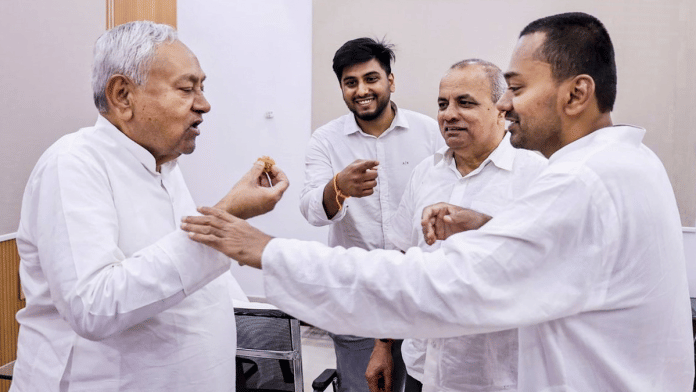



Lucknow: Just days after Bihar Chief Minister Nitish Kumar filed his nomination for a Rajya Sabha seat in Bihar, his son Nishant Kumar has formally joined the Janata Dal (United). With Nishant’s entry on Sunday into politics looking, walking and talking like a succession plan, the National Democratic Alliance (NDA) now gets yet another family-run constituent shaped by family control, with the JDU now the 10th constituent within the coalition fold under dynastic leadership.
Ironically, while the Prime Minister has often criticised dynastic politics, the ruling coalition is now home to a legion of parties running on family fuel. These include the Telugu Desam Party, Lok Janshakti Party, Apna Dal (Sonelal), Suheldev Bharatiya Samaj Party (SBSP), Hindustani Awam Morcha (HAM), Rashtriya Lok Dal (RLD), the Nishad Party, Janta Dal (Secular), National People’s Party and the Nationalist Congress Party.
The NDA’s ‘dynasts’
NDA parties mostly show a pattern where leadership remains within a single family over the years while one or more family member holds a post in the government as well.
In Bihar, the Lok Janshakti Party (Ram Vilas) is led by Chirag Paswan, who inherited the party and its legacy from his late father and former Union minister Ram Vilas Paswan. Another ally, the Rashtriya Lok Morcha, headed by Upendra Kushwaha, also has family members in politics: his wife Snehlata Kushwaha is an MLA while his son Deepak Prakash Kushwaha is a minister in the Bihar government.
Similarly, the Hindustani Awam Morcha (Secular) led by Jitan Ram Manjhi is another example where family members hold key positions: Manjhi’s son Santosh Kumar Suman is a minister in the Bihar government and his daughter-in-law Deepa Manjhi is an MLA.
In Uttar Pradesh, NDA ally Apna Dal (Sonelal) has its chief Anupriya Patel serving as a Union minister, while her husband Ashish Patel is in the Yogi Adityanath Cabinet. Another ally, the Suheldev Bharatiya Samaj Party, led by Om Prakash Rajbhar, features his sons Arvind Rajbhar and Arun Rajbhar holding key positions within the party. Likewise, in eastern Uttar Pradesh, Nishad Party chief Sanjay Nishad is a Cabinet minister while his son Praveen Nishad is also active in the party.
In western Uttar Pradesh, NDA ally Rashtriya Lok Dal is headed by Jayant Chaudhary who inherited the party’s leadership after the death of his father Ajit Singh.
Dynastic politics isn’t confined to the cow belt. In Meghalaya, Chief Minister Conrad Sangma, who is also the national president of the National People’s Party, carried forward the political legacy of his father P.A. Sangma. In Maharashtra, after the death of Ajit Pawar, his wife Sunetra Pawar leads the Nationalist Congress Party(NCP), a key part of the Mahayuti government.
Similarly, the Janata Dal (Secular) led by HD Deve Gowda has prominent family involvement, with his son HD Kumaraswamy serving as a Union minister in the government led by Narendra Modi.
Also Read: Nitish’s exit is good for Bihar. It’s the beginning of JD(U)’s end and BJP’s supremacy
Nishant’s induction a U-turn
For decades, Nitish Kumar stood strong against dynasty politics, refraining from bringing his son into active politics. The latest development marks a stunning reversal from that long-held position.
The buzz is that Nishant, an engineer by training, may be elevated as deputy chief minister in the new government. According to JD(U) functionaries, it is a unanimous decision to appoint Nishant to the second-most powerful position in the new state government that will be formed in the wake of the Nitish resignation.
A large section of the Janata Dal (United) has welcomed the decision, though others in the party remain concerned about its future, questioning whether the “inexperienced” Nishant would be able to carry everyone along. The optics are cheery, however. JD(U) president Sanjay Jha described the move as a welcome step. “We have been waiting for his entry for a long time. Everyone is happy now. Nishant will travel across the state to meet party workers,” he said. The people who protested outside the party’s headquarters a day earlier had no connection with the party, he added.
Several opposition parties, including the Indian National Congress and the Rashtriya Janata Dal, took a dig at Nishant’s entry, claiming that Nitish Kumar himself has now turned into a ‘parivarvaadi’ (dynast). Aizaz Ahmad, spokesperson of RJD, took a dig at what he called dynastic politics within the National Democratic Alliance. “You will find the most examples of dynastic politics in the NDA. They are doing it to remain in power. Earlier they used to taunt us, but now they themselves have become the biggest dynasts. The public is watching everything,” he said.
Meanwhile, Abhay Dubey, a Congress spokesperson, said, “Nitish Kumar has spoken against parivarvaad in the past, but now he has been forced to become a participant in it. Bringing Nishant Kumar into politics is actually a face-saving exercise by the Janata Dal (United), as its top functionaries are playing into the hands of the Bharatiya Janata Party. Nishant has no political experience, and his entry only helps the BJP.”
Refuting the opposition allegations, JD(U) spokesperson Rajiv Ranjan Prasad told ThePrint, “If someone is capable, what is wrong in inducting him into the party? Nishant is an engineer and an educated person. Youth have high hopes from him. We are very happy with his joining. Let the opposition say whatever they are saying, no one has a belief in them.”
Tanvir Aeijaz, a Delhi based political analyst and associate professor at the University of Delhi, who is also vice-president of the Centre for Multilevel Federalism at the Institute of Social Sciences, said bringing Nishant Kumar into politics does not appear to be a smart move by Nitish Kumar.
“By doing so, Nitish has taken upon himself the charge of parivarvaad. Nishant also lacks political experience. The Janata Dal (United) has taken a big risk, especially if it is projecting him as Nitish’s replacement in the coming years. Nitish is a seasoned politician who began his political career very early and had been strongly against dynasty politics until a few months ago. His sudden shift has surprised many in political circles; now he is also becoming like many other dynastic parties,” he told ThePrint.
(Edited by Nardeep Singh Dahiya)
Also Read: Long arc of Nitish Kumar: From Modi-baiter to BJP’s bridge in Bihar