





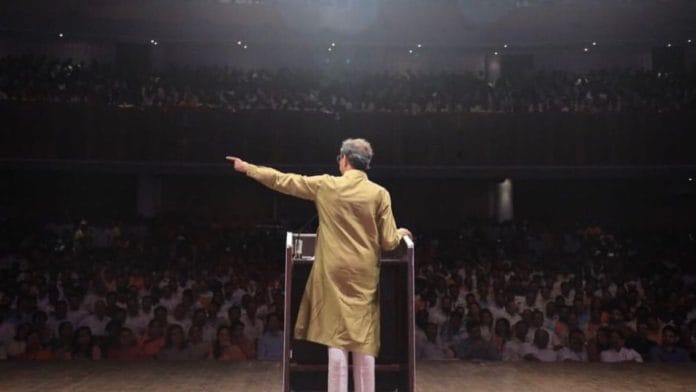



Mumbai: When Uddhav Thackeray rose to address the Maharashtra Legislative Council on 24 March, he reached for a poem—one about being misunderstood by the people closest to him.
Thackeray recited lines by Marathi poet Suresh Bhat.
It went something like this: “I did not realise who my friend was nor my enemy. Everyone who met me tormented me; my close ones were upset with me but nobody tried to understand me.”
It was a fitting epitaph for a six-year MLC tenure—officially ending in May—one that began under compulsion, spanned both the treasury and opposition benches, and is assessed by colleagues as a steep but incomplete learning curve, and by critics as an opportunity wasted.
Also Read: Mahayuti allies Sena, NCP haul BJP over the coals for ‘manipulating’ Satara zilla parishad polls
The compulsion
Uddhav Thackeray became a member of the Maharashtra Legislative Council on 14 May 2020—not by choice but by constitutional necessity. When the Maha Vikas Aghadi government of Shiv Sena, NCP and Congress came to power in 2019 and Uddhav became chief minister, he had no legislative or executive experience, and was not a member of any house. He had six months to remedy that or vacate the post.
A photographer by profession, he entered Vidhan Bhawan as the second Thackeray to have done so. His son Aaditya, who had contested the 2019 assembly elections, was the first for the family to fight any polls.
For a family that had always wielded power from outside electoral politics—Bal Thackeray famously refused to become chief minister, insisting that the “remote control” would remain with him—both the moves were significant departures.
Political analyst Sanjay Patil framed this shift as a generational reckoning.
“The decision of the Thackerays to enter electoral politics with Aaditya’s candidature at first was a positive sign. Later, with Uddhav Thackeray becoming an MLC, it meant he let himself get exposed to public criticism and face democratic responsibility. This was a big transition even though it happened because of a compulsion, Patil said.
He added, “Uddav coming out of that Thackeray aura and participating in democratic process and accepting the CM post was a big thing.”
CM in Upper House
His years as CM were his most engaged in the upper house of the state legislature—partly because running a government made disengagement impossible. Uddhav steered Maharashtra through the Covid-19 pandemic and two cyclones that struck the state’s western coastline in June 2020 and May 2021. Colleagues say parliamentary affairs consumed him daily.
“When he was the CM, he was involved in parliamentary affairs daily because he had to run the government. It also changed him because being a party boss is different and parliamentary affairs are different,” said Anil Parab, senior Shiv Sena (Uddhav Balasaheb Thackeray) leader and MLC.
His physical presence in the house also served a disciplinary function.
“With him being around, Shiv Sena leaders saw that their boss was near them. He was watching them. And despite the rumours that more MLAs would leave him, leaders were wary of his presence around—whom they were meeting, what was transpiring behind the scenes. From that aspect, Uddhav being present at the assembly/council was important,” said political analyst Hemant Desai.
The Uddhav-led MVA government did end up collapsing in 2022, when a rebellion within his Shiv Sena resulted in the coalition losing its majority. Consequently, Shiv Sena was divided into Uddhav’s UBT and another faction led by now-deputy CM Eknath Shinde.
Uddhav’s use of MLC constituency funds during his tenure in the house reflected both personal attachment and political ambition.
In 2021, he allocated Rs 1.25 crore to Rs 1.3 crore to upgrade and illuminate the walking pathways at Shivaji Park—a location long associated with the Thackeray family. He also used MLC funds to distribute books to libraries across Mumbai.
In 2022, he proposed a ‘Democracy Square’—Lokshahi Chowk—at Azad Maidan and allocated Rs 5 crore for its construction. The project did not materialise after his government fell.
On governance, Sena (UBT) spokesperson and leader Harshal Pradhan pointed to environmental stewardship as a defining thread.
“Maintaining balance between development and environment was one of the key aspects of his tenure,” Pradhan said. One of Uddhav’s first decisions after becoming a CM was to declare Aarey in Mumbai, by then embroiled in a development vs conservation battle, as a forest. He also directed the setting up of a mangrove park, Mumbai’s first, in Gorai.
Pradhan said Uddhav was criticised for his tenure, “but one thing was clear—he emerged as someone who doesn’t run away from problems, but faces them. He never criticised his opponents on a personal level. His retirement is not just of one person, but of a leadership model”.
Opposition years
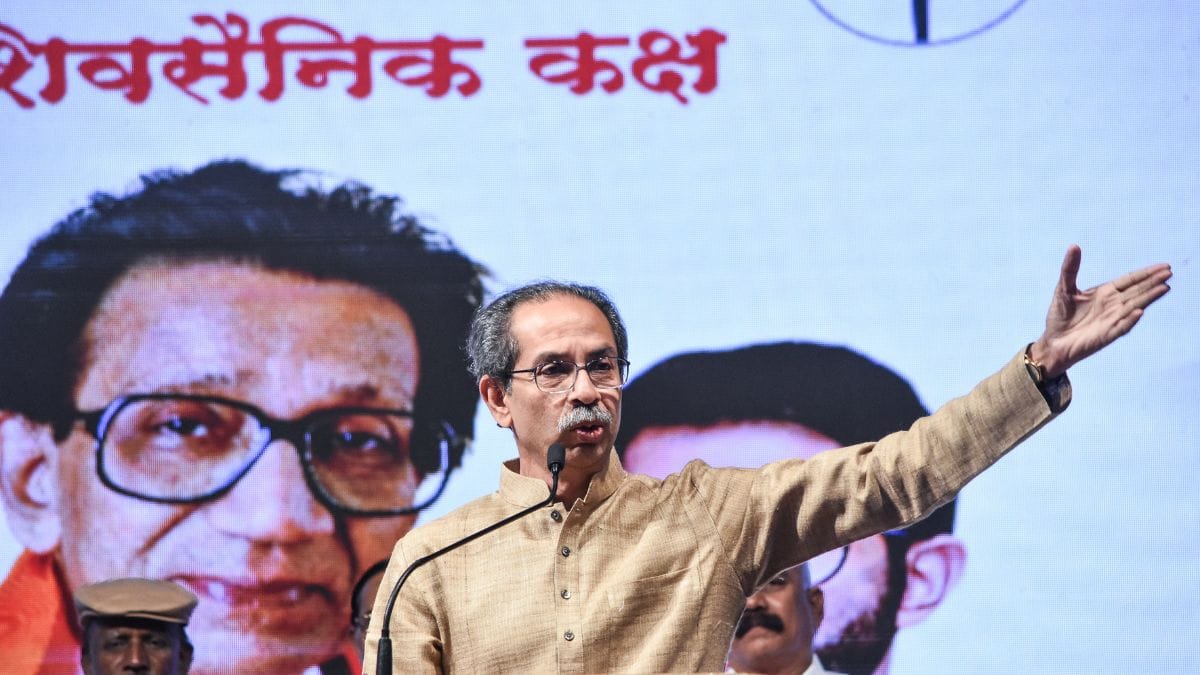
After his government fell in 2022, Uddhav moved to the opposition benches. His style—already calmer and more poetic in the house than the combative register his father had made synonymous with the Thackeray name—remained measured.
He raised the issues of farmer suicides, demand for farm loan waivers, Dharavi redevelopment, alleged voter manipulation during the assembly elections, the status of the Marathi language, and the prolonged legal battle over the Shiv Sena name and symbol.
Before each session, Pradhan said, Thackeray would convene a team to identify key issues, guiding his MLAs and MLCs on what to raise on the floor.
“Even though his speeches were not aggressive, they were balanced and had a pointed direction. His tenure showed that politics is also about patience, dialogue, and balance,” Pradhan said.
Parab defended the quieter approach. “He doesn’t necessarily have to speak. Earlier, he was a CM, so asking starred questions against his own government wouldn’t have looked nice. And later, we all were there. His directions would be there. He would sit for discussions, but it is not mandatory for him to speak,” he said.
Criticism
That defence does not satisfy Uddhav’s critics, who allege that Uddhav’s attendance fell sharply as he shifted to the opposition benches.
The Thackeray camp cited health concerns; opponents were less charitable.
“He did not seem serious about it. Just look at his presence during the session. Except for taunts, his speeches did not have any impact. So even if he comes again, it won’t make much of a difference,” a Shiv Sena (Shinde) leader said, speaking on the condition of anonymity.
Desai offered a more considered but unflattering verdict. “His performance was average overall. I doubt he would go as an MLC again but I think he should go back to being an MLC. If he does, his performance should improve. His colleagues and party leaders should feel his towering presence. He should be serious about cornering the government and concentrate on legislative work,” Desai said.
The political analyst drew a comparison: “As an MLC, his work wasn’t effective. He did not put up any topic on the floor of the house that would create an impact. On that count, his tenure was just like Sharad Pawar and a couple of his last tenures in Rajya Sabha, where Pawar would also stay silent.”
Uddhav’s speeches, Desai said, “weren’t something to be remembered… With the exception of Anil Parab and Bhaskar Jadhav, Shiv Sena UBT leaders were also lackluster”.
Patil conceded that the MLC platform was a “good opportunity” that was “lost” by Uddhav.
“When Uddhav Thackeray speaks, it becomes news. But, when he speaks inside the assembly, it can become even bigger news,” he said.
On the question of attendance too, Patil admitted that Uddhav’s presence in the assembly “would have added a good pressure on his colleagues and the government”.
“He had the opportunity. Just like… how his critics and public say that he did good work as a CM, the same cannot be said about his tenure as MLC,” Patil said.
The farewell
In his farewell speech, Uddhav was reflective rather than combative—in keeping, his supporters would say, with the artist he has always been.
“My forte is not political but I am an artist at heart and despite that, you all supported such a person. I thank every one of them,” he said.
Then, characteristically, he turned the moment outward to comment on the condition of Maharashtra politics. “This looks like an Indian Political League, and alliances keep on changing. One team is getting stronger and others are not. To play a match, don’t you think there need to be other teams as well,” he asked.
Maharashtra Chief Minister Devendra Fadnavis, recalling a friendship forged when BJP and an undivided Shiv Sena were alliance partners, offered a farewell tinged with rueful warmth.
“We developed friendship. I will not say it is not there (now). Jinko mera haath pakad kar chalna tha, hairat hai wo baat pakadkar baith gaye (The ones who had to hold my hand and walk along stuck on to some words and stopped),” he said, praising Uddhav for his measured temperament and skills as a photographer.
What’s next?
The MLC election, due in May, were necessitated as the terms of nine members, including Uddhav, are concluding. MLCs are elected by MLAs, who vote anonymously.
Given the current composition, MVA can collectively send only one of their leaders to the 78-member upper house.
Those close to Uddhav said they want him to return. “We all feel that he should come back. When he is there, he could speak to the MLAs and MLCs. Before becoming a CM, he did not know the day-to-day activities on how the house functions… what directions need to be given. Now, he understands the floor management and that impacts a lot,” Parab said.
Sanjay Raut, the party’s Rajya Sabha MP and Uddhav’s confidant, is also among those urging him to return. Whether he will seek that seat is, as yet, his decision alone.
(Edited by Prerna Madan)
Also Read: Fadnavis hands farmers another loan waiver even as 6 lakh await benefits of 1st one