





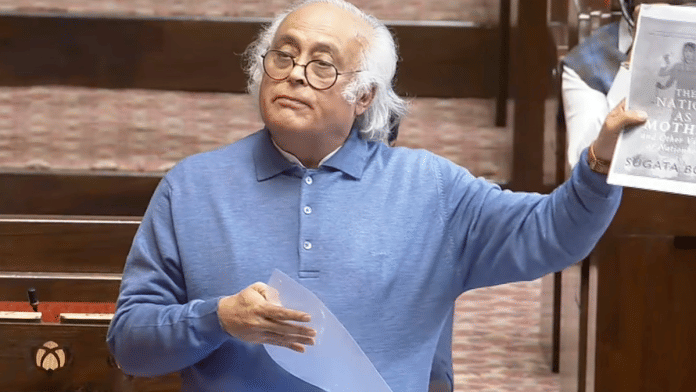



New Delhi: Senior Congress leader Jairam Ramesh, during the Vande Mataram debate in the Rajya Sabha Wednesday, launched an attack on the Bharatiya Janata Party’s (BJP) own history in response to allegations of appeasement, saying that BJP is insulting those who fought for the country’s independence, when their erstwhile leaders were ready to work with the British.
The Vande Mataram debate began in the Parliament on 8 December on the 150th anniversary of the song. This comes after the BJP accused the Congress of cutting down the song to two stanzas to appease the Muslims, under the leadership of Jawaharlal Nehru.
“The debate in the Rajya Sabha and the Lok Sabha has proved once again that we have far too little history in our politics, and far too much politics in our history. Prime Minister, Home Minister, and everybody who has spoken from that side have proven that they set out to be historians but became ‘distorians’,” Ramesh said, beginning his address.
Referring to the country’s atmosphere in 1937, when the Congress Working Committee (CWC) passed a resolution recommending that the first two stanzas of Vande Mataram be sung at national events, he said, “Several organisations were responsible for spreading a communal atmosphere in 1937; one such organisation is celebrating its 100th year now. It was formed in 1925. They lit the fire of communalism. Now they blame the Congress party for appeasement.”
Pointing out that many leaders of the time, including Gandhi, agreed to the resolution, he asserted, “When you take Nehru’s name again and again, you’re really insulting all those people who gave their lives for independence, when all of you were ready to work with the Britishers.”
Ramesh also referred to historian Sabyasachi Bhattacharya’s 2003 book Vande Mataram: The Biography of a Song, promising to deliver the book to all parliamentarians by Wednesday night. “Today, it isn’t just Nehru who is being defamed. This is the defamation of Rabindra Nath Tagore. What is this government doing? Bankim Chandra Chattopadhyay versus Tagore.”
Ramesh referred to allegations of appeasement against the Congress and asked, “What does appeasement mean? When Syama Prasad Mookerjee became a part of a coalition government with A.K. Fazlul Huq, who on 23 March 1940 moved the Pakistan resolution in Lahore. Isn’t that appeasement? It is the same Syama Prasad Mookerjee, on whose advice, the Hindu Mahasabha formed a coalition government in Sindh and North West Frontier Province. Isn’t that appeasement?”
“On 4 June 2005, Bharat Ratna Lal Krishna Advani went to Karachi, and who does he appreciate? They hate Nehru so much that he appreciated Jinnah. Isn’t that appeasement? In 2009, Jinnah’s biography was published. Its author was Vajpayee’s former foreign minister and finance minister Jaswant Singh,” he added, asking, “So much hate for Nehru that you would embrace Jinnah?”
Calling the debate a part of a project to defame Nehru, Ramesh said, “This project is so terrifying that even a simple, polite, sober defence minister also comes under its spell and starts saying a lot of things which are not backed by any historical evidence.” He clarified that Vande Mataram is sung at every session of the Congress.
Also Read: From Bankim’s private musings to a war cry—the many lives of Vande Mataram
‘Is this appeasement?’
In his speech, Ramesh referred to a letter written by Dr Rajendra Prasad to Sardar Vallabhai Patel on 28 September 1937, “raising concerns and worries prevalent in large sections of our political system on Vande Mataram and requesting Sardar Patel that the Congress Working Committee should take a stand.”
He then asked, “Was this appeasement? Are you accusing Dr Rajendra Prasad of appeasement or Dr Sardar Vallabhai Patel of appeasement?”
Ramesh mentioned another letter dated 16 October 1937 by Netaji Subhash Chandra Bose to Tagore, asking for advice on what the stand of the Congress should be on Vande Mataram.
Tagore then wrote to Bose, according to Ramesh. While he couldn’t locate the letter, he referred to a book written by former Trinamool Congress (TMC) MP Prof Sugata Bose, who is related to Bose. The book makes a reference to this correspondence.
He referred to several such correspondences on the issue of Vande Mataram, before the 28 October 1937 resolution. He asserted that Gandhi, Bose, Patel, Nehru, Maulana Azad, Govind Vallabh Pant, and Acharya Kriplani were also in agreement with the motion.
“Are they accusing them of appeasement?” Ramesh asked, referring to the BJP’s recent attack on Nehru.
He also referred to Tagore’s interview published in Anandabazar Patrika on 30 October 1937. “In that interview, he (Tagore) said that I gave this advice to CWC and on my advice, they passed this resolution so that a few stanzas of Vande Mataram be adopted as the National Anthem, which became the national song,” Ramesh said.
He referred to another book written by Chattopadhyay, translated by Bibek Debroy, who was the Chairman of the Prime Minister’s Economic Advisory Council, saying, “In this book, Chattopadhyay says, India’s biggest problem is the caste problem. Our history is the history of casteism.”
(Edited by Insha Jalil Waziri)
Also Read: Shah doubles down— ‘Congress’s truncation of Vande Mataram, appeasement politics led to Partition’
Oh dear ! Who truly embraced Jinnah to agree to partition India that is Bharat on religious lines ? Mr Jairam, do your homework !