





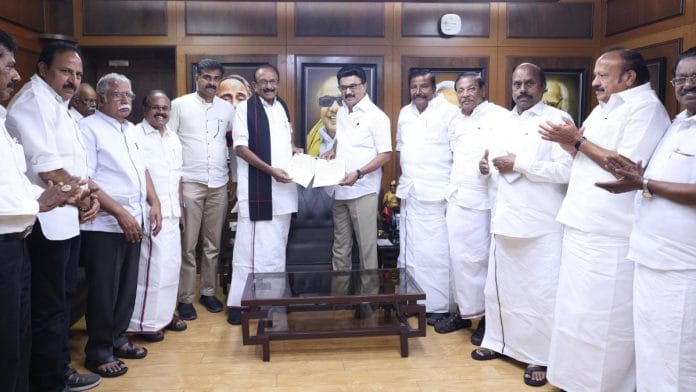



Chennai: If it’s election season in India, tensions over seat-sharing can never be far behind. As Tamil Nadu gears up for a crucial assembly election next month, differences have emerged within the state’s ruling DMK-led Secular Progressive Alliance (SPA), which is looking to retain power by defeating the BJP-AIADMK alliance.
Smaller allies are unhappy over the Dravida Munnetra Kazhagam’s (DMK) perceived ‘big brother’ attitude, while larger allies, like the CPI and CPI(M), are grumbling after securing only five seats each following protracted negotiations. The Tamilaga Vazhvurimai Katchi (TVK) exited the alliance just earlier this week.
Leaders from the parties are particularly upset that they have got fewer seats than the 10 allotted to the DMDK, founded by the late actor Vijayakanth, even though it’s a newer entrant and has a smaller vote base.
After the seat-sharing talks, the Congress got 28 seats, the Desiya Murpokku Dravida Kazhagam (DMDK) was allotted 10, the Viduthalai Chiruthaigal Katchi (VCK) eight, the Communist Party of India and Communist Party of India (Marxist) five each, and the Marumalarchi Dravida Munnetra Kazhagam (MDMK) four. The Indian Union Muslim League (IUML) and Humanist People’s Party got two each.
The DMK will contest 175 of the 234 seats under the ‘Rising Sun’ symbol in the 23 April election.
The decision by Kamal Haasan’s Makkal Needhi Maiam (MNM) to opt out of the election while offering unconditional support to the DMK-led alliance has also caused a stir.
While allies like the VCK have urged the DMK to allow individual parties to retain their ideology as part of the alliance, party chief and Chief Minister M.K. Stalin is trying not to let the dissatisfaction bubble over, and has asked party and alliance members to stay united.
Despite the tensions, there’s no open revolt besides the TVK walking out of the alliance. But as the election campaign heats up, these issues could impact DMK’s momentum.
The opposition AIADMK seized on SPA’s internal discord by projecting it as a sign of impending collapse. The party’s general secretary Edappadi K. Palaniswami took a dig at the ruling party during his election campaign in Chennai on Wednesday.
“The AIADMK treated its partners with respect, unlike the DMK,” he said, adding that several allies of the ruling party were dissatisfied and not given due importance.
But Stalin dismissed these claims as “conspiracies based on imagination” after failed attempts to divide the SPA in a letter to DMK workers Wednesday. He emphasised the role of DMK’s alliance partners in developmental measures that have helped Tamil Nadu stand out at the national level.
“The contribution of our ideological alliance partners to this achievement has been significant. Recognising this, the seat-sharing talks on behalf of the DMK were conducted in a democratic manner this time as well,” he wrote.
He added that the party was having personal discussions with long-time allies while new entrants required adjustments. He highlighted the alliance’s unity against what he described as BJP’s “communal politics”, underscoring the SPA’s foundation in secularism, state rights, social justice and equality.
Also Read: AIADMK’s 297 poll promises: Free fridge, Rs 2,000/month for women & more in Tamil Nadu manifesto
10 seats for DMDK, fewer seats for CPI, CPI(M)
While DMK has allocated single-digit seats to many parties that have been in the alliance for many years, including CPI and CPI(M), the allocation of 10 seats to the DMDK, which recently joined the alliance, has sparked major debate.
Allies and even the DMK’s own party functionaries are questioning the decision to allocate 10 seats to the party, even though it has a comparatively lower vote share, and is also a new entrant in the alliance.
“There can be internal factors based on electoral arithmetic that the party is considering for the DMDK, though it is a new entrant. We may not be able to understand those factors now, but it is likely to be understood after the elections. We were not expecting more than five seats for the DMDK,” a DMK functionary told ThePrint.
Analysts said the DMK took this decision based on the fact that the DMDK has a wide voter base across the state.
“The dissatisfaction cannot be denied, but there are multiple factors that need to be addressed while allocating seats to any party,” political analyst Ramasamy told ThePrint.
“The winnability of the seats is important when considering the allocation to parties. Community votes and numerical calculations are being considered by the DMK when allocating seats, while there can also be internal factors within the party,” he added.
Leaders from the CPI and CPI(M) have privately expressed dissatisfaction, arguing that their long-standing loyalty warranted more constituencies.
But the CPI accepted five seats, down from six in 2021, to accommodate new parties in the alliance.
“We were asked to cooperate by the DMK to accommodate new parties joining the alliance. We want to defeat the BJP and its alliance, and we stand with the alliance,” CPI State Secretary M. Veerapandiyan told the media after the finalisation of number of seats.
The reduction in seats disappointed party workers, but they said they had accepted the DMK’s focus to stand united against the BJP-AIADMK alliance.
CPI(M) State Secretary P. Shanmugam told the media that the party was not satisfied with the number of seats, given that it had contested six constituencies in the 2021 Assembly election.
“The party was hoping to win more seats in 2026 in comparison to 2021, but upholding the alliance was important as well,” he said.
He reiterated the party’s commitment to the alliance in a statement Wednesday.
“Many new parties have joined the alliance. There are now about 26 parties. Some small parties supported us during the Lok Sabha elections, but they were not given seats then. Now they also have to share seats. This is one of the biggest alliances Tamil Nadu has seen. We agreed to this because our main goal is to defeat the BJP-AIADMK alliance,” he said.
“We were already allocated very few seats, and it was upsetting that it was reduced further. However, our party members are guided by ideology. If a decision is made, we will fully accept it. There may be minor disappointments in the beginning. But after the agreement, our comrades will work in complete unity.”
Political analysts said there was no room for DMK allies to negotiate for more seats because they cannot join the NDA alliance, even though established DMK allies felt betrayed when the DMDK was given more seats.
“It has come as a surprise for established DMK allies to see the DMDK, a new entrant, get more seats than them. The VCK has a better vote share than DMDK,” political analyst Sumanth Raman told ThePrint.
“Since communists cannot join the BJP, they could only accept the seat allocation by the DMK and continue with the alliance. The AIADMK would have been an option for them if the BJP were not their ally.”
Since the DMDK champions the Telugu-speaking non-Vanniyar population throughout the state, DMK’s strategy of giving it more seats is seen as a strategic move aimed at grabbing those voters.
“There can be multiple theories behind the allocation of more seats to DMDK, the primary reason being the attempt of DMK to consolidate non-Vanniyar votes and gain the support of Telugu-speaking voters, who are DMDK supporters,” Raman said.
Tensions within the alliance seem to have intensified after actor Kamal Haasan’s MNM, which had a four percent vote share in 2019, opted out of contesting the upcoming assembly polls, as the party was asked to contest under the DMK’s ‘Rising Sun’ symbol.
Kamal Haasan’s MNM said in a statement that the number of seats the DMK offered and the “suggestion” that MNM nominees should contest under the Stalin-led party’s symbol were not acceptable, but that he would continue to extend support to the alliance.
Stalin hailed the announcement as a “magnanimous decision setting aside self-interest with dignity and prioritising the welfare of Tamil Nadu”.
“I don’t know how to express my gratitude to him. His decision has deeply moved me,” he added.
But MNM founder Haasan’s decision to still extend unconditional support to all the candidates of the DMK-led alliance ignited further debate on the DMK’s pressure on the allies.
“Makkal Needhi Maiam was keen on contesting the elections with the ‘Torch’ symbol, and the party was insisting on bringing allies under the ‘Rising Sun’ symbol. The differences over seat preferences are common, but that does not mean the allies are seeing any conflict within the alliance because such decisions are based on proper electoral strategies and other demographics,” said a DMK spokesperson, on condition of anonymity. “While there can be disagreements, the alliance remains united, and there is no rift.”
VCK’s emphasis on ideological strength of allies
In response to the MNM decision, VCK chief Thol Thirumavalavan issued a pointed statement urging the DMK to reconsider, emphasising that seat-sharing should factor in “ideological strength”, alongside vote banks and social identity.
“It is the responsibility of the leadership to formulate winning strategies while taking into account the specific interests of constituent parties,” he said in a statement Wednesday. “During negotiations between alliance parties, it is the strength of the vote bank that primarily takes precedence in these measurements. Most often, seat-sharing within the alliance is carried out based on the confirmed vote percentage. Some parties that fall outside those parameters are evaluated, taking their social identities as the backdrop. However, the bitter truth is that the ‘ideological strength’ of parties is not taken as a criterion.”
He added that forcing allies to forgo their symbols would paralyse the independence of their individual ideologies and risk damaging the alliance’s image.
Thirumavalavan praised MNM’s dignified withdrawal and its pledge to support the SPA externally, but urged Stalin to invite Haasan back under his own ‘Torch’ symbol.
Tamilaga Vazhvurimai Katchi’s exit
The first sign of fracture in the SPA alliance was the exit of the TVK, led by T. Velmurugan.
He accused the DMK of prolonged delays in seat talks and unfulfilled promises, alleging that the party was sidelining smaller players. He said his party would now go solo to protect its cadre’s interests.
Velmurugan had won the Panruti Assembly seat in 2021 on the DMK’s ‘Rising Sun’ symbol, and had earlier worked with the Pattali Makkal Katchi (PMK) founded by S. Ramadoss.
While his party has a limited electoral presence, Velmurugan could gain the Vanniyar community’s support in parts of northern Tamil Nadu, where the PMK is in alliance with the NDA.
According to analysts, his exit from the alliance could split votes and, in turn, help the NDA alliance in northern Tamil Nadu, but his individual influence was limited.
“The PMK has a good voter base among the Vanniyar community, and Velumurugan would have wanted to counter it, but it won’t be possible for him individually. The votes will not translate even if he campaigns independently,” said political analyst and professor A. Ramasamy.
“He had earlier contested under the ‘Rising Sun’ symbol, and now he will only split the votes. The DMK has to accommodate more alliances; so it is not a very significant loss.”
(Edited by Sugita Katyal)