





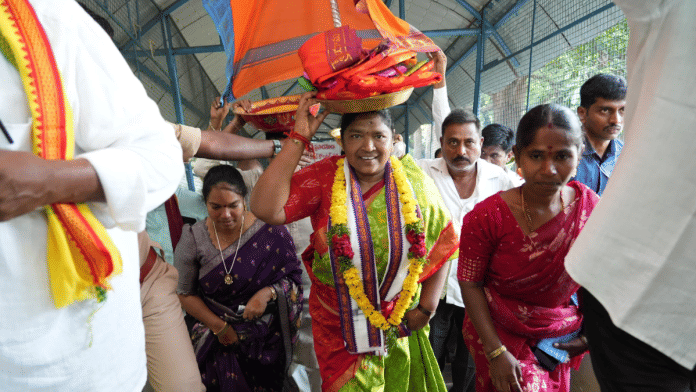



Hyderabad: At the time of her swearing in on 6 December 2023, Telangana minister for panchayat raj and rural development and women and child welfare Danasari Anasuya Seethakka was welcomed on stage with a thunderous applause by her followers.
The frenzy of the crowd prompted the then governor Tamilisian Soundararajan to pause for a few minutes before administering the oath to the Congress MLA from Mulugu. Some even said the arousing welcome she received was louder than what the chief
minister-to-be Revanth Reddy got.
Born to a tribal family in present day Telangana’s Mulugu district, a young Anasuya once wielded the gun for the cause of the poor and the downtrodden. That journey as a teenage Naxal began with the nom de guerre Seethakka, a name with which she is still more commonly known in the region.
Her journey from the forests of Adilabad to the legislative assembly saw her join the political mainstream in 2004. She is also a lawyer, a legislator as well as now has a PhD in political sciences from Osmania University.
Sharing her journey with ThePrint, the three-time MLA stated that she and her government would offer jobs, land, or access to capital for them to pursue a life of peaceful purpose.
Also Read: 2 neighbouring states allow Muslims to leave work early for Ramzan. 1 faces ‘anti-secularist’ barb
What exposure did you have to the Maoist and the People’s War Group (PWG) movements during your childhood and how did this impact you?
I was an Adivasi tribal girl, all of 14 years, when I first began taking up issues that were important to me and my friends. As a Grade 8 student, my first protest was against the poor hygienic practices at the government girls hostel. I was studying at the Mulugu Girls High School.
I took the lead in protesting against stale food served to the students and also filed complaints against ruffians who used to engage in eve teasing while we played in the school grounds during evenings. Later, in 1986, when there was a Godavari flood, I went around Mulugu town with my classmates to collect funds and distribute whatever money was raised among the flood victims.
There used to be plenty of discourses by the senior Naxals in our village square. The Dalams (groups) used to convey their messages through songs and plays that impacted us deeply.
How did interest in public welfare then metamorphose into joining the Naxalist movement? Who was your inspiration?
During my fifth or sixth grade in the 1970s, I read about Phoolan Devi. I don’t know how the book made its way to my house. I remember being taken in by her fearlessness and resolve to stand by women and the poor who were discriminated against and exploited in many ways. How Phoolan Devi dealt with caste and gender-related issues moved me greatly. She was the biggest influence on me and I turned a rebel.
Around the time, my maternal uncle joined the Naxal movement in 1975 and was an active opponent of the Emergency in 1977. Later, my cousin (later husband) was also part of the movement and joined the PWG forces. So, this paved the way for my joining the movement. My elder brother followed soon after I joined.
Some years later in 1994, when the movie ‘Bandit Queen’ was released, I visited Hyderabad for a health check-up and took a short break from my activism. I watched the movie and saw how the entire story and the characters came alive once again. I went back with an even firmer resolve.
At what age did you join the Naxal movement? Weren’t you scared about how your family would react?
I left home after completing my 10th grade in 1988 July. Since I used to have numerous interactions with people from my village who joined the movement earlier, I had an inkling of what it meant to live the life of an underground armed rebel.
I decided to leave one fine day and did not inform my parents or others in my family. The first few months were very difficult but I later adjusted to life in the jungle and among the revolutionaries.
Did you have an understanding of the issues you were standing up for or against?
I learnt everything after I joined the PWG. We used to be given lessons on equality, land rights, protecting the weaker sections of the society, and not exploiting natural resources. For me, the fight against gender discrimination and slavery was felt timely.
Even as a child, I often questioned established practices and never adopted any practice without understanding it myself. As a school goer, people in my village often asked me why I wasn’t interested in adorning my hair with flowers or wearing a bindi. The resolve to never bow down to anyone was strengthened after I joined the Naxalist movement.
The sense of unity made me fearless. I studied in a girls’ hostel and we used to stand up against injustice collectively and raise our voices unequivocally. So, the belief that we could work together for any cause was an experiential lesson for me. That we would be ironing out societal problems working together unitedly was what gave me the strength to plunge into the Naxalist movement.
Then what circumstances led you out of the movement?
A reality check and plenty of other disturbances. Firstly, the PWG and the CPI (Maoist) groups were split into multiple groups in the late 1990s. The infighting led to cadres from both sides losing lives. The constant vigil against enemy groups proved to be exhausting and many of us were disenchanted by our leaders. I began to question the purpose of joining this movement and nearly 30-40 of us decided to come overground.
Also, with successive governments introducing many pro-people policies, I noticed that our people’s lives were getting better. There was visible change in the societal conditions. This almost made our movement toothless that was anyway weakened by internal rifts. These circumstances pushed me to surrender in 1997. I joined the Telugu Desam Party in 2004 and after the creation of Telangana, I joined the Congress in 2017.
What kind of changes did you bring about during your 11-year stint as a Naxal?
Foremost is bringing about a consciousness among people to question. To question the lack of rights, absence of basic services, the increase in crime against women, and dignity of all irrespective of caste and economic status.
That most of our tribal villagers have patta passbooks today and cultivate their produce is because of our struggle to make this a reality. Then the ‘Jal-Jungle-Jameen’ call given by Gond tribal hero Komaram Bheem to protect our water resources, forests, and land was what I strived to make a reality.
For those of us who live in tribal communities, this is our very foundation of life; our identity. So, my contribution was to raise awareness for protecting our fundamental rights and my voice against any form of exploitation.
Later, when did you decide to pursue further education and join mainstream politics?
We come from the Gotthi Koya tribe and my parents are very simple people. They still live in the same village and are more concerned about their goats straying and they remain unaffected by power. Just as people used to approach them earlier during my Naxal days to have them convey a message to me on issues of land tenancy, even today, people line up before our house seeking their intervention for ration cards or piped water connections.
My father still cycles to the forest every day and does his work himself. As a self-respecting individual, though uneducated, he recently fought with me for revoking his pension because I mentioned that they did not need government assistance anymore because I could take care of both of them.
Do you still think the tribals in Telangana or the villagers who have moved from Chhattisgarh continue to face problems?
Yes, we continue to have a lot of problems with the Ministry of Environment and Forests even to secure our basic rights. The Gutti Koya tribes who live largely areas adjoining the central forest region in Chhattisgarh and Telangana, still can’t dig a borewell without the MoEF’s permission.
After a borewell is dug, the forest officials fill the pits with mud to halt the process. There are many villages who still do not have access to electricity because we need the department’s permission to erect electricity poles. I have brought these issues to the notice of Konda Surekha, the state forest minister, but for certain areas, we still need the Centre’s permission for many projects that would fulfill the basic needs of the tribes.
Governments at the Centre and the state have introduced reforms such as the Integrated Tribal Development Agency (ITDA) and PM-JANMAN. In your view, how far have these schemes or reforms been successful?
The forest continues to be exploited even to date. Earlier it was by the Britishers, and later it was the smugglers. The irony is that if tribals use forest resources, it is called exploitation, but if the government or a private organisation does it, it is called development.
We need a Right to Forest Produce Act to allow the tribals the right of first refusal. Because Adivasis do not need lessons in forest conservation.
For them, the forest or the trees are not a source of business revenue, but an extension of their identity. Their lives are for the forest, by the forest, of the forest. So, allowing controlled access to the forest resources will not help them live better, but also reduce conflict with the State.
Secondly, the ITDA needs to be strengthened and more education opportunities have to be created.
Of late, a number of senior Maoists have been surrendering. Have you made any specific suggestions to your government on how to deal with them?
Now that they have surrendered, we have decided to give them a space to voice their concerns. The chief minister meeting them in his office is a gesture to give them the dignity and respect they now deserve for leaving behind their armed rebellion. We would encourage them to participate in the democratic process in every way possible.
The Union home minister has made a special appeal to women Maoists to surrender. Why do you think a special announcement was made?
I must say that a number of women Maoists have lost their lives in the encounters because they made up the cadre. A special appeal is perhaps needed because the women require more time to blend into the society and firm up their plans to live life differently. It is not easy to gain acceptance in society and raise a family.
So, this could deter a lot of women from surrendering and taking their lives. But I too want to make an appeal to them that our government will offer equal access to men and women – financial, educational, and employment opportunities- if they surrender.
You chose to be a lawyer, pursued PhD, and you’re now a minister. Not everyone is lucky to have such avenues. Will your government provide any employment opportunities to the surrendered cadres?
After I surrendered, I pursued law because I wanted all Maoists who come into society to have legal access after surrendering. After practicing law for a while, I joined politics through the sheer dint of my hard work because I wanted a bigger platform to work for the people. I neither had economic access nor did I have any family legacy.
So, to all those seeking opportunity, particularly women, I will do whatever I can in my purview to offer jobs in my ministries and provide livelihood assistance to the women to live life better. Alternatively, if the Maoists would like to go back to their villages, government-owned lands could be given to them for cultivation. I will not rule out an opportunity for them to take part in village-level elections. We may also use their expertise and take suggestions from them on dealing with people’s issues.
CPI (Maoist) politburo member Devuji and central committee member Malla Raji Reddy, who surrendered in February, said that Maoist ideology will continue to live even if armed rebellion dies. Is this true?
Communist ideology will change forms but will never die. Maoism is not about violence or armed rebellion alone. It is about respecting the poor, ensuring there is equality, and prevention of exploitation of the lower strata of the society. There is no problem in believing in the ideology as long as it is conforming to our Constitution and it does not harm anyone. People’s franchise and the democratic process need to be respected.
(Edited by Tony Rai)
Also Read: Disease mapping, drone-aided farming & punugulu—Bill Gates’ day out with ‘friend’ Chandrababu