


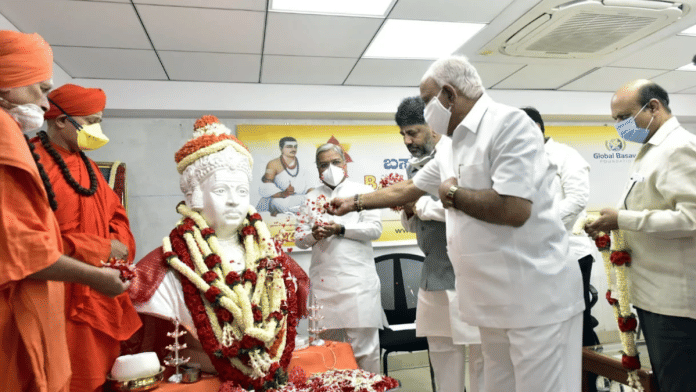
Bengaluru: The controversy over Kannada author Ravi Hanj’s book on Basavanna has reopened a long-running debate in Karnataka over the 12th-century reformer’s legacy, the identity of Lingayats and Veerashaivas, and competing interpretations of his teachings. The row has also drawn in Karnataka’s Congress government, which has reacted with a crackdown on the book.
“Veerashaivas and Lingayats are the same… The followers of Basavanna are called ‘Lingahathas’ and not ‘Lingayats’… Basavanna emptied King Bijjala’s treasury and used it for charity… The Sharana literature—Basavanna’s teachings—is full of contradictions!” These are some of the statements and writings in Chicago-based Ravi Hanj’s 600-page book, ‘Basava Mantapa’, which have sparked intense backlash and uproar in various quarters, drawing scrutiny and criticism for allegedly distorting the works and teachings of the 12th-century social reformer.
The Congress government led by D. K. Shivakumar was quick to decide on confiscating copies of the controversial book from stands and filing police complaints against Hanj and the publisher.
“The government will not remain silent if the honour of our Basavanna is violated. However, it is condemnable that an author named Ravi Hanj has written a controversial book titled ‘Basava Mantapa’ and has insulted Basavanna in a very derogatory manner. Our government will not tolerate this insult to a great social reformer who was a beacon for the entire human race,” Shivakumar said in a post Friday.
"ನಮ್ಮ ಬಸವಣ್ಣನವರ ಗೌರವಕ್ಕೆ ಧಕ್ಕೆಯಾದರೆ ಸರ್ಕಾರ ಸುಮ್ಮನಿರಲ್ಲ"
ಕರ್ನಾಟಕದ ಸಾಂಸ್ಕೃತಿಕ ನಾಯಕ, ಕ್ರಾಂತಿಕಾರಿ ಮಾರ್ಗದ ಹರಿಕಾರ ಜಗಜ್ಯೋತಿ ಬಸವಣ್ಣನವರು ನಮ್ಮೆಲ್ಲರ ಅಸ್ಮಿತೆ. 12ನೇ ಶತಮಾನದಲ್ಲಿಯೇ ಕರ್ನಾಟಕದ ಸಾಮಾಜಿಕ, ಧಾರ್ಮಿಕ ಹಾಗೂ ಸಾಂಸ್ಕೃತಿಕ ಇತಿಹಾಸಕ್ಕೆ ಹೊಸ ದಿಕ್ಕು ನೀಡಿದ ಮಹಾನ್ ಚೇತನರು.
ಜಗತ್ತಿಗೆ ಮೊಟ್ಟಮೊದಲ ಬಾರಿಗೆ… pic.twitter.com/NoiElKpaXq
— DK Shivakumar (@DKShivakumar) November 20, 2026
While the state government is confiscating all copies of the book from stands, protesters have publicly torn and burnt pages in protest against the author and publisher, prominent Kannada newspaper editor Vishweshwara Bhat.
The issue has united various factions within the community that are usually divided by politics, ideology and different schools of thought. These include leaders such as B. S. Yediyurappa, who has resisted attempts to classify Lingayats as a separate minority religion.
Lingayats are one of Karnataka’s most dominant communities and are believed, according to their own estimates, to account for around 15-17 percent of the state’s total population. They are a major bargaining bloc, politically and socially.
‘Distortions’ and disclaimers
Basavanna was a 12th-century reformer revered for his teachings, which remain relevant today.
According to H. Thipperudraswamy’s book ‘Makers of Indian Literature: Basaveshwara’, first published in 1975, Basavanna, as he was fondly known, was born in 1131 AD in Ingaleswara-Bagevadi (now in Bijapur district of Karnataka).
Although Basavanna read ancient Hindu scriptures while growing up, he rejected most practices of the faith. His main teachings included the rejection of caste and untouchability, Kayaka (work is worship), Dasoha (selfless sharing), worship of the Ishta Linga and monotheism, gender equality, and a preference for Kannada over Sanskrit, among others.
His teachings and philosophy, expressed through thousands of lyrical prose pieces, became known as Vachanas, which were exclusively written in Kannada.
Inspired by the Bhakti movement, Basavanna was critical of Vedic practices and believed in a casteless society.
Now Ravi Hanj’s comments on his book on Basavanna have fuelled the controversy.
“Basavanna never opposed Sanatana practices; he only opposed certain changes,” Hanj told Vishwavani in an interview, which has since been removed from the Kannada TV news portal’s YouTube channel.
In the same interview, Hanj said that one Vachana states, ‘Kalabeda, Kolabeda’ (don’t steal or kill), but that, historically, Basavanna emptied King Bijjala’s treasury for the welfare of his followers (jangamas).
“Did Basavanna have a right to that treasure? Doesn’t this amount to stealing? Also, it is said that Basavanna got Bijjala killed. This goes against Kolabeda,” Hanj said.
He later apologised for his statements during the interview, saying that his views on Basavanna had been “misinterpreted”, and apologised to the community.
“Without any hesitation, the government will take the strictest legal action against such miscreants who write lightly about the great people of the country and disturb the peace of society,” Shivakumar said in his post.
Yediyurappa, widely regarded as the most significant Lingayat political leader in Karnataka, also hit out at the book and its author.
“Recently, it has been said that the book ‘Basava Mantapa’ by author Ravi Hanj contains material that disrespects Basavanna and undermines his ideas. I strongly condemn, in the harshest and most forceful terms, any disparaging remarks about Jagajyoti Basaveshwara, whoever may have made them,” Yediyurappa said.
12ನೇ ಶತಮಾನದಲ್ಲಿಯೇ ಸಮಾನತೆ, ಸಾಮಾಜಿಕ ನ್ಯಾಯ, ಕಾಯಕ ಮತ್ತು ದಾಸೋಹದ ಮೂಲಕ ಮನುಕುಲಕ್ಕೆ ಹೊಸ ದಿಕ್ಕು ತೋರಿದ ವಿಶ್ವಗುರು ಅಣ್ಣ ಬಸವಣ್ಣನವರು ಕನ್ನಡ ನಾಡಿನ ಹೆಮ್ಮೆ ಮಾತ್ರವಲ್ಲ, ಇಡೀ ವಿಶ್ವದ ಮಾನವೀಯ ಮೌಲ್ಯಗಳ ಪ್ರತೀಕ. ಇತ್ತೀಚೆಗೆ ಕೃತಿಕಾರ ಶ್ರೀ ರವಿ ಹಂಜ್ ಅವರ “ಬಸವ ಮಂಟಪ” ಕೃತಿಯಲ್ಲಿ ಅಣ್ಣ ಬಸವಣ್ಣನವರ ಗೌರವ ಮತ್ತು ಚಿಂತನೆಗಳಿಗೆ…
— B.S.Yediyurappa (@BSYBJP) November 19, 2026
Bhat, the publisher and editor of the Kannada daily Vishwavani, has since issued a clarification about the book.
In a post Friday, Bhat said that his newspaper had been publishing articles by author Ravi Hanj under the ‘Basava Mantapa’ column for the past year and a half.
“Later, the collection of those articles was published in book form under the name ‘Basava Mantapa: Lingayat Veerashaiva Satyadarshan’. Even when Ravi Hanj wrote the articles, there was opposition here and there. We have given equal space to both pro- and anti-articles,” Bhat said in his post. He added that his newspaper was a platform for healthy debates on the subject.
Not the first time
For decades, a section of Lingayats has pursued attempts to formally delink itself from the Hindu faith.
Its members have also consciously tried to distinguish themselves from ‘Veerashaivas’—a term that is sometimes used interchangeably with Lingayats—as they believe the latter are either a sub-sect or a Hinduised version of the community.
On the eve of the 2018 Karnataka Assembly elections, then Chief Minister Siddaramaiah accorded minority religion status to Lingayats and made a clear distinction between them and Veerashaivas.
However, the move was projected by the Yediyurappa-led Bharatiya Janata Party (BJP) as an attempt to divide the Hindu vote bank.
This is not the first attempt to appropriate Basavanna’s legacy.
In November 2024, intellectuals were up in arms over ‘Vachana Darshana’, published by RSS-affiliated think tanks Ayodhya Publications and Prajna Pravah, which argued that Basavanna’s teachings had been “misinterpreted” by Leftist thinkers and the Jawaharlal Nehru University (JNU) fraternity.
To counter these claims, author Meenakshi Bali released a 60-page book, ‘Vachana Nija Darshana (The True Teachings of Basavanna)’, challenging the arguments made in the RSS-backed publication. Among other things, the publication claimed that Basavanna’s teachings, or Vachanas, were an extension of Vedic teachings—a characterisation criticised as running counter to the social reformer’s beliefs.
The controversial book was released by BJP National General Secretary (Organisation) B. L. Santosh in August 2024. It was viewed and criticised as an extension of a wider Hindutva push in education, particularly after the Basavaraj Bommai-led BJP government attempted to change school textbook syllabi in 2022.
Under Bommai, the Rohit Chakrathirtha-led revision committee came under intense scrutiny for changes made to textbooks from Classes 6 to 10, including nuanced edits and carefully crafted changes that selectively removed references to various historical personalities.
At the time, the opposition Congress and academics alleged that the revision committee had selectively used the word ‘Dharma’ for major religions while referring to Buddhism, Jainism and others as ‘Matha’ (caste in Kannada) or ‘Sampradaya’ (traditions). This was alleged to be part of an attempt to co-opt them into Hinduism.
“In Bharata (India), Jews, Christianity and Islam are the only ones that can be called religions. Buddhism, Jainism and various traditions (Sampradaya) are different from religion. They can be distinguished and identified as believers and non-believers in them. Those traditions (Sampradaya) that believe in the Vedas are called theist traditions. Those that do not believe in the Vedas are non-believers or atheists. Dharma refers to a concept of a way of life,” said a revised textbook at the time.
(Edited by Viny Mishra)