



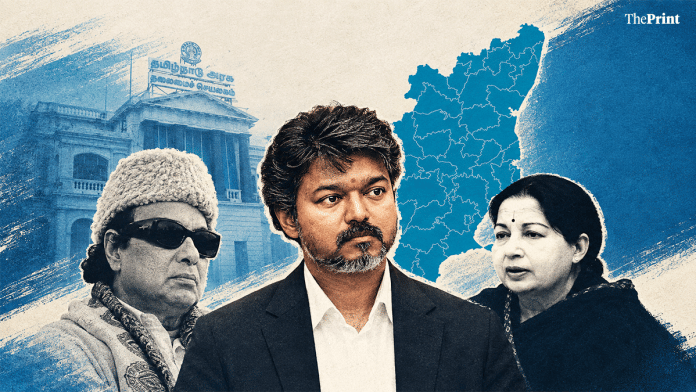

Chennai: Movie stars have long essayed the lead roles in Tamil Nadu’s politics but Chief Minister C. Joseph Vijay’s return to a silent era is a whole new script in play. The Tamilaga Vettri Kazhagam (TVK) leader’s recent Assembly speeches may have become major talking points of late, but the chief minister has largely remained silent on several state and national issues. He has also maintained an unbridgeable distance from unscripted media interactions.
The media distance, to be sure, is no new twist in the tale; only that Vijay has taken it to an extreme. M.G. Ramachandran (MGR) was the first actor-chief minister who championed public presence and working on the ground with the masses, but he did have limited media engagement. J. Jayalalithaa mastered the art of selective public engagement even as she maintained an aura of distance from the media. Vijay’s silence—touted by the party as a less-talk more-work strategy—features an almost complete avoidance of unscripted media interactions, reliance on tightly scripted speeches, and prolonged silence on many key issues.
As the TVK government completed its first 100 days last month, the ‘silent government’ approach became one of the most debated features of Vijay’s leadership, praised by allies as disciplined focus and criticised by opponents as opacity and disconnection.
Also Read: Stalin advises ‘CM Thambi Vijay’ to stop jawing about, ‘speak with dignity befitting office’
MGR: Rare and measured interactions
MGR, who became chief minister in 1977 after founding the All India Anna Dravida Munnetra Kazhagam (AIADMK), cultivated an air of deliberate inaccessibility to the media once he came to power. It was not easy for journalists to get access to the chief minister since he rarely met the press and almost never granted exclusive interviews. Political analysts say that requests for one-on-ones of MGR were rare; some journalists lucky enough to get them had to wait years.
When interactions did occur, they were carefully managed. In a rare 1978 interview with India Today, MGR answered questions in measured Tamil through his chief security officer, who acted as interpreter. Political analyst A. Ramasamy recalls that MGR’s public encounters were largely limited to rallies, party functions and other related events but he was seen meeting the common people during such events. As Opposition leader, however, MGR was more approachable, frequently meeting senior journalists from major publications.
“His communication strategy rested less on frequent press conferences and more on the emotional bond forged through public interactions, cinema and mass rallies. Cinema was a key platform of communication for MGR and he believed that films were ultimately about communicating with the people. It worked for MGR but the times have changed, and while Vijay relies on social media narratives, media interactions and press conferences are required to elaborate on the positioning of the government,” political analyst Arun Kumar told ThePrint.
Jayalalithaa: Selective media engagement, formal distance
Jayalalithaa, who rose from being a co-star and political aide of MGR to multiple-term chief minister, was even more distant from the media once in office than MGR. She did give out individual several pages-long statements but her interactions with journalists remained minimal during her tenure, a feature that marked her days in the Opposition too.
After returning to power in 2011, Jayalalithaa held a formal interaction at the secretariat and did met the media on a few occasions, but only short bites would be available from her media interactions during official visits or after events. She would, however, issue statements after meetings with the prime minister or other key events.
The 2004 BBC Hardtalk session with Karan Thapar made headlines as Jayalalithaa turned visibly confrontational in defending herself from charges of authoritarianism and media bias. A later conversation with Simi Garewal was more personal and reflective. Overall, Jayalalithaa’s media interactions remained limited and selective.
Political commentator S. Gurumurthy calls J. Jayalalitha very intelligent and intellectually involved in politics, even in terms of her media strategy. “She was chosen for politics and her distance from media was a clever move to convey only what was necessary through regular statements and those could get across really well. Most official communication flowed through press notes issued by the AIADMK party office or the Department of Information and Public Relations. She repeatedly maintained that she was accountable to the people, and kept reporters at a distance,” he told ThePrint.
Vijay’s strategy of silence
While Vijay’s distance from media is being compared to previous actor-turned-politicians in Tamil Nadu, Gurumurthy says that there is no comparison of MGR with Vijay because the former made a party on his own within the Dravida Munnetra Kazhagam (DMK), and he had that infrastructure to build it. “AIADMK was not a new party and MGR was active in politics and came with an understanding of politics, moving with Annadurai. Vijay’s silence is coming not from strategy but more from lack of understanding of politics and experience, because he needs to gain the knowledge of Tamil Nadu politics and political clarity to comment on whatever is ongoing in the state,” he said.
Vijay stopped media interactions long before entering politics, and the actor was labelled arrogant. That same attitude of preferring silence over direct interactions is reflected in his role as chief minister. He has held no formal press conferences, takes no questions from journalists, and relies almost exclusively on scripted speeches, official statements, and occasional pre-recorded video messages.
During the 2026 campaign his public speaking time was unusually limited, often cited to have been dependent on police permissions and as avoiding public inconvenience. Even after the Karur stampede during the TVK rally, condolences poured in from everywhere but Vijay’s recorded statement came after two days.
That was said to be a disturbing event for party and Vijay himself, but the chief minister showed his reluctance in matters of celebration too. When TVK emerged as the single-largest party after 2026 Assembly elections, he delayed public remarks. Since assuming office, the pattern has continued. On many state and national issues the Chief Minister’s Office remains silent or responds only through formal channels, leaving allies or official notes to fill the gap.
“We are seeing the silent strategy being applied on a general basis in the politics, with more than one politician, both at the Center and at the State level. The lack of media interaction is seen as silence but the fact remains that politicians have a way of interacting with the media, and they may do it for various reasons, including avoiding questions from the media or some form of strategy to develop curiosity,” political commentator Mukund Padmanabhan told ThePrint.
Party leaders argue that the silent approach has clear advantages, as controlled messaging prevents unnecessary or misleading narratives. In May this year, TVK minister K.A. Sengottaiyan defended work over interaction when answering questions about why Vijay was not holding regular press conferences or meeting journalists directly. He said that the chief minister does not follow the style of issuing daily statements or engaging in frequent debates like other leaders. Instead, Vijay directly announces schemes and addresses public needs when required. Sengottaiyan added that Vijay “will certainly meet journalists when necessary”.
The silence strategy helped Vijay navigate crises including the Karur stampede and personal controversies of divorce or being linked with co-actors. Allies such as Viduthalai Chiruthaigal Katchi (VCK) leader Thol Thirumavalavan has also described it as a “talk-less, work-more” formula that prioritises governance over political theatre. The distance from media also preserves the larger-than-life actor image built over decades of cinema.
Not without criticism
However, the drawbacks of this ‘silent government’ has created an opaque environment around official position of the government on the state issues, federal disputes, law-and-order concerns, women’s safety, and other pressing matters.
Without regular unscripted engagement, the public and media rely on source-based information, while official information is not communicated. Opposition leaders have repeatedly questioned the absence of a clear position of the chief minister on issues such as the student protests, farmer loan waivers, Mekedatu dam conflict with Karnataka, and others. Some analysts see the style as a reflection of inexperience or sense of entitlement rooted in star status, noting that governance requires explaining complex decisions and answering criticism.
Tamil Nadu’s earlier star-chief ministers limited media access but never fully abandoned the possibility of engagement. Vijay’s silent experiment tests whether a modern, mass image-driven electorate will accept a chief minister who communicates very rarely will be welcomed in the long run by the people.
Gurumurthy says that Vijay has been a mystery because he never really prepared himself to be in power. “The victory was a shocker and when you get into such a position, you need to stabilise yourself on understanding the handling of the Centre, and national and state issues. He declared the BJP as an ideological enemy but never said anything on policies against them since he came to power. He called DMK also as evil power and declared them enemy but he is supporting all the policies of the rival party. People have not voted for policy changes or ideology, it is just that they were fatigued with the two Dravidian parties.”
He further added that the government still needs more political clarity and unless Vijay has a larger and stronger understanding of issues, he might choose to stay silent. “TVK has hijacked Tamil identity issues and used them to win over the people. TVK’s ideology still remains a blur and we do not know how he will shape up. We do not know when the government will make a move to issue a clear communication,” he added.
(Edited by Nardeep Singh Dahiya)
Also Read: Investments push in UK, Silverstone pitstop—Vijay’s first overseas trip as Tamil Nadu CM