








New Delhi: The government is likely to introduce a bill to implement the 2023 women’s reservation law during the ongoing budget session–a move that drew immediate pushback from the Opposition, which questioned its timing ahead of elections to four states and a Union territory.
The Nari Shakti Vandan Adhiniyam is a 2023 law that reserves one-third of seats for women in the Lok Sabha, state assemblies, and the Delhi Assembly. The Act was passed three years ago, but it was not implemented due to the pending delimitation exercise. It is speculated that the government may bring amendments to the law to unlink its implementation from delimitation, which is expected in the next financial year (2027-2028).
On Thursday, the government indicated in Rajya Sabha that it will move to operationalise the women’s reservation law. Opposition parties reacted to this, asking why the government had chosen to act now, considering elections were imminent in Assam, Kerala, Puducherry, Tamil Nadu and West Bengal this month.
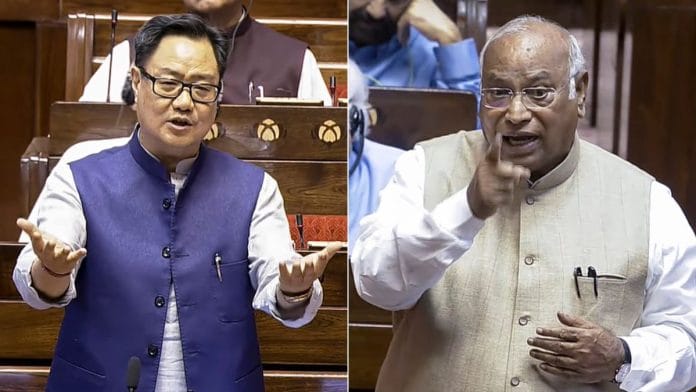
Leader of Opposition in Rajya Sabha, Mallikarjun Kharge, said the bill could have been introduced at the start of the budget session or at any point in the past three years. “We all will support this but don’t make it an election issue by bringing it during elections,” he said.
Union parliamentary affairs minister Kiren Rijiju rejected the charge, arguing that the government was honouring a commitment.
“We have a bounded duty, a commitment, which the Parliament of India has given to the women of this nation,” he said, adding the move had “nothing to do with a specific state election”.
He said the government had already consulted 80 percent of parties on the matter, and that there were constraints on the timescale within which the legislation could be enforced. “There should be no politics on women’s reservation,” he said.
The issue came up on Thursday when Rijiju told the Upper House the government planned to bring “certain bills and certain important issues” in the next two to three weeks—items he said had already been shared with Opposition members.
Congress leader Jairam Ramesh, who twice sought clarity on whether the House would be adjourned sine die or to a later date, characterised the timetable as politically motivated. Kharge had written to Rijiju demanding that an all-party meeting on the matter be held only after polling across states concluded on 29 April.
“The government has a single minded objective of getting some political advantage of passing a bill, violating the election model code of conduct and have the bill passed in the next two to three weeks,” Ramesh said.
Leader of the House J.P. Nadda denied that the timing was orchestrated and asserted the government’s right to schedule legislative business as it saw fit.
“You think we’ll take credit for the bill. Why don’t you consider the fact that the bill that you couldn’t pass for 30 years, was passed within 2 days by the Prime Minister. We took credit for it that day itself. And this isn’t about taking credit, this is the question of women’s identity,” Nadda said.
He added, “The sign of this developed India will be that, in the coming times, 33 percent of women will sit in this House (Lok Sabha), this will be its impact.”
Union Commerce and Industry Minister Piyush Goyal sharpened the government’s counter-offensive, demanding that the Opposition state its position clearly.
“I just seek clarification from the Leader of the Opposition and other senior leaders here, are they suggesting that they are opposing women’s reservation? Let us be clear about it,” he said.
Several Opposition MPs lined up to contest the government’s framing.
Aam Aadmi Party’s Sanjay Singh said the government’s claimed urgency was at odds with its inaction through the session. “You want to look at the elections and politicise the issue. You don’t want to give women reservation or their rights… You’re the one politicising the issue and blaming us instead,” he said.
Rashtriya Janata Dal’s Manoj Kumar Jha placed on record that the Opposition was united in supporting women’s reservation, but said his party, along with the DMK, was pressing for quota within reservations for SC, ST and OBC women.
NCP-(Sharadchandra Pawar) MP Dr Fauzia Khan alleged she was among those called for government consultations but was made to wait outside Union minister Rijiju’s home. She also raised another question: “I want to ask, will you give reservations in the Rajya Sabha and Legislative Councils as well? Why not in the upper houses?”
Congress’s Jairam Ramesh Thursday revisited the September 2023 passage of the bill, when the then Leader of Opposition had demanded the law’s implementation from the 2024 Lok Sabha election. The government had then cited the need to complete a census and delimitation exercise first.
“For 30 months, they have slept. Suddenly, they have discovered, we don’t need census, we don’t need delimitation, because we have a challenge in West Bengal, Tamil Nadu…” he said.
(Edited by Prerna Madan)
Also Read: What happens when ‘women’s work’ becomes a profession? It’s still men who rise