






Chennai: A day after Tamil Nadu Chief Minister Joseph Vijay unveiled a nuanced change in his government’s stance on delimitation from a hard ‘freeze’ to a softer ‘fair’, the Tamilaga Vettri Kazhagam (TVK) government resurrected its ‘freeze’ demand, but not without leaving an icy knot in its wake.
On Friday, the party made it clear that it needs a ‘freeze’ on delimitation, meaning the number of seats in the Lok Sabha must not change; ‘fair delimitation’ implies that a state’s proportional strength remain the same in the House. The state government’s came a day after Chief Minister Vijay appeared to have revised his party’s stance, seeking from the Centre what sounded to many like a ‘fair delimitation’, a stance similar to that of the Opposition Dravida Munnetra Kazhagam (DMK).
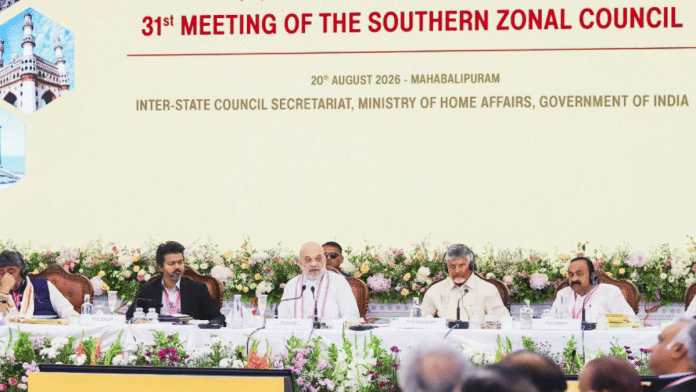
Presented at the 31st Southern Zonal Council Meeting at Mahabalipuram near Chennai—chaired by Union Home Minister Amit Shah—on Thursday, Vijay’s seemingly thought-out stance on delimitation was widely seen as a departure from his government’s own. It has been only days since 12 August when the TVK government took the initiative to get an Assembly resolution passed, calling for a freeze on the number of seats in the Lok Sabha at 543. The resolution was backed by the DMK and Left parties as well.
“As the freeze on the allocation of Lok Sabha seats based on the 1971 Census approaches its end and the Delimitation Bill 2026 is considered, there is a genuine and shared concern across the southern states that delimitation based predominantly on populations may diminish our collective voice in Parliament,” Vijay had said at Mahabalipuram, Shah seated right beside him.
“The southern states have been at the forefront of population stabilisation, human development, and economic growth. These achievements reflect the successful implementation of national priorities and should not result in a reduction of our representation. Public policy must not inadvertently penalise states for fulfilling national objectives,” he’d further said.
Such an approach would uphold the principles of equity, preserve the federal balance envisioned by the Constitution, and reinforce the confidence of all states in democratic institutions, he had added.
Critics said that Vijay had moved to ‘fair delimitation’ by urging the Union government to provide a clear legislative assurance that no state would suffer a reduction in its percentage of representation in Parliament on account of its success in population stabilisation.
DMK spokesperson Saravanan Annadurai accused Vijay and the TVK government of performing a “spectacular U-turn”. He told the media that the meeting revealed the U-turn of the TVK government, and Chief Minister Vijay, thereby ditching the Congress.
“Earlier, on the question of delimitation, the stand of the TVK party was ‘no delimitation’. ‘Please don’t do any delimitation, freeze it for 543 seats,’ they said. But in that meeting, he said Tamil Nadu should not be put at a disadvantage, the same percentage of political weight that Tamil Nadu has right now should be maintained,” he said.
That the ‘chill factor’ had gone missing in Vijay’s speech was jumped on the Opposition in the House too. As the Assembly reconvened on Friday after a four-day break, the issue sparked an exchange between the ruling TVK and Opposition DMK. Leader of Opposition Udhayanidhi Stalin asked why Chief Minister Vijay did not use the word ‘freeze’ at the Southern Zonal Council meeting even though his government had passed a resolution in the Assembly to freeze the total Lok Sabha seats at 543.
In response, TVK legislator CTR Nirmal Kumar said that the agenda of the Southern Zonal meeting was to discuss broader issues pertaining to all southern states, and that Chief Minister Vijay had said the same thing. Highways Minister Adhav Arjuna intervened, saying: “Our government has no change in stand with regard to delimitation. We don’t need ‘fair delimitation’, what we need is ‘freeze delimitation’.”
Taking the attack to the DMK camp, Aadhav charged the party with not opposing delimitation firmly. “You have to oppose, not boycott. When DMK was the ruling party, they burnt copies of the Delimitation Bill and staged protests, saying the number of MPs should not be increased. When the Bill comes up in Parliament, DMK should not stage a walkout. The central government should bring a special law, like Vajpayee did, to freeze the [number of] Lok Sabha seats for the next 25 years,” he said.
He added that all 39 MPs of the DMK should stay inside the House and register their opposition. “If you boycott, that too will turn out to be favourable for the ruling party. If the Lok Sabha constituencies are delimited based on population, the political representation and rights of the southern states will be lost.”
The IT wing of the TVK, the party’s information technology and social media division, had taken up their leader’s defence as soon as the criticism began on Thursday. A clarification on social media platform X said that the chief minister’s speech at the Southern Zonal Council meeting expressed a “broad visionary view to protect the current representation of the southern states that have succeeded in population control”.
The statement insisted that this was consistent with the 12 August Assembly resolution, which sought to fix the number of Lok Sabha members at 543, continue the current seat allocation ratio between states without alteration, and ensure one-third reservation for women. The clarification said that a direct letter had also been written to the Prime Minister on the matter and accused critics of spreading “wrong opinions” without understanding the position.
With the freeze on seat allocation based on the 1971 Census nearing its end, there is widespread concern that a population-based exercise could reduce the collective political weight of states that have successfully stabilised population growth. Questions remain over how a “percentage protection” would be legislatively guaranteed in practice and whether an expansion of the House would further tilt numerical dominance towards northern states.
(Edited by Nardeep Singh Dahiya)
Also Read: Hits, misses & criticism: 100-day report card of Vijay’s TVK govt in Tamil Nadu