





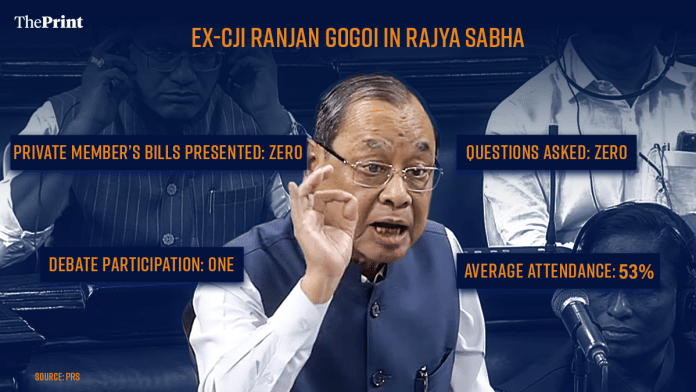



New Delhi: Questions asked: zero. Private member’s bills presented: zero. Debate participation: one. Average attendance: 53 percent. That, in a nutshell, is the Rajya Sabha performance of Ranjan Gogoi, the former Chief Justice of India who completes his six-year tenure in the Upper House of Parliament next month.
According to data compiled by PRS Legislative Research—a Delhi-based non-government research organisation—till 13 February 2026, Justice (Retired) Gogoi’s average parliamentary attendance of about 53 percent over six years is much lower than the average 80 percent attendance of Rajya Sabha MPs.
On his report card as a Rajya Sabha MP, Gogoi told ThePrint, “Though I attended almost as many sessions as I could manage, I know my attendance has been a little below my own expectations and I know I didn’t ask any questions or introduce any private members bill and spoke once on the NCT bill.
“It is because of the House having witnessed disruptions for one reason or the other. It is only of late that the question hour and the zero hour in the Rajya Sabha is being held in a meaningful manner.”
Gogoi retired from the Supreme Court in November 2019 after serving as the country’s top judge for around 13 months. Barely six months after his retirement, he was nominated to the Upper House, becoming the first former CJI to have been nominated to Rajya Sabha.
As the CJI, he headed the Constitution bench that delivered the landmark judgment in the Ramjanmabhoomi-Babri mosque title dispute in Ayodhya.
In his six years as a nominated MP, the former CJI has not asked a single question in the Upper House or introduced any private member’s bill, as per data provided by PRS and Rajya Sabha records.
He also has no ‘special mentions’ to his account, which MPs make on matters of public importance.
Asked about it, he told ThePrint, “Also, I didn’t ask questions for the sake of asking questions. I didn’t participate in the proceedings for the sake of participation because I’m not a professional politician who needs to make a mark for a rise in career politics.”
He went on to say, “But there are several other areas where I have contributed being a member of Parliament like addressing foreign delegations, heads of mission, law enforcing agencies on varied topics starting with the evolution of the constitution, its detailed provisions, its actual working, the role of the judiciary and the legislature under the constitution.
“The meetings with the foreign delegations, heads of missions and law enforcement agencies were under the auspices of the institute of constitutional and parliamentary studies headed by the Lok Sabha speaker.”
He added, “To the law enforcement agencies I had addressed on the dimensions of the three criminal laws that had come into force and by law enforcement agencies I mean that part of the Delhi police who are actually on the ground namely inspectors and below.”
Explaining the rationale behind accepting his nomination to the Rajya Sabha, Gogoi had said that he “accepted the offer of nomination to the Rajya Sabha because of a strong conviction that the legislature and judiciary must, at some point, work together for nation-building”.
“My presence in Parliament will be an opportunity to project the views of the judiciary before the legislature and vice-versa,” he had further said at the time.
In December 2021, Gogoi again defended his decision to take up the posting in his memoir Justice for the Judge. He explained that he accepted the nomination without hesitation because he wanted to raise issues pertaining to the judiciary and the Northeast region, to which he belongs.
While the average for a member participating in debates stands at 144, Gogoi has participated in merely one.
The ex-CJI delivered his maiden and only speech in Parliament in August 2023, more than three years after being nominated to Rajya Sabha in March 2020. He participated in the discussion on the Government of National Capital Territory of Delhi (Amendment) Bill, 2023.
Supporting the bill, Gogoi had said, “In my respectful submission, the bill is perfectly valid. The position in my perception is this—the state legislature makes laws for the states, Parliament makes laws for the Union territories. For NCT of Delhi, the legislature makes laws on state subjects except three. By virtue of 239AA(3)(b), Parliament has the power to frame laws beyond these three.”
“That is exactly what the bill is seeking to do. Therefore, there is no question of overreaching (SC order). As a layman, it is not subjudice, what is pending before the SC is the validity of the Ordinance and specifically two questions referred to the Constitution Bench, and has nothing to do with what is being discussed in the House,” he added.
When Gogoi delivered his maiden speech, several women leaders from opposition parties staged a walkout over sexual harassment allegations against him. The Supreme Court had cleared him of any wrongdoing in 2019.
In April 2019, a former junior court officer had alleged that she was sexually harassed by Gogoi. A three-member in-house committee of the Supreme Court, led by Justice S.A. Bobde (since retired), unanimously cleared him of the sexual harassment charges.
Also Read: ‘Basic structure’ doctrine a judicial coup against Parliament. Gogoi is right in debating it
The Rajya Sabha numbers
According to PRS data, Gogoi’s attendance in the 2026 budget session stood at 50 percent, while it was 80 percent during the 2025 winter session, and 81 percent in the Monsoon Session before that. His attendance during the 2025 budget session was 85 percent, while it was 58 percent during the 2024 winter session.
Going further back, it was just 12 percent in the monsoon session of 2021, 4 percent in the budget session that year, and 67 percent in the budget session of 2020.
“Out of the salary received as a Rajya Sabha member amongst other things I had created a scholarship fund and have taken care of the legal education of over 50 students for a period of 3-4 years for now. Not a penny of this ‘income’ has been used by me for my personal needs,” Gogoi told ThePrint.
While his attendance did rise in the past few sessions, he made no significant intervention such as asking questions or participating in debates. The national average for a Rajya Sabha MP when it comes to asking questions stands at around 261 over a six-year term. Gogoi did not submit any questions or private member’s bills, according to the data.
From October 2024 onwards, he has been a member of the Consultative Committee for the Ministry of Law and Justice. Before that, in September 2024, he was made a member of the Committee on Personnel, Public Grievances, Law and Justice.
Between September 2021 and May 2022 he was a member of the Committee on Communications and Information Technology. As part of the committee on communications too, where Gogoi served for eight months, he did not attend a single meeting, according to Rajya Sabha records.
In 2021, Gogoi justified his absence from Rajya Sabha due to Covid, and later said as a nominated member he is an independent member, not governed by any party whip.
Summing up his tenure as a member of the Upper House, Gogoi told ThePrint, “My experience in the Rajya Sabha has been wonderful. It’s a rare experience for a former member of the judiciary. I think there are a lot of good practices in the Rajya Sabha which the judiciary can seriously consider adopting.
“Given the circumstances, I believe I have done my best but as the saying goes one could have always done better.”
(Edited by Ajeet Tiwari)
Also Read: Why judges with post-retirement jobs only criticised, why not ‘activist judges’: Ex-CJI Gogoi
Expected from a jurist who wasat most a very mediocre judge who was promoted on seniority nothing else hence expecting this guy to talk anything meaningful is sheer day dreaming. Good riddence to a bad rubbish