





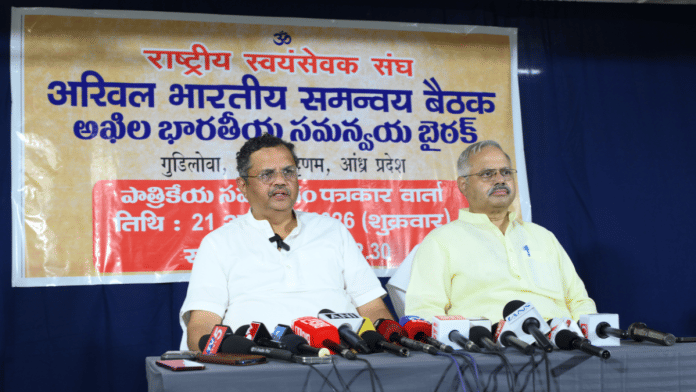

Hyderabad: The protest led by the Cockroach Janata Party (CJP) at Jantar Mantar, New Delhi, in the last couple of months was over systemic flaws and not corruption alone, RSS leader Sunil Ambekar said in Gudilova, Visakhapatnam at an event Friday.
Ambekar, the RSS’ Akhil Bharatiya Prachar Pramukh (all-India publicity chief), and C R Mukunda, the Sah Prachar Pramukh (joint publicity chief) called for a constructive approach to “improve the system”.
“Addressing systemic flaws requires vigilance and effort from both the government and society. Whether it involves issues like NEET or other systemic problems, such matters cause anxiety among Gen Z regarding their future. It is essential to understand this anxiety and find solutions for it,” Mukunda said, responding to a media query.
Over three days, 32 wings of the RSS shared their experiences, future challenges, and the upcoming course of action, according to a release shared by the RSS.
In the backdrop of the protests in both New Delhi and Jharkhand, much of the RSS’ discussions seemed to focus on India’s Gen Z and their concerns on various social media platforms. Extensive discussions were held regarding the ideas, aspirations, and creative potential of Gen Z, their concerns about the future, and their role in nation-building, Ambekar said.
“Instead of merely engaging in didactic conversations with the youth, it is essential to connect with them directly, understand their sentiments and concerns, and foster a sense of affinity towards the nation, culture, and social values through dialogue,” Mukunda said, responding to media queries on how the RSS intends to respond to youth issues.
Continuing on the problems of today’s youth, the RSS discussed the need for society’s participation in eliminating drug consumption instead of relying on the police and the government alone. The Sangh said it believes in coordinated efforts involving educational institutions, parents, social organisations, the administration, the police, and other relevant stakeholders to create a drug-free society.
Key deliberations
Ambekar and Mukunda spoke to the media Friday after the three-day RSS all-India coordination meeting held at a school in Gudilova, on the outskirts of Vizag. Briefing the media, they said their discussions revolved around social issues such as demographic imbalance, youth drug abuse, a review of the RSS Panch Parivartan framework (social harmony, family values, eco-friendly lifestyle, indigenous consciousness, and civic duty), alongside a development model for India’s future.
“Serious deliberations also took place regarding demographic changes and imbalances. The situation in India was discussed against the backdrop of challenges arising from aging populations and declining fertility rates in many countries across the world, the shifting population ratios across various regions and communities and their social impact, while also considering measures to maintain societal balance and harmony,” Mukunda said.
The meeting also featured a discussion on a development model rooted in an Indian perspective. Deliberations focused on ensuring that development is self-reliant, eco-friendly, and inclusive—encompassing all sections of society—and reviewed the experiences of organisations working in the economic sector.
Against the backdrop of the Sangh’s centenary year, a special discussion was held during the meeting regarding the various aspects of ‘Panch Parivartan’ aimed at societal change.
The RSS spokespersons also spoke of their fellow organisations’ work undertaken in the devastating Assam flood to provide relief to people and rehabilitate the flood victims.
Prominent office-bearers and activists from Sangh-inspired organisations working in various sectors for the benefit of society and the nation participated in this meeting. A total of 326 delegates were invited to the meeting, including women leaders from various organisations; 49 women delegates participated in the three-day event.
The invitees, participants, and senior RSS ideologues also studied the growing impact of Artificial Intelligence (AI) on society, the release said.
While discussing the positive opportunities offered by AI alongside the associated precautions and challenges, the need to view it through an Indian perspective and within the Indian social context was underscored. “Deliberations will continue about how to utilise technology for the welfare of society and how to raise public awareness regarding its potential adverse effects,” Mukunda said.
Mohan Bhagwat’s overseas trip
Responding to a question on the purpose of Sarsanghchalak Mohan Bhagwat’s proposed visit to the USA, Canada, and Britain, the spokespersons said the tour was part of the extensive global outreach initiative marking the Sangh’s centenary year. It has three primary objectives.
First—to present a fact-based, positive perspective amidst the misconceptions and propaganda circulating globally regarding India, Hindu society, and the RSS. Second—to convey the message of Vasudhaiva Kutumbakam and universal oneness—teachings imparted by India’s sages and seers—to diverse societies across the globe. Third—to foster dialogue with mainstream societies in various countries regarding the interests and rights of Hindus and people of Indian origin residing in those countries.
(Edited by Viny Mishra)
Also read: RSS chief Bhagwat adds to PM’s Gen Z outreach on I-Day—‘dissent central to democracy’