



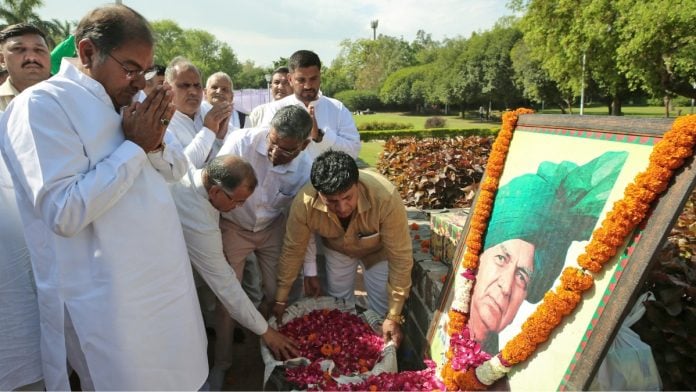
Gurugram: When the day broke on Friday, workers in Haryana’s Nuh were hammering the last nails into a stage. Two hundred kilometres away in Sirsa, another team was putting the finishing touches to a newly cast statue. Both were being readied for the 113th birth anniversary of former Haryana chief minister Chaudhary Devi Lal, but by two rival political camps that trace their lineage—political and biological—to the farmer leader who once made prime ministers in Delhi answer to a crowd at Boat Club.
The stage in Nuh will host the Indian National Lok Dal’s (INLD) ‘Samman Rally’ on Sunday while the statue in Sirsa is being installed by the Jannayak Janta Party (JJP). The two parties were once part of the same political family. Today, their separate commemorations offer a glimpse of how fractured Devi Lal’s legacy has become within his own family.
Devi Lal was born on 25 September 1914, in Teja Khera village of Sirsa district, a village which was brought into existence by his ancestors after they migrated from Rajasthan and settled in nearby Chautala village a few hundred years ago.
Friday marked 113 years since that birth, and preparations were in full swing to honour the man locals still call Tau—a Haryanvi word for uncle.
But, as in recent years, there was no single commemoration. INLD and JJP, the two halves of a family split in 2018, were observing the day separately, while individual branches of the family owing allegiance to neither outfit had their own programmes.
INLD chief Abhay Singh Chautala, Devi Lal’s grandson, is organising the party’s rally in Nuh—a location he said was chosen precisely because it lies outside the party’s traditional Jat strongholds.
“Chaudhary Devi Lal enjoyed massive support not just from across the state but throughout the country,” Abhay Singh Chautala told The Print. “We choose a new district every year so that people from all parts of the state can pay their homage to the late leader.” Last year, the party held its main event for Devi Lal’s birth anniversary in Rohtak.
Abhay said the guest list for the Nuh event includes former Punjab deputy chief minister Sukhbir Singh Badal, Jammu and Kashmir deputy chief minister Surinder Kumar Choudhary, former MP K. Kavitha, Rajasthan MP and Rashtriya Loktantrik Party founder Hanuman Beniwal and farmer leader Rakesh Tikait.
By the standards of recent years, it is an ambitious list. It also speaks to the breadth of Devi Lal’s appeal, which was never confined to Haryana’s Jat belt, even if INLD’s footprint today largely is.
The scale of the celebrations, however, is a far cry from the days when Devi Lal’s son and former chief minister Om Prakash Chautala personally led the birth anniversary programme. In those years, chief ministers, former chief ministers, deputy chief ministers and ministers from several states were invited—and many turned up.
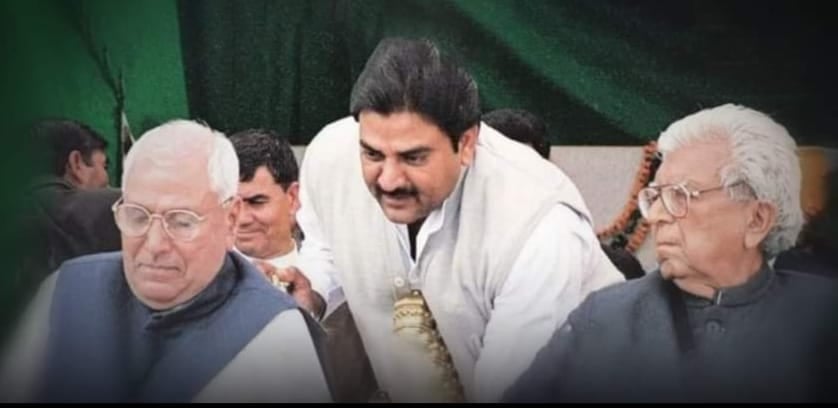
As recently as 2021, invitations went out to former prime minister H.D. Deve Gowda, Shiromani Akali Dal patriarch Prakash Singh Badal, Samajwadi Party founder Mulayam Singh Yadav, National Conference leader Farooq Abdullah, Telugu Desam Party chief N. Chandrababu Naidu, Rashtriya Lok Dal MP Jayant Chaudhary and Bihar chief minister Nitish Kumar. Only Farooq Abdullah and Prakash Singh Badal attended. Chaudhary Birender Singh, by then a BJP member, also made a surprise visit to pay homage to the late leader.
Since Om Prakash Chautala’s death in 2024, his son Abhay Singh has taken over as the face of INLD’s commemorations.
Ahead of the Nuh rally, Abhay Singh and his sons, Karan Chautala, chairman of the Sirsa zila parishad, and Arjun Chautala, MLA from Rania, have been travelling across the state, inviting people to the rally. INLD workers are also observing the day separately in Sirsa, Dabwali, Panniwala Mota and Ellenabad—areas that have remained the party’s strongholds since Devi Lal’s time.
Also Read: Jat khaps rally behind Dhankhar, but ‘mentor’ Devi Lal’s clan divided over shock resignation
A family calendar of separate tributes
JJP has its own programme. It is installing a new statue of Devi Lal in Shakkar Mandori village of Sirsa district, to be unveiled by JJP supremo Ajay Singh Chautala—Abhay Singh’s brother.
Honouring his great-grandfather on his birth anniversary, Ajay Singh’s son, former deputy CM Dushyant Chautala, shared an AI-generated video on Friday depicting how Devi Lal launched the ‘Jaccha Baccha Yojna’, a scheme providing financial assistance to poor families on the birth of a child.
The video shows Devi Lal meeting a pregnant woman performing manual labour on a roadside near Charkhi Dadri and asking whether she was eating properly and drinking milk. She responds: “Doodh kya hum gareebon ko toh roti bhi sukhi hi milte hai (forget about milk, we poor people get nothing but dry roti to eat).”
हरियाणा निर्माता, पूर्व उपप्रधानमंत्री, किसान-कमेरे के मसीहा, ‘जगत ताऊ’ एवं युगपुरुष स्व. जननायक चौधरी देवी लाल जी की पावन जयंती पर हम सभी की ओर से उन्हें कोटि-कोटि नमन।
जनसेवा, किसान और कमेरे वर्ग के अधिकारों के लिए उनका संघर्ष सदैव प्रेरणा देता रहेगा।
जननायक चौधरी देवी लाल जी… pic.twitter.com/PT7uxaScWq
— Dushyant Chautala (@Dchautala) September 25, 2026
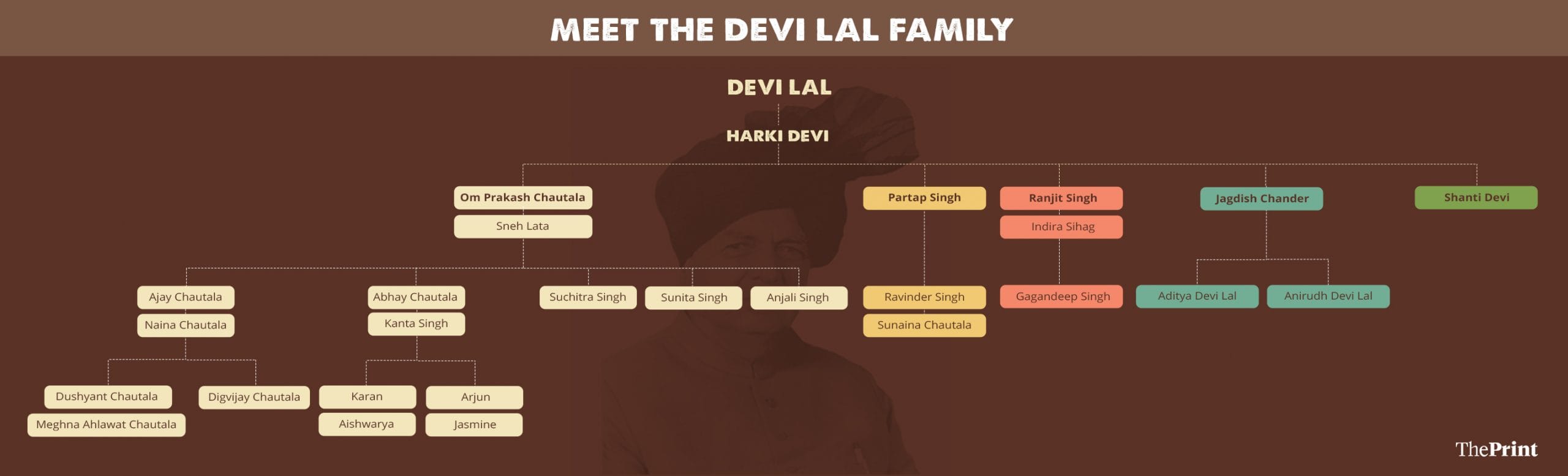
Dushyant’s brother, Digvijay Singh Chautala, has meanwhile started building a house in the family’s ancestral village of Chautala, from where he intends to strengthen his political base for the Dabwali assembly seat.
He did not have a house in the village because Devi Lal’s original ancestral home there—the base from which Tau once directed politics across the country—was inherited by Dabwali MLA Aditya Devi Lal, son of Devi Lal’s youngest son Jagdish Chautala.
Digvijay’s father Ajay Singh was elected from Dabwali in 2009, and his mother Naina Chautala in 2014. He contested from there in 2024 but finished third, behind Aditya and Congress’s Amit Sihag, both from Devi Lal’s clan.
Former Haryana power minister Ranjit Singh Chautala, another of Devi Lal’s sons, has maintained his own tradition, separate from both INLD and JJP. As in previous years, he held a district-level programme at his residence on Barnala Road in Sirsa, drawing workers from the Rania segment and beyond.
His son Gagandeep Singh Chautala, grandson Surya Prakash Chautala and granddaughter Gayatri attended, as they had in previous years, when they addressed supporters.
The making of Tau
To understand why nine members of one family have spent nearly eight decades winning seats in the Haryana assembly, the Lok Sabha and the Rajya Sabha, it helps to go back to where Devi Lal began—not in a legislature, but in a jail cell.
Devi Lal was the son of farmer Lekh Ram and grew up in Chautala village, from which the family later took its political name. His schooling stopped at Class 10, when he was 16, after which he joined the Civil Disobedience Movement of 1930 and went to prison, an experience that shaped him as much as any classroom might have.
He joined the Indian National Congress and built his presence through Punjab’s Sirsa region, becoming a member of the undivided Punjab Legislative Assembly in 1952. But his differences with what he saw as Congress’s urban bias eventually pushed him out in 1959.
He built his own political vehicles instead, first the Haryana Lok Samiti and then the Haryana Lok Dal, the direct ancestor of today’s INLD. The message remained consistent: a fair deal for farmers, through measures such as loan waivers, better crop prices and access to irrigation.
It was a simple political proposition, but one rooted in the concerns of his core constituency—farmers and the working class.
The Emergency years hardened his standing further. Devi Lal spent 19 months in Mahendragarh jail between 1975 and 1977, alongside his sons Om Prakash and Jagdish, for resisting the imposition of the Emergency rule. When elections were restored, the image of a jailed farmer leader who had refused to bend acquired its own political force.
As chief minister from 1977 to 1979, he pushed through debt relief for farmers and expanded rural infrastructure before Bhajan Lal’s defection to Congress brought his government down.
Devi Lal returned stronger. The Lok Dal-BJP alliance he assembled swept the 1987 Haryana elections, winning 76 of 90 seats—60 for the Lok Dal and 16 for the BJP.
Congress won just five seats. The CPI and CPM bagged one seat each, with Devi Lal’s support—he did not field candidates against them. Even Medhavi Kirti, an independent who won from Jhajjar, did so with Devi Lal’s support.
“Medhavi was former deputy PM Jagjivan Ram’s granddaughter and had filed her nominations from the Jhajjar seat. She approached Chaudhary Devi Lal and requested his support, addressing him as Dadaji. Chaudhary sahab withdrew his candidate from there and not just ensured her victory, but also inducted her into his ministry,” said a leader long associated with Devi Lal.
In his second term as chief minister, from 1987 to 1989, he rolled out free electricity for farmers and introduced what became one of his most enduring welfare legacies—the old-age pension scheme. It gave Haryana’s elderly a monthly income independent of their children and is widely credited with reshaping rural social security in the state.
Devi Lal is also credited with being the first in the country to launch a social security scheme.
Delhi, the Meham violence, and Mandal Commission
Devi Lal’s national career peaked and unravelled almost simultaneously.
As deputy prime minister in V.P. Singh’s National Front government from 1989 to 1991, he was, for a brief period, arguably the second most powerful man in the country. He used the position to keep farmers’ concerns on the national agenda.
After the 1989 elections, he could have become PM, with his name announced amid an intense tussle between V.P. Singh and Chandra Shekhar. Instead, Devi Lal used the moment to place the crown on V.P. Singh’s head.
The relationship between the two soon curdled over the 1990 Meham assembly by-election in Haryana, contested to secure a seat for Om Prakash. The bypoll was marred by violence and allegations of booth capturing. The fallout cost Devi Lal support among Deswali Jats in Rohtak, Jhajjar and Sonipat—a dent from which the party never fully recovered.
V.P. Singh moved to sideline him, and Devi Lal was shown the door.
He did not go quietly.
Devi Lal responded by organising a mammoth rally at Delhi’s Boat Club, a show of strength intended to demonstrate that he still commanded a following that no prime minister could ignore. The rally is remembered in Haryana politics as one of the largest mobilisations the national capital had seen from a regional leader, and it forced Delhi to reckon with Devi Lal’s continuing relevance.
Against this backdrop of pressure from Devi Lal’s camp, the V.P. Singh government moved to implement the Mandal Commission report, extending 27 percent reservation to Other Backward Classes (OBCs) in central government jobs and educational institutions and opening a chapter of OBC reservation politics that has shaped Indian public life ever since.
‘He picked people from the grassroots’
What set Devi Lal apart from many contemporaries, according to those who worked closely with him, was his instinct for elevating ordinary people into positions of power rather than relying on established political families.
That was long before his own family came to dominate the ticket distribution his descendants are now associated with.
Sampat Singh, now an INLD patron, who served as Devi Lal’s home minister during his 1987 tenure and later as finance minister under Om Prakash between 2000 and 2005, remembers how it began for him.
“I was a contractual college lecturer at Hisar. He picked me, first as his political advisor, and then made me contest from the Bhattu Kalan assembly seat vacated by him in 1980,” Singh told The Print. He has since been elected MLA six times.
He was not the only one plucked from obscurity. The late Bhagi Ram, also a five-time MLA, was working as a tailor in Sirsa’s Mithi Surera village before Devi Lal brought him into politics.
It was this pattern of spotting talent far outside the landed Jat gentry that old-timers in Haryana politics point to when explaining Devi Lal’s social base. His appeal, they say, cut across caste lines even though his party’s core support remained rooted in the Jat community, which makes up roughly a quarter of the state’s population.
A shrinking inheritance
The family that inherited Devi Lal’s name has not inherited his winning margins.
Om Prakash’s conviction in 2013 in the junior basic teachers recruitment scam, which sent him to prison for 10 years, badly damaged INLD’s credibility. Ajay Singh was convicted in the same case.
Then came the 2018 split between Ajay and Abhay Singh, producing JJP as a breakaway from INLD and further dividing the family’s vote base.
The numbers from the 2024 Haryana assembly election tell their own story. Of eight Chautala family candidates who contested, only two won—Arjun Chautala from Rania and Aditya Devi Lal from Dabwali after switching from the BJP.
Abhay Singh lost the Ellenabad seat he had held since 2000. Dushyant lost the Uchana Kalan seat and Digvijay Singh lost Dabwali for the second time in a row.
Sunaina Chautala, daughter-in-law of Devi Lal’s son Pratap Singh, managed to win just 9,681 votes in Fatehabad.
(Edited by Chingkheinganbi Mayengbam)
Also Read: Fractured Chautala clan shows signs of thaw amid JJP’s internal storm, but Abhay holds firm